
The safest way to choose a plastic extruder manufacturer in China is to verify what the supplier can produce with your material, dimensions and acceptance criteria—not how many machines appear in a catalog.
Before comparing prices, ask for a live factory walkthrough, a written line configuration, traceable component models, a pre-shipment test plan and a clear division of delivery and commissioning responsibilities. A capable supplier should be able to connect each part of the proposed line to your finished product.
This guide is for two common buyer situations:
- First-time importers who need a repeatable method to verify a factory and compare unfamiliar quotations.
- Experienced processors replacing a supplier because of unstable output, poor cutting, slow support or unclear project scope.
If you already know the required product, start with Jinxin’s plastic extrusion line range. If you are still deciding which process architecture is suitable, compare a single-screw extruder with a twin-screw extruder first.
Quick Answer: Use These 8 Checks
- Define the finished product, material, size range, tolerance and target output.
- Verify that the supplier operates the factory shown in its sales materials.
- Require a pre-shipment test with an agreed product—and your own material when technically necessary.
- Record dimensions, output, speed, scrap and key process settings during the test.
- Confirm exact electrical and control component models, not only brand names.
- Compare quotation scope before comparing price.
- Put FAT, packing, delivery, installation, training and spare-parts responsibility in writing.
- Choose a manufacturer whose proven process matches your application, not the one claiming the broadest catalog.
The first three technical checks below carry the most weight because they turn sales claims into evidence.
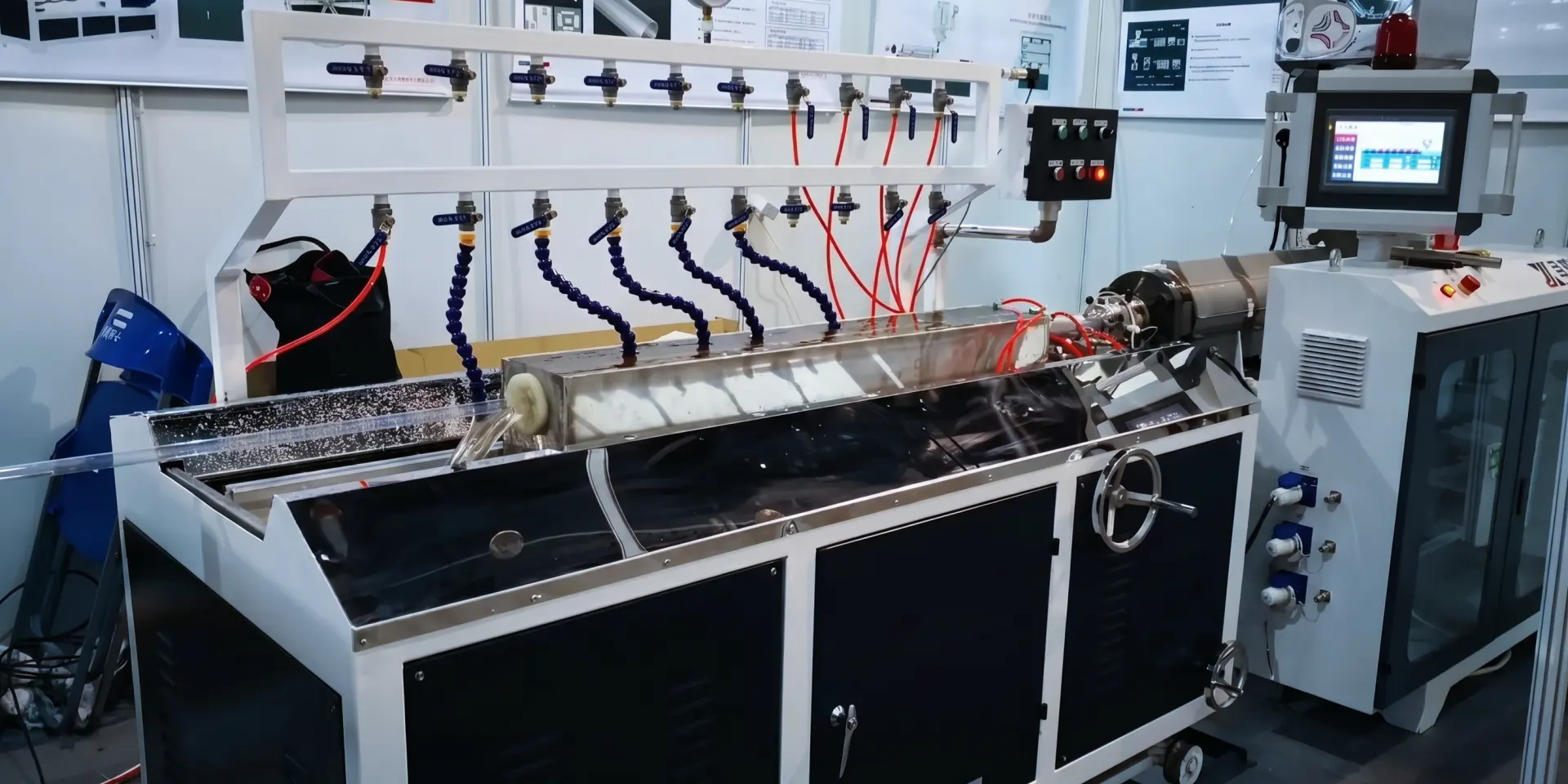
1. Require a Pre-Shipment Test With an Agreed Product
A generic no-load machine video proves that motors and controls can switch on. It does not prove that the line can hold your tube diameter, cut cleanly, maintain wall thickness or reach a stable output with your material.
Ask the manufacturer to define the factory acceptance test before you place the order.
| Evidence to request | What it should show | Weak substitute |
|---|---|---|
| Test product | Agreed material, size and final-product form | Running an unrelated, easier product |
| Material confirmation | Resin grade, formulation responsibility and whether buyer material is required | “PP/PE/PVC is no problem” without a grade or process route |
| Continuous run | Enough stable production time to expose drift, cutting or cooling problems | A short startup clip |
| Measurement record | OD/ID, wall thickness, length, speed, output and reject observations as applicable | Video only, with no measured result |
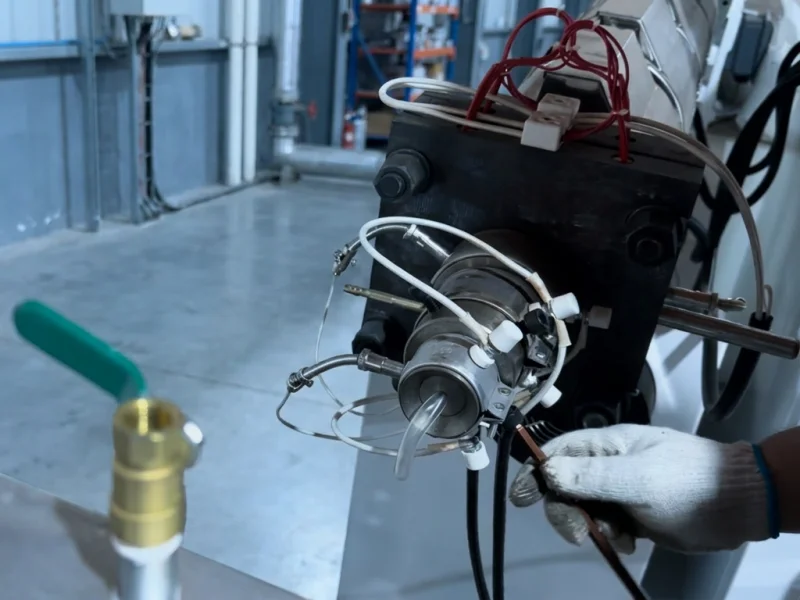
| Tooling confirmation | Die, sizing, cutter or winder used for the accepted product | Showing equipment without identifying the tooling |
| Corrective action | What happens if the test misses the agreed criteria | “We will adjust it after shipment” |
Use Your Own Material When the Formulation Changes the Result
Buyer material is especially important when the formulation, hardness, filler, color, surface finish or cutting behavior affects the finished product. The supplier should confirm how much material is needed, who pays the freight and what data will be recorded.
When shipping material is impractical, agree on an equivalent grade in writing and identify what must be reconfirmed during commissioning. Do not let “same material family” silently become “same process behavior.”
Ask for the Full Test Context
A useful test video should identify the line, tooling and product, then show stable running, measurement and finished-product inspection. It should not rely on close-up footage that hides the rest of the line.
Jinxin test-runs the agreed product before shipment and can verify critical tooling under real extrusion conditions. For product-specific projects, the test plan is tied to the supplied configuration rather than treated as a generic showroom demonstration.
2. Verify Components by Model, Function and Local Serviceability
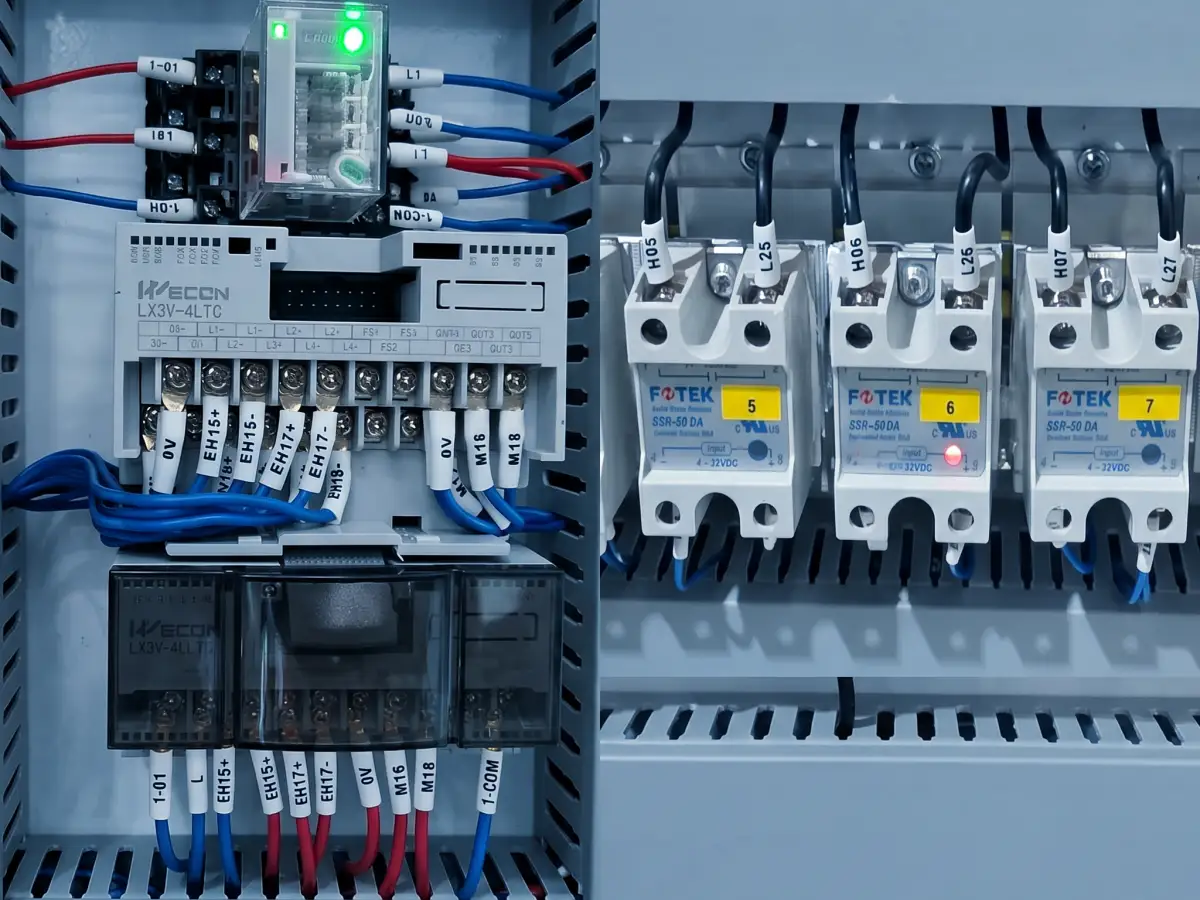
“International components” is too vague for a purchase order. Ask for the exact maker, model or series, function and substitution rule for critical items such as the inverter, PLC, HMI, temperature controller, motor and major protection devices.
Recognized brands such as Siemens, Schneider Electric and ABB can make local sourcing and maintenance easier in many markets, but the logo alone does not guarantee a good line. A reliable design must also provide:
- correct sizing for the motor, drive and load;
- labeled wiring and an electrical schematic that matches the delivered cabinet;
- alarms and interlocks connected to the actual process risk;
- documented replacement parts;
- an agreed approval process for any component substitution.
The correct component choice depends on the project and the buyer’s local service environment. Jinxin configurations may use Siemens, ABB, Schneider, RKC, Fotek or proven Chinese brands according to the agreed scope; the final brand and model should be listed in the quotation rather than assumed from a website logo.
3. Turn the Material Trial Into an Acceptance Record
The strongest supplier evidence is not simply “the line ran.” It is a record showing what ran, under which conditions and what result was accepted.
For the relevant product, include the following in the test record:
- material grade or approved formulation;
- die and tooling identification;
- product OD, ID, wall thickness, width or profile dimensions;
- line speed and measured output;
- cutting length and cut quality, or winding condition;
- startup scrap and stable-run observations;
- key temperature, speed and cooling settings;
- photos or video of measurement and packed samples;
- open issues, corrective action and final approval.
This record becomes a baseline for startup at the buyer’s factory. It also exposes a supplier who can assemble machines but cannot connect tooling, cooling, haul-off, cutting and controls into a stable process.
For pipe projects, use a defined size and capacity range rather than asking for “one line for every size.” See how to confirm pipe extrusion line size range and capacity.
4. Confirm That the Supplier Is the Manufacturer You Intend to Buy From
A trading company is not automatically a bad supplier. It can be useful when it adds local service, procurement coordination or application expertise. The risk is believing you are contracting directly with a factory when the actual design, production and warranty responsibility belongs to an undisclosed third party.
Use several checks together:
Check the Legal Entity
Ask for the Chinese business license and compare the company name, registered address, business scope, quotation, bank beneficiary and contract entity. A mismatch needs an explanation; it is not automatically fraud, but it must not remain hidden.
Request a Live, Continuous Factory Walkthrough
Ask the salesperson to show the exterior sign, workshop, machining or tooling area where applicable, assembly stations, electrical work, test area, finished equipment and packing area in one live call. Pre-recorded clips can support the review, but should not replace it.
Ask Technical Questions That Require Ownership
A real project team should be able to explain why it selected the screw size, L/D, drive, die, calibration method, haul-off, cutter or winder for your product. Repeatedly forwarding every question to “the engineer” without a traceable answer is a warning sign.
Treat Audited-Supplier Badges as One Input
A marketplace audit can help confirm that a legal entity or facility was inspected at a point in time. It does not prove that the supplier has made your product, owns every machine shown or will deliver the quoted scope. Read the audit report, date, address and auditor—not only the badge.
For Jinxin’s factory focus and current product boundaries, see About Jinxin Extruder.
5. Check CE and ISO Claims Correctly
Certificates should reduce uncertainty, not replace technical due diligence.
For CE, Ask About the Specific Machine and Applicable Rules
CE marking applies only where the relevant EU product rules require it. The manufacturer is responsible for identifying applicable requirements, carrying out conformity assessment, preparing technical documentation and issuing the EU Declaration of Conformity. There is no central EU office that simply awards a universal “CE certificate.” See the European Commission’s official guidance on CE marking.
For a quoted extrusion line, ask for:
- the equipment model and scope covered;
- the EU Declaration of Conformity where applicable;
- the directives or regulations and harmonized standards referenced;
- the manufacturer identity and authorized signatory;
- the relationship between the documents and the serial/model being delivered;
- electrical drawings, safety design and manuals included in the technical file.
A PDF with a CE logo, no matching model and no declaration is not enough.
For ISO 9001, Verify Scope, Site and Validity
ISO 9001:2015 is a quality-management-system standard. A valid certification can show that documented quality processes exist within the certified scope, but it does not prove that a particular extrusion line can make your product.
Check the certified legal entity, factory address, activity scope, issue and expiry dates, certification body and certificate status. Then return to the product test and acceptance criteria.
6. Use Industrial Clusters and Trade Shows as a Search Map, Not Proof
China’s plastics machinery supply chain is concentrated in several industrial areas. Buyers commonly encounter pipe, hose and profile extrusion suppliers around Jiangsu and Zhangjiagang; twin-screw and compounding specialists around Nanjing; broad plastics-processing supply networks in Guangdong and Zhejiang; and machinery suppliers around Shandong and Qingdao.
This map helps you build a shortlist, but location alone does not prove capability. Two factories in the same city can have completely different process strengths.
Trade shows can speed up the first screening. CHINAPLAS is focused on plastics and rubber, while the Canton Fair covers a much broader range of export industries. Use a booth meeting to collect technical contacts and compare physical exhibits, then verify the actual factory, team and test capability separately.
7. Normalize Quotation Scope Before Comparing Price
A low quotation may describe a bare extruder, while a higher quotation may include the die, cooling, haul-off, cutter, testing, packing and commissioning. Comparing the headline totals without normalizing scope creates a false price gap.
| Scope item | Questions to ask every supplier |
|---|---|
| Main extruder | Screw/barrel material, motor, drive, heating, controls and output basis? |
| Die and tooling | Which product and sizes are covered? Which inserts, sleeves or cutters are included? |
| Cooling/calibration | Tank, sizing, vacuum, cooling length and utilities included? |
| Haul-off | Type, speed range, synchronization and product-contact design? |
| Cutting/winding | Cutting method, length tolerance, dust/burr control, coiler or stacker scope? |
| Test run | Material, product, test duration, measurements and acceptance criteria? |
| Packing/delivery | Export packing, loading, shipping term and insurance boundary? |
| Installation/training | Remote or on-site support, days, travel costs and buyer obligations? |
| Spare parts | Start-up spares, wear parts, quantities, part numbers and future supply? |
Ask every bidder to mark each item Included, Optional, By Buyer or Not Applicable. For a detailed comparison sheet, use the extrusion line quotation checklist.
Do not use a marketplace price range as your budget until the product, output, size range, tooling and service boundary are comparable.
8. Put FAT, Delivery, Installation and Spare Parts in Writing
The purchase decision is not complete when the machine passes a factory video call. Define what happens between FAT approval and stable production at your site.
Factory Acceptance Test
Write the test product, material, dimensions, speed/output basis, run duration, measurement method, acceptance authority and corrective-action process into the contract or technical annex.
Packing and Delivery
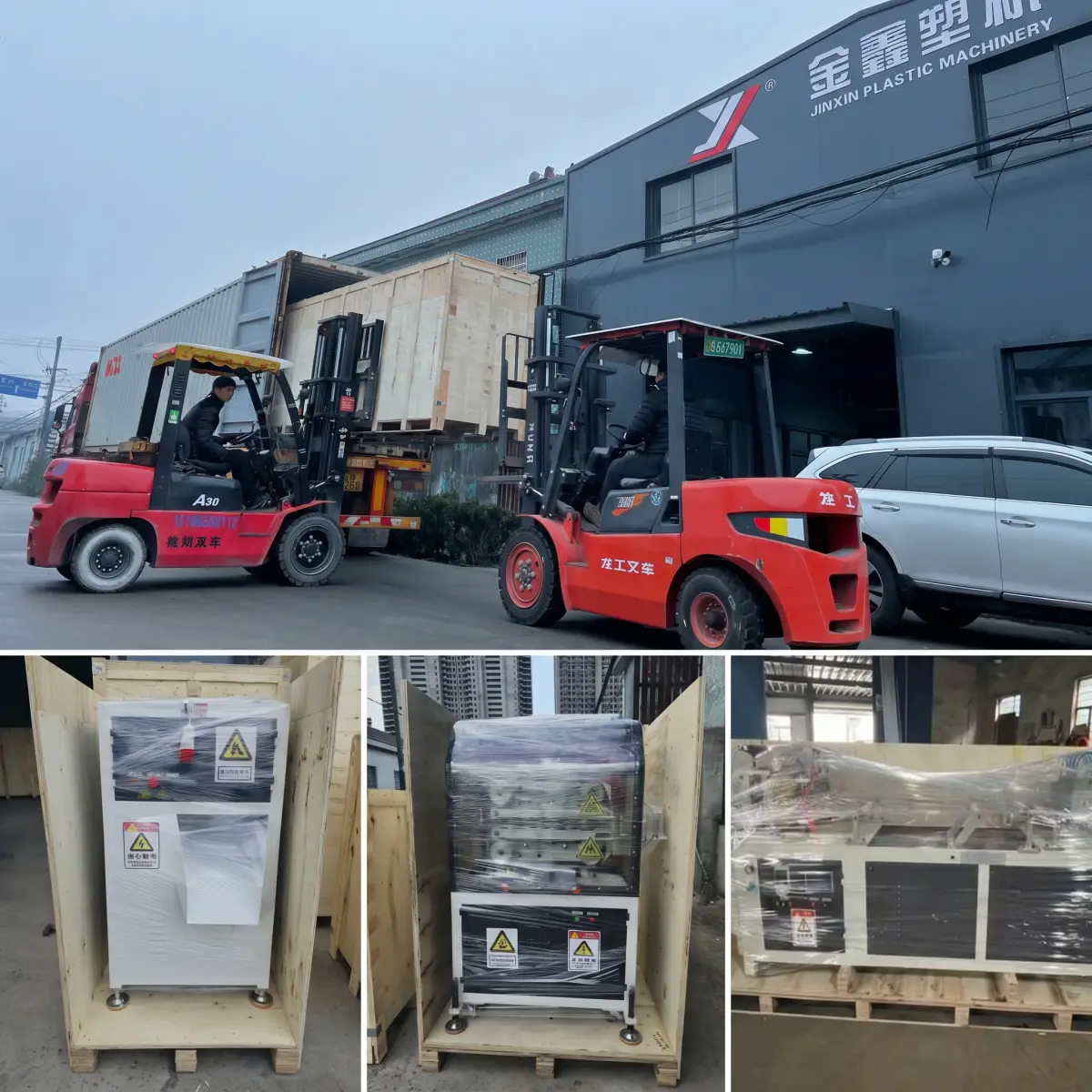
Confirm rust prevention, moisture protection, disassembly marks, packing list, crate or container arrangement, lifting points and shipment terms. Ask for loading photos and a final document package.
Installation and Commissioning
Clarify whether support is remote or on-site; who prepares power, water, compressed air, material, tools and operators; who pays travel and accommodation; how many days are included; and what counts as completion. Jinxin’s extrusion line installation and commissioning scope explains these responsibilities.
Spare Parts and Support
Request a start-up spare-parts list, wear-part lead times, electrical part numbers, troubleshooting contact and warranty process. A supplier’s response after payment matters as much as the sales response before payment.
9. How to Read “Top 10” and “Best Manufacturer” Lists
Many manufacturer rankings are written by a listed company, a marketplace, an affiliate site or a paid-PR distributor. The list may still introduce useful names, but the ranking order is not independent evidence.
Before trusting a list, ask:
- Who published it, and does the publisher sell the same equipment?
- Are the ranking criteria and evidence visible?
- Does every company have a verified factory and relevant product proof?
- Is the content comparing equivalent processes, or mixing single-screw lines, twin-screw compounding, recycling and unrelated plastics machinery?
- Does the page explain why one manufacturer fits a particular application?
- Is the “Top 10” updated with real evidence or only a new year in the title?
Large manufacturers such as JWELL are visible because they offer a broad portfolio and operate at scale. That does not make a large generalist automatically better for every small-diameter tube, hose or profile application. Likewise, a focused factory is not automatically suitable for a large compounding or pipe project.
The useful question is not “Who is number one in China?” It is “Who has repeatable evidence for my process, product and delivery risk?”
| Application need | Manufacturer profile to prioritize |
|---|---|
| Powder compounding, masterbatch or reactive processing | Proven twin-screw/compounding specialist |
| Pellet-fed small pipe, hose or profile | Focused single-screw line manufacturer with relevant tooling and downstream proof |
| Very broad plant package across many process families | Large multi-product manufacturer with project-management capacity |
| Tight cutting, surface or small-dimension tolerance | Supplier with product-specific samples, measurement and cutter/tooling evidence |
10. When a Focused Single-Screw Manufacturer Is the Better Fit
Jinxin is a focused China plastic extruder manufacturer with more than 14 years of single-screw extrusion equipment experience and equipment supplied to buyers in more than 15 countries. Its verified product focus includes small-diameter pipe, hose, profile, dip-tube and TPE medical-band extrusion lines.
Examples include:
- PPR pipe extrusion lines for defined pipe sizes and configurations;
- PVC braided hose extrusion lines built around the hose structure, yarn reinforcement and winding requirements;
- dip tube extrusion lines where small dimensions and cut quality drive the configuration;
- TPE tourniquet extrusion lines for validated medical-band applications—not TPE raw-material supply or generic yoga-band production.
Do not choose Jinxin merely because you want to buy from China. A different specialist is the better choice when the core process requires twin-screw compounding, rigid-PVC powder processing, a very large HDPE pipe line, broad sheet or film capability, or another application outside Jinxin’s validated equipment range.
That boundary is part of due diligence. A reliable manufacturer should be willing to say when a project is not a fit.
Buyer Due-Diligence Checklist
Before issuing a purchase order, make sure you can answer Yes to the relevant items:
- Finished product, material, size range, tolerance and target output are written down.
- The supplier’s legal entity, factory address, quotation and payment beneficiary are consistent.
- A live factory walkthrough has confirmed the production and test environment.
- The technical proposal explains the main extruder, tooling and downstream choices.
- Critical component brands and models are listed, with substitution approval rules.
- The pre-shipment test product, material, duration, data and acceptance criteria are agreed.
- CE or ISO claims have been checked for the correct entity, scope and equipment.
- Every quotation uses the same Included/Optional/By Buyer comparison table.
- Packing, shipping, installation, training and buyer-preparation responsibilities are written down.
- Spare-parts scope, warranty procedure and support contacts are clear.
- Any customer reference request respects the customer’s permission and confidentiality.
On the last point, do not demand an unrestricted customer list. Ask for anonymized project evidence, shipment or test records, or a direct reference only where the customer has authorized contact. Protecting customer confidentiality is not itself a red flag.
FAQ
How do I verify a plastic extruder manufacturer in China?
Check the legal entity and factory address, request a live continuous factory walkthrough, review a product-specific technical proposal, and require a pre-shipment test with agreed acceptance data. Use marketplace audits and trade-show meetings as supporting evidence, not the final proof.
What should I ask a plastic extrusion machine supplier to show in a test video?
Ask the supplier to identify the line, tooling, material and target product; show stable continuous running; measure relevant product dimensions; record speed or output; inspect cutting or winding quality; and explain any corrective action. A no-load startup clip is not a product acceptance test.
Is CE marking enough to prove an extrusion line is good?
No. CE concerns compliance with applicable EU requirements; it does not prove product output, tolerance or process capability. Verify the equipment scope, Declaration of Conformity and technical documentation, then evaluate the line through a product-specific factory acceptance test.
Is an audited-supplier badge enough to confirm a real factory?
No. Read the underlying audit’s date, address, legal entity and scope, then confirm the workshop and project team in a live walkthrough. A badge does not prove that the supplier has produced your application.
How should I compare plastic extrusion line prices?
First normalize the scope. Compare the main extruder, tooling, cooling, haul-off, cutting or winding, controls, test run, packing, installation and spare parts on an Included/Optional/By Buyer basis. Only compare totals after the configurations and responsibilities are equivalent.
Should I choose a single-screw or twin-screw extruder manufacturer?
Choose by process. Single-screw extrusion is commonly suitable for stable pellet-fed pipe, hose and profile applications. Twin-screw systems are commonly preferred for compounding, intensive mixing, powder-fed rigid-PVC processing and other processes that need stronger distributive or dispersive mixing.
Should a supplier give me names of existing customers?
Only with customer permission. A professional supplier may provide anonymized project evidence or arrange an authorized reference while protecting confidential customer information. Refusing to publish a customer list is not the same as refusing to provide evidence.
What should be agreed before installation and commissioning?
Agree who provides power, water, compressed air, raw material, lifting equipment, operators and local tools; whether support is remote or on-site; travel costs and included days; the acceptance result; and the response process for unresolved issues.
Next Step
Prepare one technical requirement sheet with your product, material, size range, tolerance, output target, factory voltage and available utilities. Then ask shortlisted suppliers to respond against the same configuration, FAT and scope table.
If your application is within Jinxin’s verified single-screw range, contact Jinxin Extruder with a sample photo, drawing or product dimensions for a project-specific review.
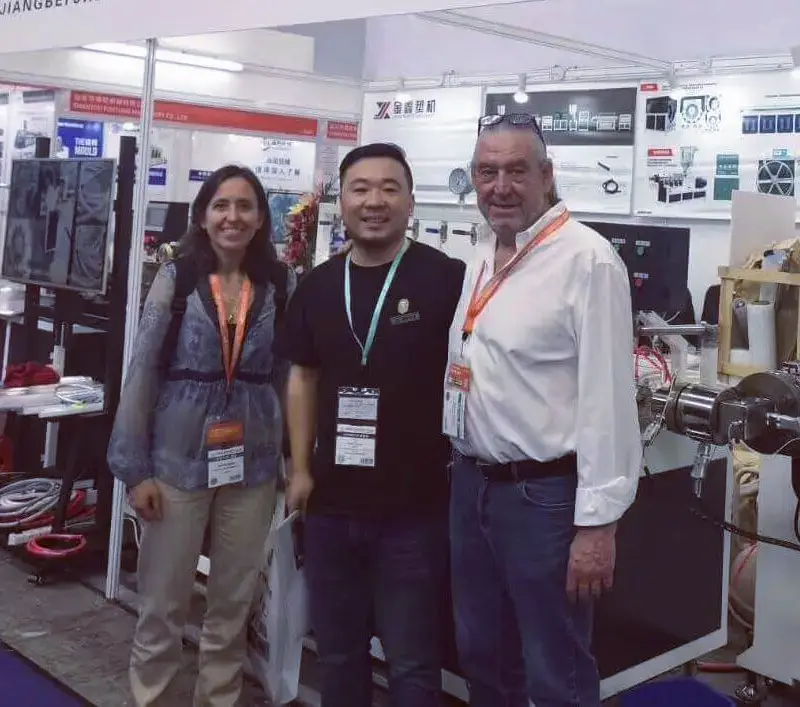
Jason Shen
Founder and Lead Engineer, Jinxin ExtruderJason Shen leads Jinxin Extruder's single screw extrusion line projects, with hands-on experience in machine configuration, tooling adjustment, factory testing and extrusion troubleshooting.
Inquiry
Email Your Line Requirements
For an accurate quotation, include your target product, material, size range, expected output, factory voltage and any product drawing or sample requirements.