A pipe extrusion line size range is not the same as a sales promise that one line can make every pipe size. A line quoted for 75-250 mm pipe may be able to run several diameters in that family. It should not be assumed to run 16 mm pipe efficiently just because the die can be changed.
This question appears often during pipe-line quotation. The buyer wants flexibility, which is reasonable. The mistake is treating the die as the only limit. In real production, the extruder, die head, calibration sleeve, vacuum tank, cooling length, haul-off and cutter all have their own working windows.
The useful question is not only “can a pipe come out?” It is whether that pipe can be made stably, economically and repeatedly.
Quick Answer
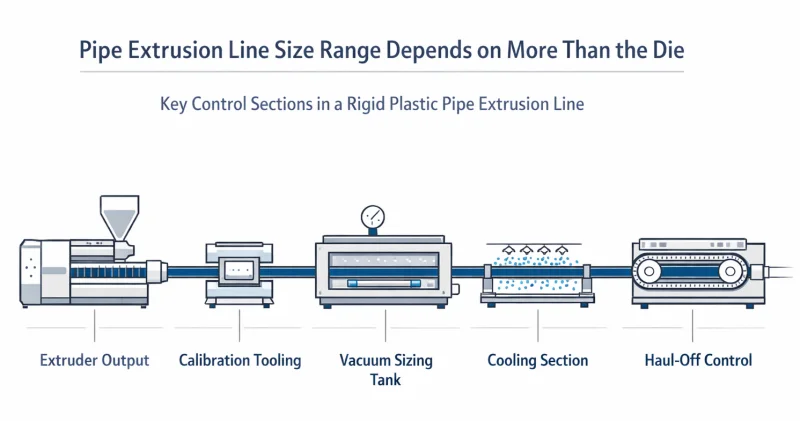
One pipe extrusion line can usually make different pipe sizes inside a defined family range. It cannot make every diameter efficiently.
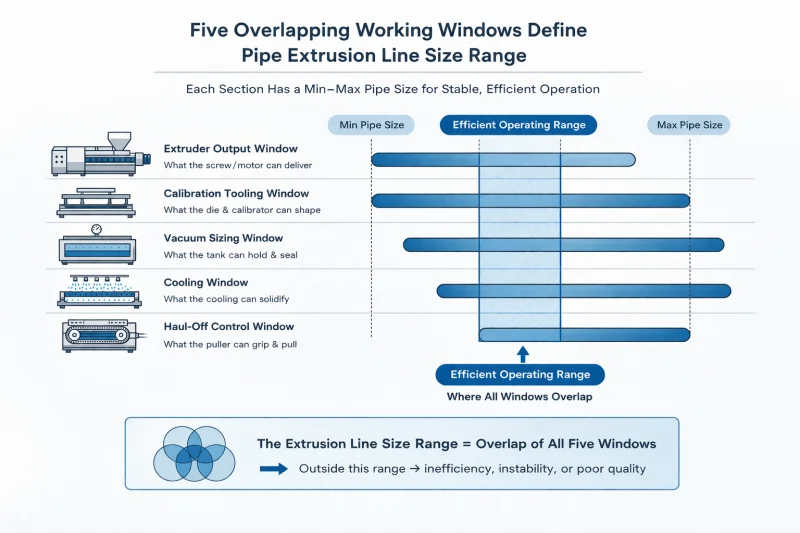
Changing the die changes the melt shape at the die exit. It does not automatically change the extruder output window, calibration range, vacuum tank capacity, cooling length, haul-off grip range, cutter opening or stacking method. The effective size range is where all of those sections overlap.
For the complete equipment context, see Jinxin’s plastic extrusion line overview.
The Real Limit Is the Overlap of Several Windows
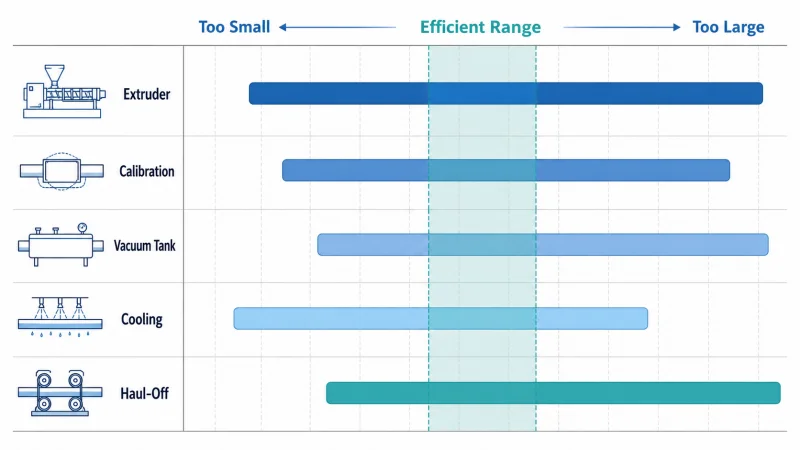
A pipe line is a continuous system. Each section can cover a range, but those ranges do not start and end at the same point. The practical production range is the common overlap.
| Line section | Lower-size limit | Upper-size limit | What happens outside the window |
|---|---|---|---|
| Extruder output | Large screw may run too slowly or unstably for tiny pipe | Small screw cannot feed enough melt for large pipe | unstable output, poor melt pressure or low capacity |
| Die and mandrel | Very small sizes need suitable die geometry and drawdown | Large sizes need larger flow channel and stable distribution | wall imbalance, high pressure or poor surface |
| Calibration sleeve | Sleeve and tooling must match OD closely | Oversized pipe cannot be held by small tooling | ovality, sizing marks or poor roundness |
| Vacuum tank | Small pipe may need precise support and fast stabilization | Large pipe needs tank diameter, seal and support space | unstable OD or poor vacuum seal |
| Cooling section | Small pipe can deform if pulled too aggressively | Large pipe needs more cooling length and slower line speed | soft pipe, sagging or dimensional drift |
| Haul-off and cutter | Pads must grip small pipe without crushing | Puller/cutter must open and support larger pipe | slip, deformation, rough cut or handling problems |
This is why a supplier should not answer only with a maximum diameter. The real answer is a stable operating window.
Why Changing the Die Is Not Enough
A die change is important, but it is only the first step in a pipe extrusion line changeover. The line also needs the correct sizing sleeve, vacuum setup, cooling support, puller adjustment, cutter setting and recipe. For a new line, these relationships should be confirmed during installation and commissioning before the buyer accepts the size range.
If only the die is changed, several problems can appear:
- the pipe exits the die but cannot be calibrated round;
- the haul-off cannot grip the pipe correctly;
- the cooling section is too short for the larger wall thickness;
- the extruder cannot feed enough output at the target speed;
- a large extruder runs a small pipe at an inefficient low-speed condition.
This is where the line links to extruder output and haul-off speed synchronization. A pipe size is stable only when output, puller speed, cooling and calibration work together.
Example: Overlapping Ranges Are Not Universal Capability
For PE, PP, PPR and HDPE single-screw rigid pipe lines, it is common to see equipment families such as:
| Typical line family | Practical meaning |
|---|---|
| 16-75 mm | small pipe family with high line speed and small calibration tooling |
| 50-160 mm | medium range, useful for many water and conduit products |
| 75-250 mm | larger downstream equipment and higher output requirement |
The overlap is intentional. A 50-160 mm line and a 75-250 mm line may both cover 90 mm pipe. That does not mean the 75-250 mm line is the best way to run 20 mm pipe, or that the 16-75 mm line can handle 200 mm pipe.
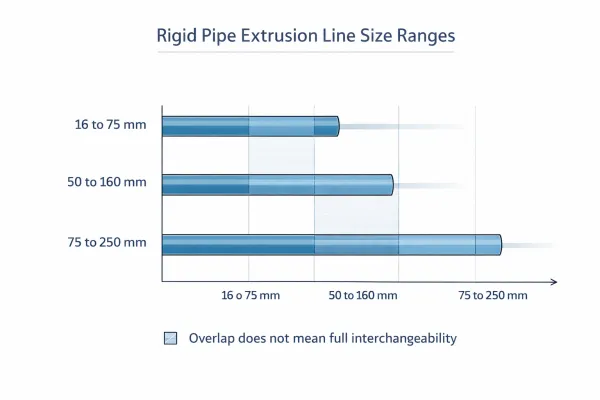
Overlap gives flexibility near the edge. It does not remove the need to choose a line around the real production plan.
What Limits the Minimum Pipe Size?
The minimum size is often limited by stability and control, not only by the smallest die.
A large extruder may deliver too much material even at a low screw speed. The melt residence time may become long. The haul-off may struggle to grip a small pipe gently. Calibration tooling may need very precise alignment. A small pipe also changes speed quickly, so small errors in puller speed or output become visible as wall-thickness or meter-weight variation.
In other words, a big line is not automatically more flexible. A line sized for large pipe can be the wrong fit for small pipe.
What Limits the Maximum Pipe Size?
The maximum size is usually limited by output, cooling and downstream handling.
A larger diameter and thicker wall need more melt per minute. The die and head must distribute that melt evenly. The vacuum tank must hold the pipe shape. Cooling must remove heat before the pipe deforms. The haul-off and cutter must support the weight and diameter.
If one of these sections is undersized, the line may produce a sample slowly, but not stable production at the required capacity.
Material Also Changes the Answer
This article is mainly about PE, PP, PPR and HDPE pipe lines, where single-screw extrusion is the normal equipment context for Jinxin projects.
PVC and UPVC pipe production often uses twin-screw equipment and different material handling, mixing and downstream matching. The same size-range logic still applies, but PVC should be evaluated as a separate equipment case, not mixed into a PE/PPR single-screw quotation.
How to Decide Whether One Line Is Enough
Before asking for the widest possible range, list the production requirement in a more concrete way:
- target pipe diameters;
- wall thickness or SDR range;
- material and formulation;
- output target for each size;
- expected changeover frequency;
- tolerance requirement;
- available floor space and budget.
Then compare those sizes against the narrowest equipment window. If most products sit inside one efficient range, one line may be enough. If the products spread across small, medium and large families with very different output targets, segmented equipment may be more practical.
This is also where extrusion line control systems and meter weight control can help. Recipes, speed coordination and material-per-meter monitoring reduce changeover errors, but they do not turn one mechanical line into every possible size range.
Conclusion
A pipe extrusion line size range is a production window, not a decorative number on a quotation. The line is suitable when extruder output, die design, calibration, vacuum, cooling, haul-off and cutting all support the target pipe family.
If you are comparing a one-line solution with segmented equipment, contact Jinxin with your pipe sizes, wall thickness, material and output target. We can help map the real operating range before equipment is selected.
FAQ
Can one pipe extrusion line make different pipe sizes?
Yes, if those pipe sizes are inside the line’s designed range. The line usually needs different dies, calibration sleeves, puller settings, cutter settings and recipes.
Is changing the die enough to change pipe size?
No. The die is only one part. Calibration, vacuum, cooling, haul-off, cutter and output settings must also match the new diameter and wall thickness.
Why can a large pipe line be bad for small pipe?
A large extruder and downstream system may run small pipe at an inefficient low-speed condition. Grip, cooling, residence time and output stability can become difficult.
What limits the maximum pipe size on an extrusion line?
Maximum size is limited by melt output, die flow capacity, calibration and vacuum size, cooling length, haul-off force, cutter opening and product handling.
What limits the minimum pipe size on an extrusion line?
Minimum size is limited by stable low output, precise calibration, gentle haul-off grip, speed control and the ability to avoid overfeeding the product.
How should I choose between one line and two segmented lines?
Map every target pipe size, material, wall thickness and output requirement against the equipment windows. Choose one line when the products sit inside one efficient range. Consider segmentation when the range is too wide for stable and economical production.
Further Reading
Plastics Technology — What Makes for Perfect Control in Tubing Extrusion?
Conair — Extrusion Processing: Basic Guide to Auxiliary Equipment
Jason Shen
Founder and Lead Engineer, Jinxin ExtruderJason Shen leads Jinxin Extruder's single screw extrusion line projects, with hands-on experience in machine configuration, tooling adjustment, factory testing and extrusion troubleshooting.
Inquiry
Email Your Line Requirements
For an accurate quotation, include your target product, material, size range, expected output, factory voltage and any product drawing or sample requirements.