
A meter weight control system keeps the finished product at a stable weight per meter by linking material consumption, haul-off speed and the target g/m value into one control loop. On PPR, PE and PP pipe lines, and on rigid profile lines, this is often not a luxury accessory. It is part of running a stable, material-efficient extrusion process.
The point is not simply to add a weighing hopper. The point is to stop the line from drifting heavier or lighter while production is running. A pipe that runs too heavy wastes resin every meter. A profile that runs too light may lose wall thickness, stiffness or assembly fit.
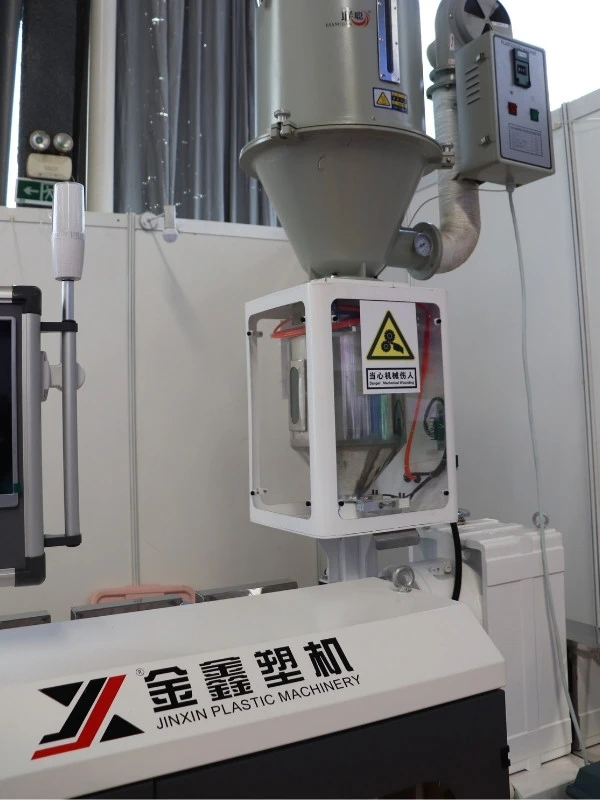
Quick Answer
In plastic extrusion, meter weight control means calculating the actual product weight per meter from real material consumption and line speed, then correcting the process automatically.
The usual setup uses load cells under a weighing hopper, a haul-off speed signal and a controller. The controller calculates weight per meter and adjusts screw speed, haul-off speed or both when the line moves away from the target.
For Jinxin, the most relevant applications are PPR/PE/PP rigid pipe lines and rigid profile lines. Rigid PVC hard pipe is a different boundary case because it is commonly built around twin-screw powder processing; it should not be the main example for this article.
What the System Measures
A meter weight system does not directly measure every millimeter of wall thickness. It measures the upstream variable that strongly influences wall thickness: how much material enters the line for each meter of product.
The system normally reads:
- hopper weight loss through load cells;
- material feed rate, usually in kg/h or g/min;
- haul-off speed or line speed;
- calculated product weight per meter;
- deviation from the operator’s target value.
The calculation is simple in principle: material throughput divided by line speed gives the weight per unit length. The engineering difficulty is keeping the weighing signal clean and making corrections smoothly enough that the line does not hunt or create new size variation.
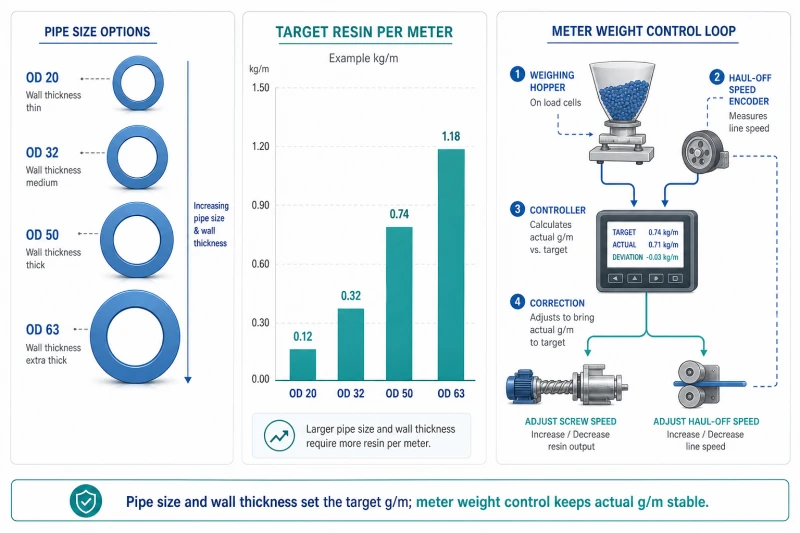
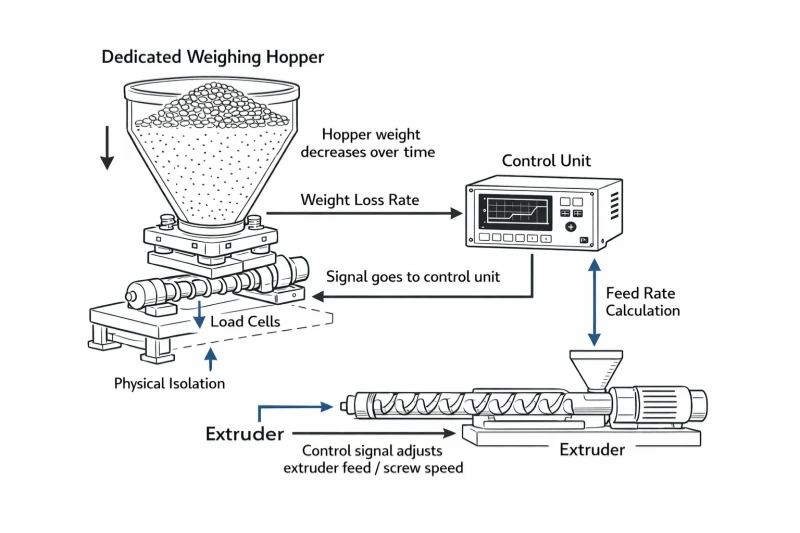
How the Closed Loop Works
A typical control loop works like this:
- Load cells measure the weight change in the material hopper.
- The controller calculates the actual material consumption rate.
- An encoder or drive signal reports the haul-off speed.
- The controller calculates the current g/m or kg/m.
- If the value is above or below the target, the controller corrects screw speed, haul-off speed or both.
- The line repeats this correction continuously during production.
This matters because extrusion does not stay perfectly steady by itself. Bulk density changes, regrind ratio, material temperature, filter resistance, screw wear and operator adjustments can all shift output. Manual correction can work during setup, but it is hard to maintain across a long shift.
Why It Matters for PPR, PE, PP and Rigid Profiles
For PPR, PE and PP pipe production, the buyer usually cares about outside diameter, wall thickness, pressure performance and material cost. Meter weight control helps keep the line close to the required weight instead of building in a hidden safety margin by overfeeding.
Rigid profiles have a similar problem. A small change in material feed can show up as visible surface inconsistency, weak sections, poor assembly fit or unstable dimensions after cooling. Because profiles often have non-round sections, operators may not see the problem as quickly as they would on a simple pipe.
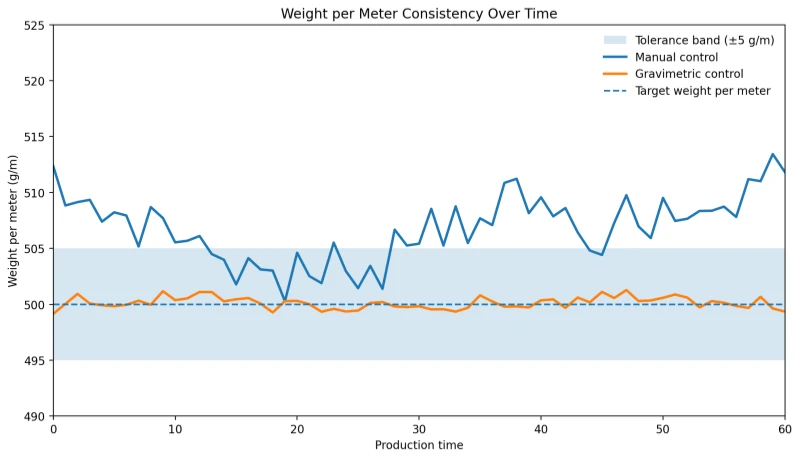
The practical benefits are:
- more stable wall thickness and cross-section weight;
- less resin wasted by running intentionally heavy;
- shorter startup adjustment after product changes;
- easier tracking of actual material consumption;
- fewer rejected lengths caused by long-term process drift.
These benefits are real, but they should not be sold as a fixed percentage. The saving depends on product size, resin price, tolerance, operator habit and how unstable the original process was.
Meter Weight Control vs Gravimetric Dosing vs Loss-in-Weight Feeder
These terms overlap, but they are not the same buyer intent.
Meter weight control is the page’s main topic. It is about controlling product weight per meter during extrusion.
Gravimetric control is the broader technical language. It means the process is controlled by weight measurement rather than only by screw RPM or volumetric settings.
A loss-in-weight feeder is one common mechanism. The hopper sits on load cells, and the controller measures how quickly the material weight decreases. That feeder is important, but the production value comes from connecting it to line speed and product g/m.
Gravimetric dosing can also mean additive, masterbatch or multi-component dosing. That is useful vocabulary, but it can become a feeder-product topic if the article focuses too much on the dosing device.
For a general view of how extrusion turns polymer into a continuous product, see this overview of polymer extrusion. For feeder terminology, Coperion also explains the principle of loss-in-weight feeding.
When It Should Be Standard
Meter weight control makes the most sense when the line runs products where every meter has value and every small dimensional drift becomes cost.
Use it as standard equipment when:
- the product is PPR, PE or PP pipe with defined wall thickness;
- the product is a rigid profile where fit, stiffness or appearance matters;
- production runs are long enough for small drift to accumulate;
- material cost is high enough that overfeeding hurts margin;
- startup scrap is a repeated cost;
- the customer requires stable weight, size or pressure performance.
This is why Jinxin treats it as a standard configuration on relevant hard pipe and rigid profile lines. It gives the line a way to control the variable that operators usually chase manually: grams per meter. For the broader equipment route, compare Jinxin’s plastic extrusion line categories and the PPR pipe extrusion line.
When It May Not Be Worth It
The system is not magic, and it is not always necessary. It may add more complexity than value for short trial runs, very low tolerance products, frequent material-change experiments, or simple production where weight variation is not a commercial problem.
It also does not replace good tooling, correct cooling, stable haul-off pressure or proper line synchronization. For the wider control architecture, see Jinxin’s guide to the extrusion line control system.
Practical Selection Checklist
Before specifying meter weight control, answer these questions:
- What is the target product weight per meter?
- How tight are wall thickness, OD or profile fit tolerances?
- Does the line run long batches or short trials?
- How expensive is the resin or compound?
- Is current production usually heavy to avoid under-spec product?
- Does the operator adjust screw speed and haul-off repeatedly during startup?
- Will the weighing hopper be mechanically isolated from vibration?
If several answers point to high material cost, tight dimensions and repeated production, meter weight control is usually justified.
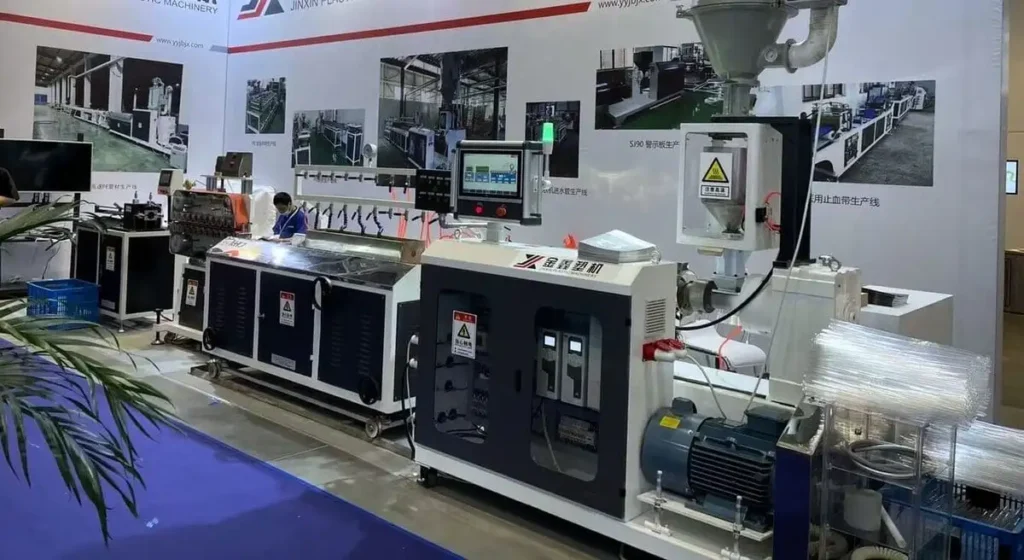
Conclusion
A meter weight control system is valuable because it controls the product by what finally matters in production: how much material goes into each meter. For PPR, PE and PP pipe lines and rigid profile lines, that value connects directly to wall thickness, dimensional stability, material usage and startup waste.
The best page angle is not “buy a feeder.” It is “build a line that can hold target g/m automatically.” That is why CT-A3 deserves to stand as its own technical article, while CT-B3 remains the broader page about the complete extrusion line control system.
If you are configuring a PPR, PE, PP pipe or rigid profile line, contact Jinxin with product size, material, target output and tolerance requirements.
FAQ
What is meter weight control in extrusion?
It is a closed-loop control method that calculates the product weight per meter from material throughput and line speed, then adjusts the extrusion process to stay near the target.
Is meter weight control the same as gravimetric control?
They are closely related. Gravimetric control means controlling by weight measurement. Meter weight control applies that principle to the finished product’s weight per meter.
Does every extrusion line need meter weight control?
No. It is most useful for long production runs, costly materials and products with strict wall thickness or dimensional requirements.
Why is it important for PPR, PE and PP pipe extrusion?
Because pipe wall thickness, pressure performance and resin consumption are tied to how much material is used per meter. Stable meter weight helps prevent both overfeeding and under-spec product.
Is a loss-in-weight feeder enough by itself?
Not always. The feeder measures material consumption, but meter weight control also needs line speed feedback and a controller that can correct screw or haul-off speed.
Should PVC hard pipe be the main example here?
No. Rigid PVC hard pipe is usually associated with twin-screw powder processing. This article focuses on Jinxin’s PPR, PE, PP and rigid profile use cases.
Jason Shen
Founder and Lead Engineer, Jinxin ExtruderJason Shen leads Jinxin Extruder's single screw extrusion line projects, with hands-on experience in machine configuration, tooling adjustment, factory testing and extrusion troubleshooting.
Inquiry
Email Your Line Requirements
For an accurate quotation, include your target product, material, size range, expected output, factory voltage and any product drawing or sample requirements.