
An extrusion line control system should not be judged by the phrase “PLC + HMI” on a quotation. Almost every modern extrusion line includes a PLC and a touch screen. The real question is what that system actually controls in production.
This matters because two offers can look similar on a specification sheet and behave very differently on the factory floor. One system may only collect temperature settings on a screen. Another may coordinate barrel temperature, screw speed, haul-off speed, pressure alarms, recipe storage and downstream response as one production logic.
For buyers, the control system is not decoration. It is the part of the line that decides how repeatable, diagnosable and manageable production will be after installation.
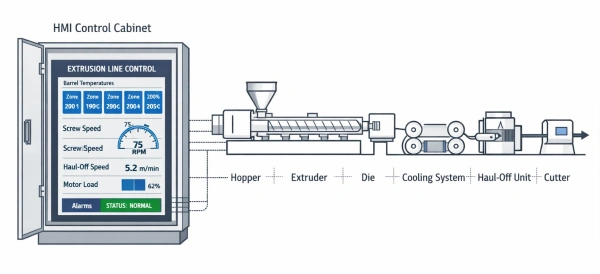
Quick Answer
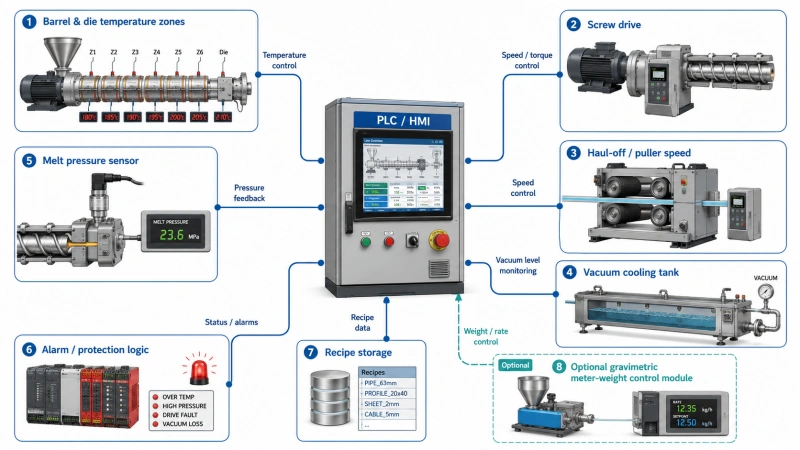
A plastic extrusion line control system connects the PLC, HMI, sensors, drives and alarm logic so the line can run as one coordinated process. It typically manages temperature zones, screw speed, haul-off speed, vacuum or cooling stations, melt pressure alarms, recipes and protective actions.
A good system does more than display values. It helps operators hold stable conditions, repeat a saved product setup, diagnose abnormal trends and protect the line when pressure, temperature or motor load goes outside the safe range.
For the equipment context around the complete line, see Jinxin’s plastic extrusion line overview.
PLC and HMI Are Only the Starting Point
The PLC is the controller that executes the line logic. The HMI is the operator interface, often described as the extruder control panel. Together they replace scattered switches, separate temperature controllers and manual notes with one operating platform.
But the hardware label is not enough. A premium PLC with weak programming is still a weak control system. A practical mid-range PLC with complete logic, clear screens and available service can be the better choice for a standard pipe or profile line.
When Jinxin configures a line, Wecon and Siemens are treated as production-fit options. Wecon covers the needs of many standard export lines. Siemens can be used when the customer requires it or when the line needs higher-level integration. The decision should be based on serviceability, spare parts, communication needs and process requirements, not on brand image alone.
The Control Loops That Matter
Temperature zones
Extrusion temperature control is one of the basic loops. The PLC or temperature controller reads thermocouples from barrel and die zones, compares actual values with setpoints and drives heaters or cooling fans. Stable zone control helps prevent poor melting, viscosity drift, surface defects and dimensional movement.
Temperature control is important, but it is still only one part of the line. A system that controls temperature but does not coordinate speed, pressure alarms or recipes is not a complete extrusion process control system.
Screw speed and output
Screw speed affects output, shear heat and melt pressure. If screw speed changes without the rest of the line following, the product may drift even if the extruder itself looks stable.
This is where PLC extrusion control becomes practical. The controller should help maintain the relationship between the extruder and downstream equipment instead of leaving every correction to the operator.
Haul-off and downstream speed
Output and haul-off speed synchronization is one of the most important control relationships in continuous extrusion. The extruder delivers material. The haul-off pulls the shaped product through calibration, cooling and cutting. If the puller runs too fast for the output, wall thickness or meter weight may fall. If it runs too slowly, the product may become thicker, larger or unstable.
This is why extruder output and haul-off speed synchronization belongs inside this article as a core control-system function. A line control system should make the speed relationship visible and repeatable. On higher-level lines, closed-loop modules can correct screw speed or haul-off speed based on measured meter weight or dimensions.
Pressure, screen condition and protective logic
Melt pressure is not just a number on the HMI. A rising pressure trend can indicate a loaded screen pack, die restriction or material change. The control system should define what happens next: warning only, speed reduction, heating check, or controlled stop.
This also connects to melt filtration and screen changers. A screen changer filters contamination, but the line control system should monitor pressure behavior and help operators respond before the line becomes unstable.
Vacuum, cooling and dimensional stability
For pipe and profile lines, sizing, vacuum and cooling influence the final geometry after the die. These stations may not always be closed-loop controlled, but they should be visible in the operating logic where they affect quality. If the line has OD, wall thickness or meter-weight measurement, the control system should make those values part of the production picture.
Recipe Management Is Not a Small Feature
Recipe management is often the most valuable daily-use function of the HMI.
When a factory changes from one pipe size, profile or material to another, many values must be restored: barrel temperatures, die temperatures, screw speed, haul-off speed, cutter settings, vacuum settings and alarm limits. If these settings live only in an operator’s memory or notebook, changeover depends on one experienced person.
A useful recipe system stores a complete product setup and lets operators recall it as a known baseline. It does not remove the need for judgment, but it reduces startup scrap and avoids rebuilding the process from memory every time.
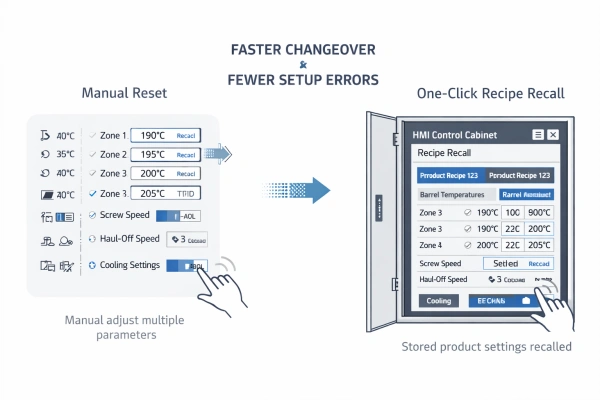
The key is completeness. If a recipe stores only temperature zones but not speed ratios, downstream settings or alarm thresholds, it is only a partial recipe. Ask suppliers exactly which parameters are stored and whether the HMI can demonstrate recall for different products.
Alarm Logic: Display Is Not the Same as Response
Many control systems can display alarms. Fewer systems are well designed in how they respond.
An alarm message tells the operator something happened. Alarm logic defines what the line does when it happens. For example:
- high melt pressure may trigger warning, speed reduction or controlled stop;
- low temperature may prevent screw start to protect the screw and barrel;
- motor overload may stop a section before mechanical damage occurs;
- haul-off fault may stop cutting or reduce upstream speed to avoid product pile-up.
This distinction matters most at night, during startup or when a less experienced operator is running the line. The value of a control system is not only that it reports a fault. It should reduce the time between abnormal condition and safe action.
Advanced Modules Are Not the Same as Basic PLC Control
A basic PLC/HMI system coordinates line operation. Some modules go further and close the loop around a measured product result.
Meter weight control is one example. It uses material consumption and line speed to calculate weight per meter, then adjusts screw speed or haul-off speed to keep the product near target. That is more advanced than simply showing screw RPM on the HMI.
A melt pump is different again. It mechanically stabilizes melt delivery between the extruder and die. The PLC can monitor and coordinate the pump, but it cannot replace the mechanical decoupling when the process truly needs it.
This is the practical way to evaluate options: first understand what the standard control system does; then decide whether the product tolerance justifies advanced closed-loop modules or mechanical metering.
How to Evaluate a Supplier’s Control System
When comparing quotations, ask for more than the PLC brand.
-
What parameters are controlled by the PLC? Ask whether the system controls only temperatures, or also screw speed, haul-off speed, cutter logic, pressure alarms and downstream coordination.
-
Which loops are closed-loop? There is a difference between showing a value and using that value for automatic correction. Ask whether pressure, meter weight, wall thickness or OD are only monitored or actually used for feedback.
-
What does the recipe include? Ask for a real HMI demonstration. A complete recipe should cover the parameters operators need to reproduce the same product, not just one screen of temperature setpoints.
-
What happens during an alarm? Ask which alarms only display a message and which alarms trigger speed reduction, interlock, section stop or full line stop.
-
Can your maintenance team support it? Check spare parts lead time, local availability, backup files, remote support and whether your team can replace modules without depending on one supplier for every small issue.
Conclusion
The right extrusion line control system is not the one with the most impressive brand name on the quotation. It is the one whose control logic, HMI screens, recipe functions, alarm response and service support match the real production task.
For standard pipe and profile lines, a practical PLC/HMI system should make the line easier to run and harder to run incorrectly. For higher-precision products, it should also provide a path toward closed-loop modules such as meter-weight control or pressure-based coordination.
If you are comparing line quotations, contact Jinxin with your product, material, tolerance, output target and required automation level. We can help separate useful control functions from expensive checkboxes.
FAQ
What is an extrusion line control system?
It is the PLC, HMI, sensors, drives and control logic that coordinate an extrusion line’s temperature, speed, pressure, alarms, recipes and downstream operation.
Is PLC extrusion control the same as an HMI touch screen?
No. The PLC executes the control logic. The HMI is the operator interface. A touch screen without useful logic behind it does not make the line well controlled.
What should an extruder control panel show?
It should show key production values such as temperature zones, screw speed, haul-off speed, melt pressure, motor load, alarm history and recipe settings in a clear workflow.
Does a better PLC brand always improve product quality?
No. Product stability depends on the control logic, sensors, drives, recipes, alarm response and serviceability. Brand matters only when it supports those requirements.
How does line control affect wall thickness or meter weight?
Wall thickness and meter weight depend on the relationship between material output and haul-off speed. A good control system makes that relationship visible, repeatable and, when needed, closed-loop.
Is extrusion process control different from a melt pump?
Yes. Process control coordinates and corrects line parameters. A melt pump mechanically meters molten polymer. They can work together, but they solve different problems.
Further Reading
Plastics Technology — What Makes for Perfect Control in Tubing Extrusion?
Conair — Extrusion Control Systems for Plastics Processing
Jason Shen
Founder and Lead Engineer, Jinxin ExtruderJason Shen leads Jinxin Extruder's single screw extrusion line projects, with hands-on experience in machine configuration, tooling adjustment, factory testing and extrusion troubleshooting.
Inquiry
Email Your Line Requirements
For an accurate quotation, include your target product, material, size range, expected output, factory voltage and any product drawing or sample requirements.