
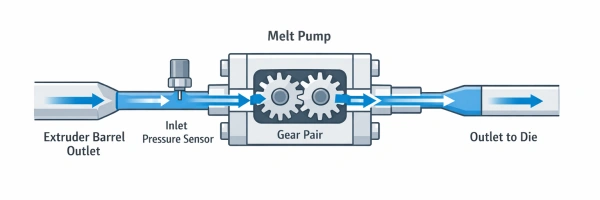
A melt pump for extrusion is a precision metering device installed between the extruder and the die. It can make melt delivery steadier when the real problem is pressure pulsation or unstable output from the screw.
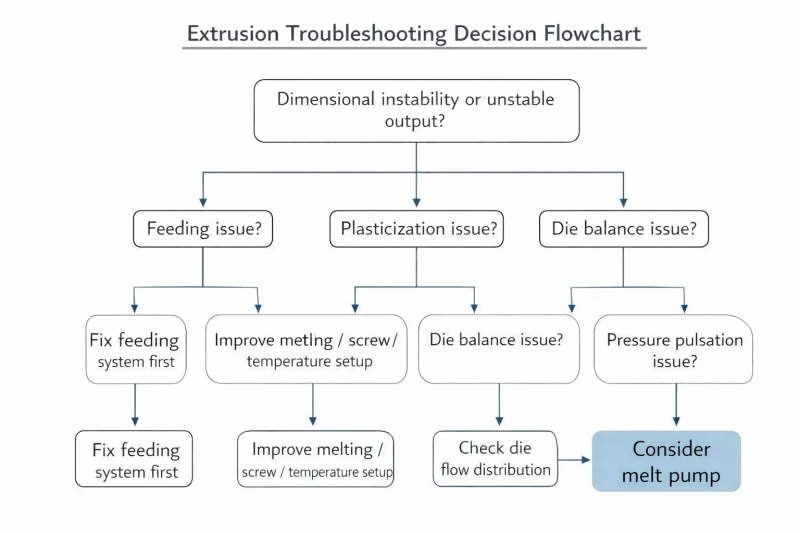
That does not mean every extrusion line should add one. A melt pump does not improve plasticization, remove contamination, dry material, fix feeding instability or correct a poorly balanced die. It delivers the melt more steadily; it does not make bad melt into good melt.
This matters in quotation discussions. Some buyers ask for a melt pump because it sounds like a higher configuration. In practice, the first question should be simpler: is the line actually unstable because screw output is not precise enough for the product tolerance?
Quick Answer
A melt pump, also called a gear pump for an extruder, uses precision gears to move a fixed volume of molten polymer per rotation. This can reduce die-side pressure variation and make wall thickness, profile weight or film thickness more consistent.
It is most useful for precision tubing, optical or appearance-sensitive profiles, thin film or sheet, and long production runs where small output variation becomes expensive. It may not be worth adding to standard pipe, hose or profile lines when the product already runs within tolerance using a good screw, stable feeding and closed-loop pressure control.
For the wider equipment context, see Jinxin’s plastic extrusion line overview.
The Screw Is Already a Pump, But Not a Precision Meter
A single-screw extruder already melts, mixes and pushes polymer forward. The problem is that those jobs interfere with each other. Changes in pellet bulk density, barrel temperature, screw wear, regrind ratio or screen resistance can all show up as output variation at the die.
A screw can build pressure. It is not a precision metering device.
A melt pump separates the jobs. The extruder focuses on melting and supplying material. The gear pump takes over the final pressure-building and metering task. When the pump inlet is properly fed, the die receives a steadier volume of melt per unit time.
That is why the value of a melt pump is not “more pressure” by itself. The value is controlled, repeatable delivery.
How a Gear Melt Pump Works
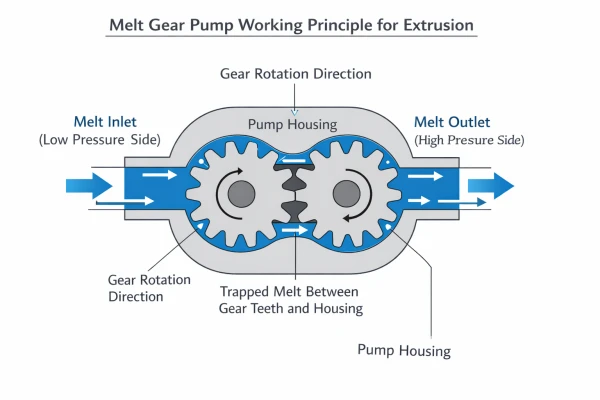
Inside the heated pump body, two closely fitted gears rotate together. Melt enters the inlet side, fills the spaces between the gear teeth and the housing, and is carried toward the outlet. Because the gear volume is fixed, pump output is closely related to pump speed.
This positive-displacement behavior is what helps isolate the die from normal screw-side fluctuation.
A typical setup also includes pressure sensors before and after the pump. The inlet sensor protects the pump from starvation. The discharge pressure shows what the die is receiving. The line control system may adjust screw speed to keep pump inlet pressure stable while the pump meters melt to the die.
What a Melt Pump Does Not Fix
This is the section that prevents expensive mistakes.
A melt pump does not improve melt quality. If the polymer is not fully plasticized, contains moisture bubbles, carries gels or includes contamination, the pump will deliver that same material more steadily. It will not mix it better or clean it.
A melt pump does not solve feeding problems. Bridging, unstable bulk density, irregular regrind feed or poor hopper flow should be corrected upstream.
If the root cause is still unclear, start with the broader plastic extrusion troubleshooting guide before evaluating a melt pump.
A melt pump does not replace melt filtration. If contamination is the issue, review the screen pack and screen changer first. CT-A2 explains why melt filtration and screen changers are a separate control point.
A melt pump does not replace meter weight control. It can make melt delivery steadier, but it does not calculate the finished product’s weight per meter or close the loop with haul-off speed. That is the role of meter weight control.
Melt Pump vs Pressure Sensor Closed-Loop Control
Many standard lines should not jump directly to a melt pump. A pressure transducer, PLC and screw-speed control loop may already be enough.
With closed-loop pressure control, the sensor reads melt pressure near the die. If pressure rises, the controller reduces screw speed; if pressure falls, it increases screw speed. This is still a feedback correction, so it has some lag, but for many standard products it is practical and much less complex. For the wider control architecture, see Jinxin’s extrusion line control system. If the symptom is wall variation, first diagnose all common causes in wall thickness variation in plastic extrusion.
A melt pump is different. It mechanically decouples the die from screw-side variation. That can be a step up in stability, but it adds a precision mechanical component, heating, seals, drive control, purge volume and maintenance.
Use the simpler route first unless product tolerance proves it is not enough. PTOnline’s pressure-control discussion and PSI’s gear-pump FAQ both support this distinction: pressure control can reduce extrusion variation, while gear pumps provide a tighter mechanical metering stage.
When a Melt Pump Is Justified
A melt pump is worth evaluating when the product tolerance is tighter than the screw and normal closed-loop control can reliably hold.
Good cases include:
- precision tubing with tight wall thickness tolerance;
- optical or appearance-sensitive profiles where flow marks are unacceptable;
- thin film or sheet where gauge variation is costly;
- long continuous runs with strict weight-per-meter or thickness contracts;
- variable-viscosity material or regrind-heavy recipes, but only when the finished product still needs tight dimensional control.
The point is not that these applications always require a melt pump. The point is that they have a real reason to investigate one.
When You Probably Do Not Need One
Most standard extrusion lines do not need a melt pump.
You probably do not need one if:
- the pipe, hose or profile already stays within tolerance;
- the line problem comes from poor melting, moisture, feeding or temperature drift;
- the die is not balanced;
- contamination is causing defects;
- the production changes color, material or size frequently;
- the compound is abrasive or highly filled and pump wear would become a major cost;
- the process is still being developed and basic control discipline is not stable yet.
In these cases, adding a melt pump can make the line look more advanced while leaving the real problem untouched.
RFQ Checklist
Before specifying a melt pump, prepare these details:
- Product type and tolerance: wall thickness, OD, profile weight or film gauge.
- Material: polymer, filler level, regrind ratio, viscosity range and abrasiveness.
- Current symptom: pressure pulsation, output variation, wall thickness drift or another defect.
- Pressure data: die pressure trend and whether a closed-loop pressure control test has been done.
- Production pattern: long stable runs or frequent color/material/size changes.
- Maintenance expectation: seals, gear wear, heating, cleaning and bypass plan.
If a supplier recommends a melt pump, the reason should be tied to measured pressure/output instability and product tolerance, not simply to a higher configuration.
Conclusion
A melt pump is useful when the line has a specific metering problem. It is not a universal quality upgrade.
For a standard pipe or profile line, start with stable feeding, correct screw design, melt filtration, die balance, pressure sensing and line synchronization. If those are already under control and the product still needs tighter output stability, then a melt pump becomes a serious option.
If you are choosing a line configuration, contact Jinxin with material, product tolerance, output target and current stability data. We can help decide whether a melt pump is technically justified or whether a simpler control path is better.
FAQ
What is a melt pump in extrusion?
It is a heated gear pump installed between the extruder and the die to meter molten polymer at a more stable volumetric rate.
Is a melt pump the same as a gear pump for an extruder?
Usually yes. In extrusion, a melt pump is commonly a precision gear pump designed for high-temperature polymer melt.
Does a melt pump improve melt quality?
No. It stabilizes flow and pressure. It does not improve plasticization, mixing, drying or filtration.
When is a melt pump necessary?
It becomes useful when verified pressure or output fluctuation prevents the product from meeting tight dimensional or weight tolerance.
Can pressure sensor control replace a melt pump?
For many standard products, yes. A pressure sensor with closed-loop screw control is often the first step before adding a mechanical melt pump.
Does a melt pump replace a screen changer?
No. A screen changer filters contamination. A melt pump meters melt flow. They solve different problems.
Further Reading
PSI Polymer Systems — Gear Pump FAQ
Plastics Technology — Use Pressure Control to Minimize Process Variations in Single-Screw Extrusion
Jason Shen
Founder and Lead Engineer, Jinxin ExtruderJason Shen leads Jinxin Extruder's single screw extrusion line projects, with hands-on experience in machine configuration, tooling adjustment, factory testing and extrusion troubleshooting.
Inquiry
Email Your Line Requirements
For an accurate quotation, include your target product, material, size range, expected output, factory voltage and any product drawing or sample requirements.