
Wall thickness variation in plastic extrusion is usually a line-balance symptom, not a single bad setting. The wall may slowly get thinner, the pipe OD may move toward the tolerance limit, the profile may become heavier on one side, or meter weight may change even though the line is still running.
The fastest response is not to chase screw speed, haul-off speed or cooling one by one. First identify the pattern, then decide whether the cause is output instability, downstream pull, cooling and calibration, die flow distribution or a broader line problem.
For the wider symptom map, use the plastic extrusion troubleshooting guide. For the draw-down mechanism, use extruder output and haul-off speed synchronization. If meter weight is part of the symptom, connect the diagnosis to meter weight control in plastic extrusion.
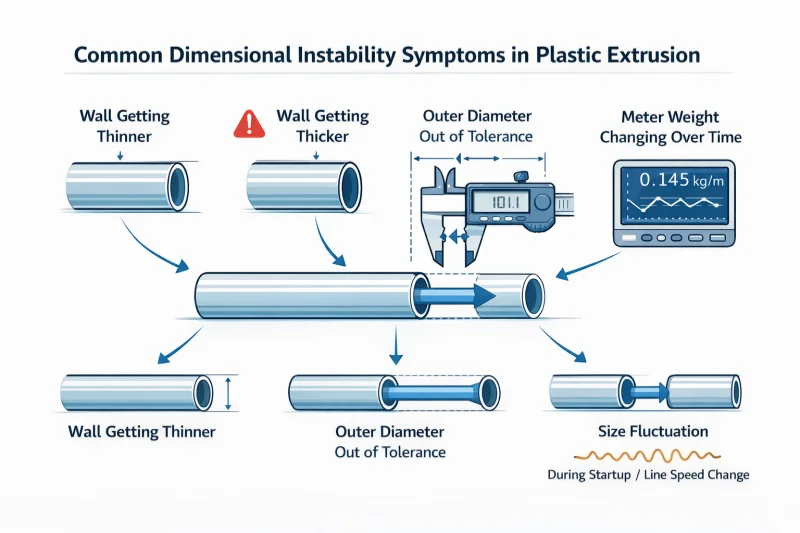
Quick Answer
When wall thickness varies in plastic extrusion, classify the pattern before changing settings:
- Decide whether the problem is gradual drift or repeated fluctuation.
- Check whether the wall is getting thinner, thicker or uneven across the section.
- Compare wall thickness with OD, meter weight, melt pressure and haul-off behavior.
- Separate output instability from downstream pull, cooling and die-flow causes.
- Make one controlled correction, wait for the line response, then recheck the trend.
| Symptom pattern | Likely direction | First check |
|---|---|---|
| Wall gets thinner over time | Overdraw or falling output | Haul-off speed versus stable output. |
| Wall gets thicker over time | Overfeeding or reduced pull | Output, puller speed and calibration load. |
| Wall fluctuates up and down | Process instability | Feeding, melt temperature, pressure and haul-off response. |
| One side stays thicker | Flow distribution or calibration bias | Die flow path, sizing sleeve, vacuum and support. |
| OD and meter weight drift together | System mismatch | Output-haul-off balance and material per meter. |
1. Read the Dimensional Symptom Correctly
Plastic extrusion dimension drift rarely appears as one clean number. A pipe line may show thinner wall and lower meter weight. A profile line may show local weakness, poor fit or a section that becomes heavier on one side. Film or sheet may show gauge variation rather than a simple OD change.
That is why wall thickness should be read together with the rest of the product: OD, width, flatness, meter weight, pressure trend and the moment when the defect appears. A line that drifts only after a speed increase is different from a line that fluctuates every few minutes at steady speed.
Use the first measurement as a clue, not as the whole diagnosis. The wall is often the earliest visible signal that material per unit length is no longer stable.
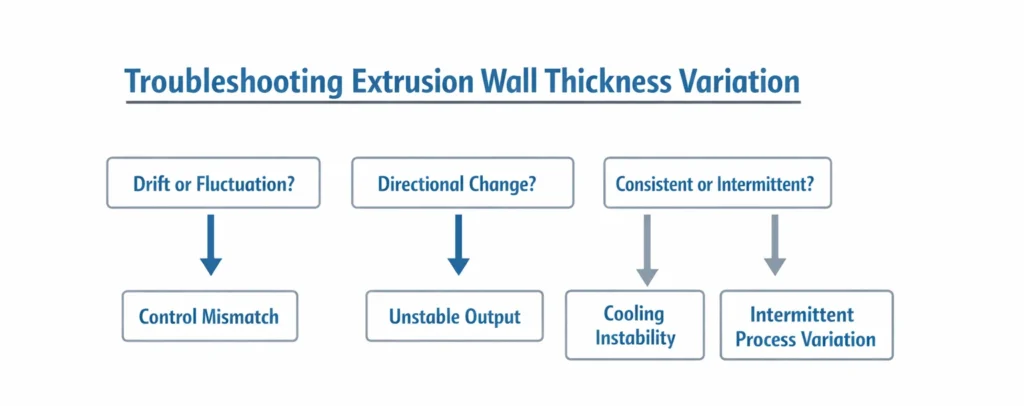
2. Drift, Fluctuation or Directional Change
Correct diagnosis starts by naming the movement pattern.
| Question | What it tells you | Typical implication |
|---|---|---|
| Is it drift or fluctuation? | Whether the product moves one way or swings around target. | Drift points to mismatch or thermal shift; fluctuation points to instability. |
| Is the wall mainly thinner or thicker? | Whether the product is being overdrawn or overfed. | Thin wall means less material per meter; thick wall means excess material or reduced pull. |
| Is it local or whole-section? | Whether the issue is line balance or flow distribution. | Whole-section change is often speed/output; local bias is often die, calibration or cooling. |
| Does it start after an event? | Whether a change triggered the defect. | Speed increase, material change, screen change or startup can expose the cause. |
Avoid blind adjustment here. If the symptom is not classified first, several quick corrections can turn a simple drift into oscillation.
3. Main Causes of Plastic Extrusion Wall Thickness Variation
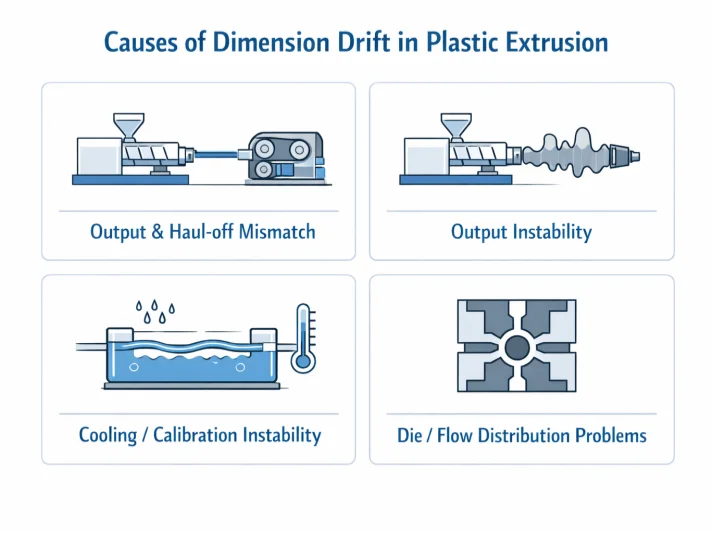
Most cases come from four areas.
| Cause area | How it appears | What to verify first |
|---|---|---|
| Output and haul-off mismatch | Thin wall after faster pull, thick wall after overfeeding, OD drift. | Match screw output, haul-off speed and product meter weight. |
| Output instability | Wall or meter weight fluctuates even when settings look unchanged. | Feeding, throat condition, bulk density, melt temperature and pressure trend. |
| Cooling or calibration instability | Dimension changes after speed change or long run. | Vacuum, sizing load, cooling water, support and downstream alignment. |
| Die or flow distribution problem | Local thick/thin area repeats in the same position. | Die lip, flow path, wear, contamination and calibration symmetry. |
Output and haul-off mismatch is common because line speed directly changes material per unit length. If the puller gets ahead of stable output, the wall becomes thinner. If the line delivers more material than the puller removes at the matched rate, the wall builds up.
If the root cause is unstable feeding, use why an extruder is not feeding before making repeated speed corrections. If screw delivery fluctuation remains confirmed after feeding, melting and filtration are stable, a melt pump for extrusion may be relevant for tighter tolerance lines.
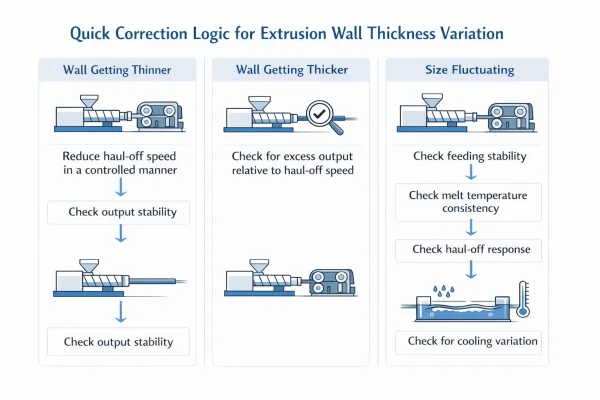
4. Correct the Line Without Chasing the Number
Correction should restore balance, not force the measurement back for a few minutes.
| If you see | Do first | Avoid |
|---|---|---|
| Wall getting thinner | Check overdraw, confirm output stability, reduce pull only in a controlled step. | Raising screw speed and changing puller speed repeatedly at the same time. |
| Wall getting thicker | Check overfeeding, calibration load and puller response. | Pulling faster aggressively without confirming output stability. |
| Wall fluctuating | Stabilize feeding, melt temperature, pressure and haul-off response. | Treating a variable process like a fixed setup error. |
| Local thick side | Inspect die flow, sizing sleeve, vacuum and cooling symmetry. | Correcting a local flow bias only with global speed changes. |
| Meter weight drifting | Recheck material per meter and the output-haul-off relationship. | Judging only by OD while material consumption is moving. |
Make one change at a time and wait for the process delay. On pipe and profile lines, the product you measure may reflect conditions that passed through the die earlier, so fast repeated adjustment can create the next defect.
5. When the Problem Is System-Level
Wall thickness variation can be only one symptom of a wider process that has lost stability.
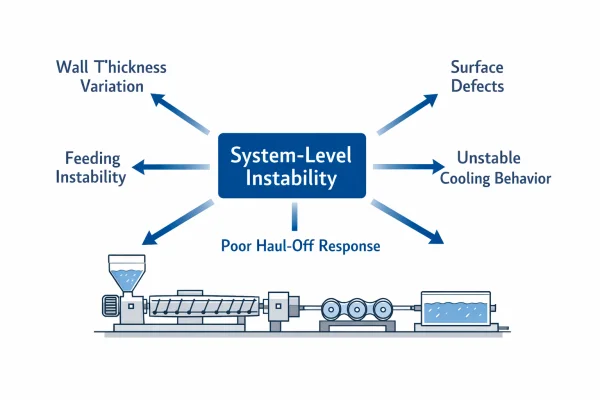
If wall variation appears together with feeding instability, pressure swings, black specks, surface streaks, bubbles or unstable cutting, stop treating wall thickness as an isolated adjustment. Start from the wider plastic extrusion troubleshooting path. If the instability begins during initial line setup, record the settings and resolve them through the extrusion line installation and commissioning service before normal production starts.
For contamination or die build-up symptoms, use black specks in extrusion to separate material contamination from die release. For recurring line instability, connect the findings to the extrusion line maintenance checklist so the same drift does not return every shift.
6. Prevention Checklist
| Routine item | Why it matters |
|---|---|
| Record wall, OD and meter weight trends together | A single reading can hide material-per-meter drift. |
| Standardize startup stabilization before full speed | Many wall defects appear while the line is still thermally or mechanically settling. |
| Keep feeding and throat cooling repeatable | Output variation often starts before the die. |
| Review haul-off speed changes with output changes | Pull and output must move as a matched condition. |
| Check cooling water, vacuum and sizing load | Downstream changes can move dimensions even when extruder settings are unchanged. |
| Document which correction worked | Repeatable records shorten the next diagnosis. |
7. Maintenance vs Troubleshooting Boundary
| Situation | Use |
|---|---|
| Wall variation is visible now | Diagnose here first, then route to the confirmed cause. |
| Multiple defects appear together | Use the OM-2 troubleshooting hub. |
| Puller and output are not matched | Use CT-B2 for output and haul-off synchronization. |
| Meter weight is drifting | Use CT-A3 for material-per-meter control. |
| The issue repeats after normal correction | Move findings into the maintenance checklist and operating records. |
Conclusion
Wall thickness variation in plastic extrusion is a symptom that must be read in context. The key is to separate drift from fluctuation, whole-section change from local bias, and line-balance problems from die or cooling problems.
Once the pattern is clear, the corrective action becomes smaller and safer: stabilize output, match haul-off, verify cooling and calibration, inspect die flow only when the evidence points there, and use system-level troubleshooting when several symptoms appear together.
FAQ
What causes wall thickness variation in plastic extrusion?
The common causes are output-haul-off mismatch, unstable feeding or screw output, cooling or calibration instability, and uneven die flow distribution.
Why does the wall get thinner when haul-off speed increases?
A faster haul-off stretches the same material over more length. If extruder output does not increase and stabilize at the same time, material per meter drops and the wall becomes thinner.
Is wall thickness variation the same as OD drift?
No. They are related symptoms. OD can drift because of pull, cooling or calibration, while wall thickness shows how material is distributed in the section.
Should I change screw speed or haul-off speed first?
Change the side that evidence shows is wrong. If output is stable and pull is too high, adjust haul-off. If output is unstable, fix feeding, melting or pressure behavior first.
When should I check the die?
Check the die when the thick or thin area repeats in the same product position, when one side is always biased, or when contamination and die build-up evidence appears.
Can a melt pump solve wall thickness variation?
Only when unstable melt delivery is the confirmed limiting cause and the product needs tighter pressure or output stability. It will not solve cooling, calibration or haul-off mismatch by itself.
Need Help Diagnosing Wall Variation?
Send the product type, target wall or OD, meter weight trend, line speed, screw speed, pressure trend, cooling/vacuum conditions and when the defect appears. We can help separate output mismatch, haul-off behavior, cooling instability and die-flow causes.
Jason Shen
Founder and Lead Engineer, Jinxin ExtruderJason Shen leads Jinxin Extruder's single screw extrusion line projects, with hands-on experience in machine configuration, tooling adjustment, factory testing and extrusion troubleshooting.
Inquiry
Email Your Line Requirements
For an accurate quotation, include your target product, material, size range, expected output, factory voltage and any product drawing or sample requirements.