
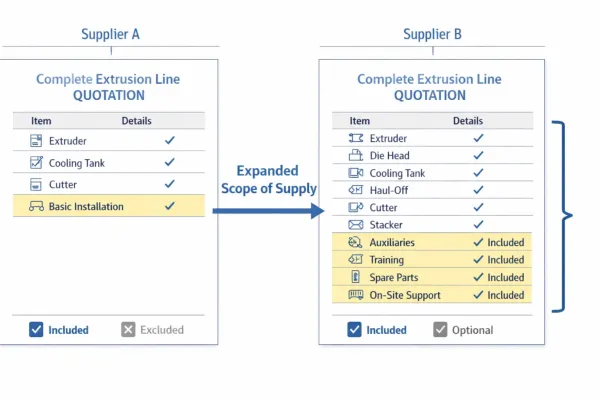
An extrusion line quotation is only useful when you know exactly what is included. Two suppliers may both say they are quoting a complete plastic extrusion line, but one may include die tooling, calibration, line control, commissioning, spare parts and training while another quotes only the main machine and downstream stations.
That is why the lowest price is often not the lowest real cost. It may simply be the narrowest scope. Before negotiating the number, compare the supply boundary.
Use this checklist to normalize quotations before you choose a supplier. For the equipment context, see plastic extrusion line categories. For control scope, see extrusion line control system. For downstream stations, see downstream equipment in plastic extrusion.
If the product could be a molded part rather than a continuous extrusion, check injection molding vs extrusion before asking suppliers to quote an extrusion line.
Quick Answer
Compare extrusion line quotations by scope first, then price:
- List every item the production line needs.
- Ask each supplier to mark each item as Included, Not Included, Optional or By Buyer.
- Confirm die sets, calibration tooling, downstream stations and control integration.
- Add utilities, shipping, customs, commissioning, training and facility work.
- Compare the true landed cost, not only the headline machine price.
| Quote wording | What to check |
|---|---|
| Complete extrusion line | Does it include tooling, downstream equipment, utilities and services? |
| One set of molds included | Which exact product size, die, sizing sleeve and calibration tooling? |
| PLC + HMI included | Is the whole line integrated or only each station has a panel? |
| Commissioning included | How many engineer days, and who pays flights, hotel and visa? |
| Spare parts included | Which parts, quantity and part numbers? |
1. What a Complete Extrusion Line Includes
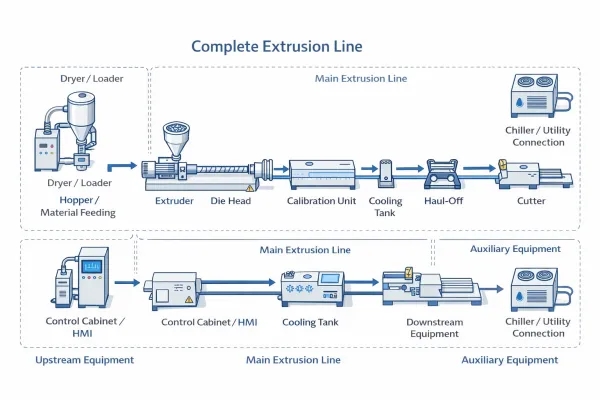
A complete extrusion line is a process system, not one machine. It normally includes the main extruder, die and tooling, downstream equipment, control integration and end-of-line handling.
| Section | Typical items | Why scope matters |
|---|---|---|
| Main extruder | Screw, barrel, gearbox, motor, inverter, heating, hopper, cabinet | Usually included, but component models still matter. |
| Die and tooling | Die, adapter, sizing sleeve, calibration tooling | One die set may cover only one size, not your whole range. |
| Downstream | Calibration tank, cooling bath, haul-off, cutter, coiler or stacker | Product type changes the whole downstream logic. |
| Control system | PLC, HMI, alarms, interconnection, speed coordination | A physical line is not automatically an integrated line. |
| Auxiliary equipment | Dryer, loader, blender, chiller, printer, measurement | Often optional or buyer-supplied. |
For synchronization scope, check whether the quotation covers the relationship between extruder output and haul-off speed. CT-B2 explains extruder output and haul-off speed synchronization.
2. Common Exclusions That Change the Real Price
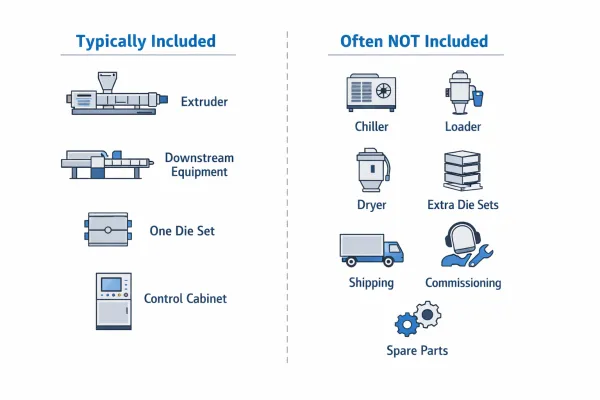
Many disputes start with the sentence: “We thought that was included.” Make exclusions visible before you issue the purchase order.
| Area | Often excluded or optional |
|---|---|
| Utilities | Chiller, cooling tower, compressor, power cable, water piping, drainage. |
| Material handling | Loader, vacuum conveyor, dryer, dosing unit, gravimetric blender. |
| Tooling | Additional die sets, calibration sleeves, inserts for extra sizes. |
| Process enhancement | Melt pump, screen changer, inline measurement, printer. |
| Services | FAT material, installation supervision, training, warranty details, after-sales response. |
| Delivery | Packing, insurance, FOB/CIF/DDP difference, customs and local transport. |
For hygroscopic materials, a dryer may be essential even if it is not in the line price. EB-2 explains resin drying in plastic extrusion.
3. Normalize Every Supplier Response
Ask every supplier to complete the same response format:
| Response | Meaning |
|---|---|
| Included | Covered in the quoted price. |
| Not Included | Excluded from the supplier scope. |
| Optional | Available at added cost; price should be listed. |
| By Buyer | Buyer must source, prepare or pay separately. |
This removes the guessing. If Supplier A includes a chiller and Supplier B lists it as optional, the headline price is not comparable until you add the missing cost.
4. Calculate True Landed Cost
The real comparison is the total cost to install, commission and run the line in your factory.
| Cost item | Add to comparison |
|---|---|
| Quoted machine price | Base supplier price. |
| Missing equipment | Chiller, dryer, loader, extra tooling, spare parts. |
| Logistics | Packing, shipping, insurance, customs, inland transport. |
| Services | FAT, commissioning, engineer travel, training. |
| Facility work | Power, water, air, foundation, drainage, layout changes. |
| Risk allowance | Delay, missing utilities, unclear warranty or spare-parts path. |
Example:
| Item | Supplier A | Supplier B |
|---|---|---|
| Quoted line price | $30,000 | $42,000 |
| Chiller | $2,300 extra | Included |
| Loader + dryer | $920 extra | Included |
| 2nd die set + calibration | $2,300 extra | Included |
| Seaworthy packing | $1,800 extra | Included |
| Shipping | $4,500 | $4,500 |
| Commissioning labor | $1,080 extra | Included |
| True landed cost | $42,900 | $46,500 |
The apparent $12,000 difference becomes $3,600 once scope is normalized.
5. “Included” Still Needs Specification
Scope alignment is not the end. Two quotations can both say “included” while using different component levels.
| Item | Ask for |
|---|---|
| Inverter | Brand, model series, power rating and control function. |
| PLC / HMI | Brand, communication, recipe, alarm and data functions. |
| Motor and gearbox | Brand, rating, service factor and spare-parts availability. |
| Sensors | Pressure, temperature, encoder and measurement details. |
| Tooling | Product size, material, drawing version and calibration coverage. |
| Electrical interface | Voltage, frequency, connector, cabinet standard and wiring scope. |
A brand name alone is not enough. Ask for model numbers where the component affects process stability, service or long-term reliability.
6. What to Put in the RFQ
A better RFQ creates better quotations. Do not ask only for “one pipe extrusion line” or “one profile line.” Send the process basis first.
| RFQ information | Why suppliers need it |
|---|---|
| Product drawing or sample | Defines die, calibration and downstream design. |
| Material and recycled content | Affects screw, drying, filtration and processing window. |
| Product size range | Defines die sets, sleeves and possible line configuration. |
| Output target | Determines extruder size, cooling length and haul-off capacity. |
| Tolerance and surface requirement | Changes control, calibration, measurement and tooling cost. |
| Factory utilities | Voltage, frequency, water, air and space limitations. |
| Required delivery term | FOB, CIF or DDP changes commercial comparison. |
For pipe size and tooling coverage, see pipe extrusion line size range.
7. Scope of Supply Checklist
Use this checklist when comparing quotations. Mark each item as Included, Not Included, Optional or By Buyer.
A. Product and Process Basis
- Product type, drawing or sample
- Material and recycled content
- Layer structure if multi-layer
- Output target in kg/h
- Line speed target in m/min
- Dimensional tolerance
- Surface quality requirement
B. Main Equipment
- Extruder body, screw, barrel, gearbox and motor
- Inverter / drive system
- Control cabinet with PLC and HMI
- Barrel heaters and cooling fans
- Hopper and feed throat
- Safety guarding and E-stop circuits
- Screen changer, if required
- Melt pump, if required
C. Die and Tooling
- Die type and quantity
- Product sizes covered by each die set
- Die adapter or transition piece
- Calibration sleeves, inserts or sizing tooling
- Tooling drawings and material
D. Downstream Equipment
- Vacuum or dry calibration unit
- Cooling bath or spray tank
- Haul-off / puller
- Cutter type
- Coiler, winder, stacker or receiving table
- End-of-line handling
E. Upstream and Material Handling
- Loader or vacuum conveyor
- Dryer type and capacity
- Dosing or gravimetric blending
- Material storage and conveying interface
F. Auxiliary Equipment
- Chiller or cooling tower
- Compressor or compressed-air connection
- Water piping and drainage
- Main power cable
- Inline measurement
- Printer or marking system
G. Delivery and Services
- FAT and trial material
- Packing type
- Shipping term and insurance
- Installation supervision days
- Commissioning and test run
- Operator and maintenance training
- Startup spare parts and tool kit
H. Documentation
- Mechanical drawings
- Electrical schematics
- Operating manual language
- Recommended spare parts list with part numbers
- Parameter backup and PLC/HMI documentation if available
I. Commercial Boundary
- Warranty period and start point
- Utility hookup responsibility
- Local installation and civil works
- Explicit exclusions
- Special assumptions
Conclusion
A good extrusion line quotation is not the cheapest number on the first page. It is the clearest scope, the cleanest RFQ response and the lowest real risk after every included, excluded, optional and buyer-supplied item is visible.
Compare scope first, then price. That is how you avoid buying a “complete line” that still needs expensive missing pieces before it can produce.
FAQ
Why do extrusion line quotations vary so much?
Usually because the scope is different. One supplier may include tooling, chiller, dryer, commissioning and spare parts, while another quotes only the core line.
What is most often missing from a quotation?
Chiller, compressor, dryer, loader, extra die sets, calibration tooling, spare parts, installation supervision, training and shipping-related costs are common gaps.
Should I choose the supplier with the most complete scope?
Not automatically. A complete scope reduces risk, but you still need to compare component specifications, service support and whether each included item matches your product.
How many die sets should I include?
At minimum, include the die and calibration tooling needed for the product sizes you will actually sell or test after installation.
What does commissioning included mean?
It should state engineer days, work content, test material, buyer responsibilities, and who pays flights, hotel, visa and local transport.
Is extrusion line price the same as true landed cost?
No. True landed cost includes the quoted line, missing equipment, logistics, customs, commissioning, training and facility preparation.
For installation, commissioning and support boundaries, see Jinxin service support.
Need a Quotation Checklist Review?
Send your product drawing, material, size range, output target, tolerance, factory utilities and any quotation you have received. We can help identify missing scope before you compare suppliers. When you are ready, contact Jinxin with these details to start the review.
Jason Shen
Founder and Lead Engineer, Jinxin ExtruderJason Shen leads Jinxin Extruder's single screw extrusion line projects, with hands-on experience in machine configuration, tooling adjustment, factory testing and extrusion troubleshooting.
Inquiry
Email Your Line Requirements
For an accurate quotation, include your target product, material, size range, expected output, factory voltage and any product drawing or sample requirements.