
Injection molding and extrusion are both high-volume plastic manufacturing processes, but they solve different production problems.
The short version is simple:
- Use extrusion when the product is continuous and has a consistent cross-section, such as pipe, tube, hose, sheet, film, cable coating or profile.
- Use injection molding when the product is a discrete 3D part, such as a cap, housing, connector, container or molded component.
The better process is not the one with the more advanced machine. It is the one that matches the product shape, material behavior, tooling budget, output target and quality requirement.
This guide compares injection molding vs extrusion from a buyer’s point of view, with extra attention to tooling cost, process stability and what to prepare if extrusion is the right path.
In UK and Commonwealth markets, the same comparison may be searched as injection moulding vs extrusion.
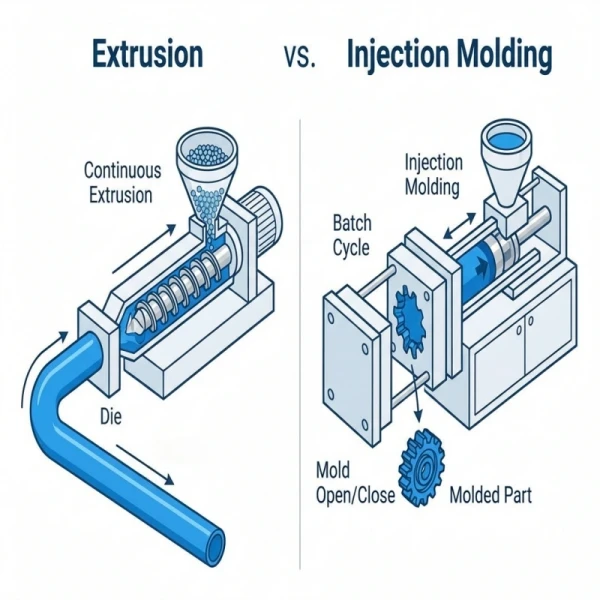
Quick Comparison: Injection Molding vs Extrusion
| Factor | Plastic Extrusion | Injection Molding |
|---|---|---|
| Production mode | Continuous | Cyclic |
| Best for | Long products with a constant cross-section | Separate 3D parts with complex geometry |
| Typical products | Pipes, tubes, profiles, sheets, films, hose, cable coating | Caps, housings, buckets, containers, clips, molded fittings |
| Tooling | Die, sizing tooling, calibration tooling | Mold cavity, core, runner, gate and ejection system |
| Tooling cost | Usually lower for simple continuous shapes | Usually higher, especially for complex multi-cavity molds |
| Material waste | Low during stable production | Runners, gates and startup scrap may add waste |
| Dimensional control | Depends on die design, cooling, haul-off and line synchronization | Depends on mold accuracy, shrinkage control, clamping and cycle consistency |
| Output style | Continuous length, then cut, wound or coiled | Individual parts produced per cycle |
| Best buyer question | ”Can this line run my profile or tube stably?" | "Can this mold repeat my part geometry accurately?” |
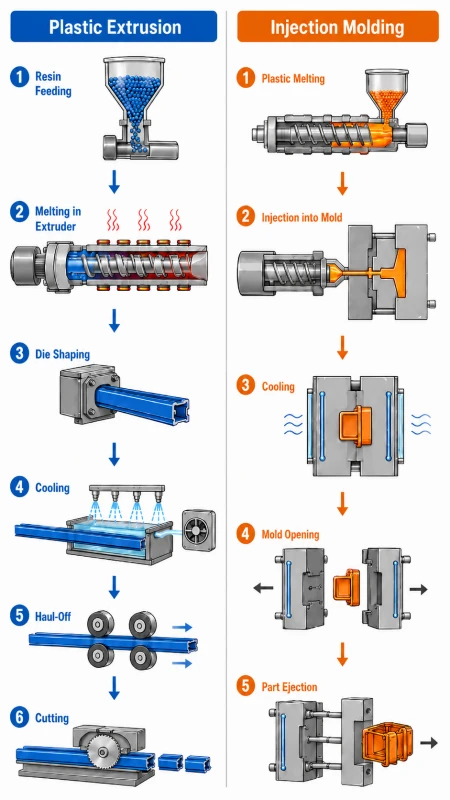
What Is Plastic Extrusion?
Plastic extrusion is a continuous process that melts thermoplastic material and pushes it through a shaped die. The melt exits the die as a continuous shape, then passes through cooling, sizing, haul-off and cutting or winding.
Extrusion is used when the product keeps the same cross-section along its length. Common examples include:
- PPR, PE and PP pipes
- Small dip tubes and precision tubing
- PVC braided hose and smooth flexible hose
- Plastic profiles made from PP, PE, ABS, TPU or selected PVC pellet compounds
- PC and PMMA optical profiles
- TPE bands and strips
- Sheet, film and cable coating
If you need a deeper process explanation, see Jinxin’s guide to what plastic extrusion is.
What Is Injection Molding?
Injection molding is a cyclic process. Plastic is melted, injected into a closed mold cavity under pressure, cooled inside the mold, and then ejected as an individual part.
Injection molding is usually selected when the product is a separate 3D component with features that cannot be made as one continuous cross-section. Typical examples include:
- Plastic caps and closures
- Electronic housings
- Containers and buckets
- Clips, brackets and small functional parts
- Handles, fittings and complex molded parts
The mold defines the final part shape. That makes injection molding powerful for complex 3D geometry, but it also makes mold design and mold cost a major part of the decision.
Core Differences Between Extrusion and Injection Molding
1. Continuous Shape vs Discrete Part
The biggest difference is product geometry.
Extrusion makes a continuous product. The cross-section can be round, flat, hollow, solid, soft, rigid or irregular, but it normally stays consistent along the product length. A pipe is a simple example: the line keeps producing the same round cross-section until the pipe is cut.
Injection molding makes separate parts. Each cycle fills a mold cavity, cools the part and ejects it. This is better when the part has complex 3D details, bosses, ribs, threads, snap-fits or variable wall sections.
If your product can be described as “a long shape with the same cross-section,” extrusion is usually the first process to evaluate. If it is “one finished part with a 3D form,” injection molding is usually the first process to evaluate.
2. Tooling Cost and Tooling Risk
Both processes need tooling, but the tooling is different.
For extrusion, the main tooling is the die and related sizing or calibration tooling. For many simple continuous products, an extrusion die can be much less expensive than an injection mold. In China-sourced custom extrusion projects, a simple extrusion die may often be quoted below about USD 1,400 (¥10,000), while a custom injection mold commonly starts in the USD 4,000–15,000+ range and can move higher as complexity increases.
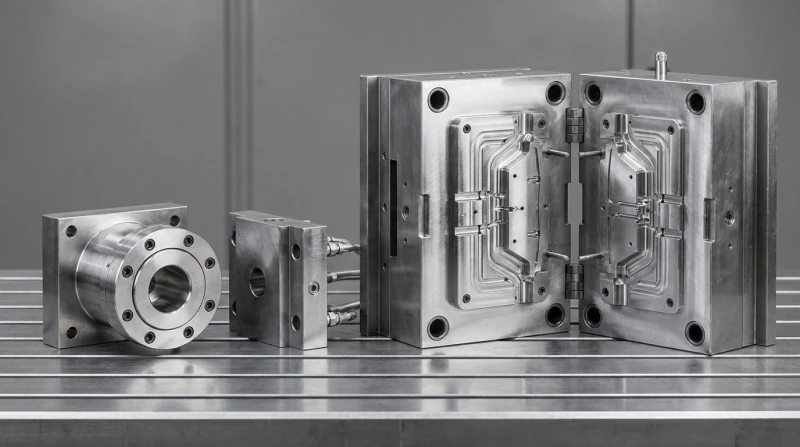
These numbers are not fixed rules. Tooling cost changes heavily with:
- cross-section complexity
- number of cavities or product channels
- tolerance requirement
- material behavior and shrinkage
- polished or mirror-finish surface requirements
- calibration or sizing method
- whether tooling must support multiple sizes or only one product
The practical point is this: extrusion tooling is often more economical when the product is a continuous profile, tube, pipe or hose. Injection molding tooling becomes justified when the value of a repeatable molded 3D part outweighs the mold cost.
3. Production Flow
Extrusion runs continuously. Once the line is stable, the main goal is to keep feeding, melting, die pressure, cooling, haul-off and cutting or winding synchronized.
Injection molding runs in cycles. Each cycle includes closing the mold, injecting melt, packing, cooling, opening the mold and ejecting the part.
This affects how manufacturers think about efficiency:
- In extrusion, stability over long runs is critical.
- In injection molding, cycle time and cavity consistency are critical.
For extrusion buyers, the production question is usually not only “how many kg/h can the extruder produce?” It is also whether the whole line can hold dimension, surface quality and cutting or winding stability over time.
4. Material Waste
Extrusion can be efficient because the product exits continuously and offcut waste can often be limited once the process is stable.
Injection molding may create more waste through runners, gates, sprues and startup adjustments, although hot-runner molds and optimized production can reduce this.
Material waste also depends on the product. A poorly designed extrusion die can cause scrap, and a well-designed injection mold can be very efficient. But for simple continuous shapes, extrusion usually has a strong material-efficiency advantage.
5. Dimensional Control
In extrusion, the die does not act alone. Final dimensions are affected by:
- die design
- die swell
- draw-down from haul-off speed
- cooling rate
- vacuum sizing or calibration
- line speed synchronization
- material shrinkage
That is why extrusion line configuration matters. The extruder, die, cooling, haul-off and cutting or winding units must work as one process.
In injection molding, the mold cavity has a stronger direct influence on the final part shape. Dimensional control depends on mold accuracy, shrinkage prediction, injection pressure, cooling, clamping force and cycle consistency.
Pros and Cons of Plastic Extrusion
Advantages of Extrusion
- Efficient for continuous products
- Usually lower tooling cost for simple shapes
- Suitable for pipes, tubes, profiles, hose, sheet and film
- Low waste during stable production
- Can support long production runs
- Good fit for custom cross-sections based on drawings or samples
Limitations of Extrusion
- Not suitable for most complex 3D parts
- Cross-section usually stays consistent along the length
- Final size depends on die, cooling and haul-off coordination
- Material changes can require process testing
- Poor line synchronization can cause thickness drift, ovality or surface defects
Pros and Cons of Injection Molding
Advantages of Injection Molding
- Excellent for complex 3D parts
- High repeatability after the mold and process are validated
- Good for parts with ribs, bosses, threads, snap-fits and detailed features
- Multi-cavity molds can produce many parts per cycle
- Strong fit for high-volume finished components
Limitations of Injection Molding
- Mold cost can be high
- Tooling changes can be expensive
- Not suitable for long continuous products
- Runners, gates and startup adjustments may create waste
- Design changes after mold build can add cost and delay
How to Choose Between Extrusion and Injection Molding
Start with the product, not the machine.
Choose Extrusion If:
- The product has a constant cross-section.
- The product is long, continuous, coiled, wound or cut to length.
- You are making pipe, tube, hose, profile, sheet, film, strip or cable coating.
- Tooling cost needs to stay practical.
- The main production risk is dimensional stability over long runs.
- You need a line configured around material, size range and downstream handling.
Examples:
- A PPR pipe should be extruded.
- A PE dip tube should be extruded.
- A TPU sealing profile should be extruded.
- A PC LED diffuser profile should be extruded.
- A flat TPE band should be extruded.
Choose Injection Molding If:
- The product is a separate 3D part.
- The part has complex geometry that cannot be made as a continuous profile.
- You need holes, bosses, ribs, snap-fits or molded details.
- The mold cost is justified by high part volume.
- The main production risk is repeatable cavity filling and part shrinkage.
Examples:
- A plastic cap is usually injection molded.
- A housing is usually injection molded.
- A small bracket or clip is usually injection molded.
- A container with a molded base and sidewalls is usually injection molded.
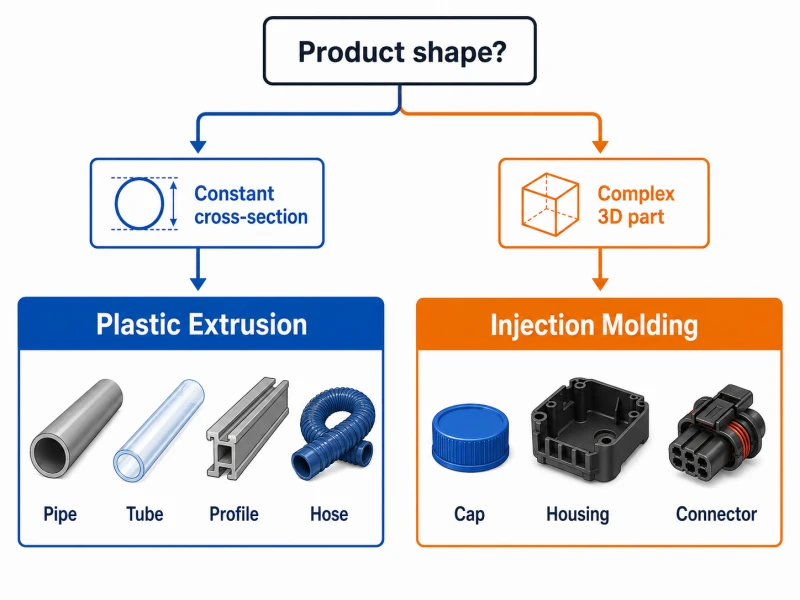
Decision Tree
Use this simple route:
- Does the product keep the same cross-section along its length?
- Yes: evaluate extrusion first.
- No: go to the next question.
- Is the product a separate 3D part with complex molded features?
- Yes: evaluate injection molding first.
- No: compare the actual geometry, material and production target.
- Is tooling budget a major constraint?
- If the shape is continuous, extrusion may reduce tooling cost.
- If the shape is a finished 3D part, injection molding may still be necessary.
- Is the production risk mostly about long-run stability?
- Extrusion line configuration becomes important.
- Is the production risk mostly about part detail and cycle repeatability?
- Injection mold design and molding process control become important.
If You Choose Extrusion: What to Prepare Before Requesting a Quote
If extrusion is the better process, the next step is not simply asking for a machine price. A reliable extrusion line quotation depends on your product and material.
Prepare these details before requesting a configuration:
- Product drawing or sample photo
- Target dimensions and tolerance requirements
- Material type, grade and form, such as pellet, compound or modified resin
- Product structure, such as single-layer, co-extruded, reinforced or hollow
- Expected output target, such as m/min, pieces per shift or daily production
- Surface requirements, such as transparent, matte, smooth, textured or scratch-sensitive
- Cutting, winding, coiling or stacking requirement
- Factory voltage and layout limitations
- Whether you can send sample material for factory testing
This information helps the supplier review the die, cooling method, haul-off, cutting or winding system and control requirements before quoting.
For a broader RFQ workflow, see Jinxin’s extrusion line quotation checklist.
Jinxin’s Extrusion Line Scope
Jinxin builds custom single screw extrusion lines for manufacturers producing small and medium plastic products such as pipes, tubes, hose, profiles and TPE bands. Common materials processed across these lines include PVC, PPR, PE, TPU, PU, PA-Nylon, PC, PMMA and TPE.
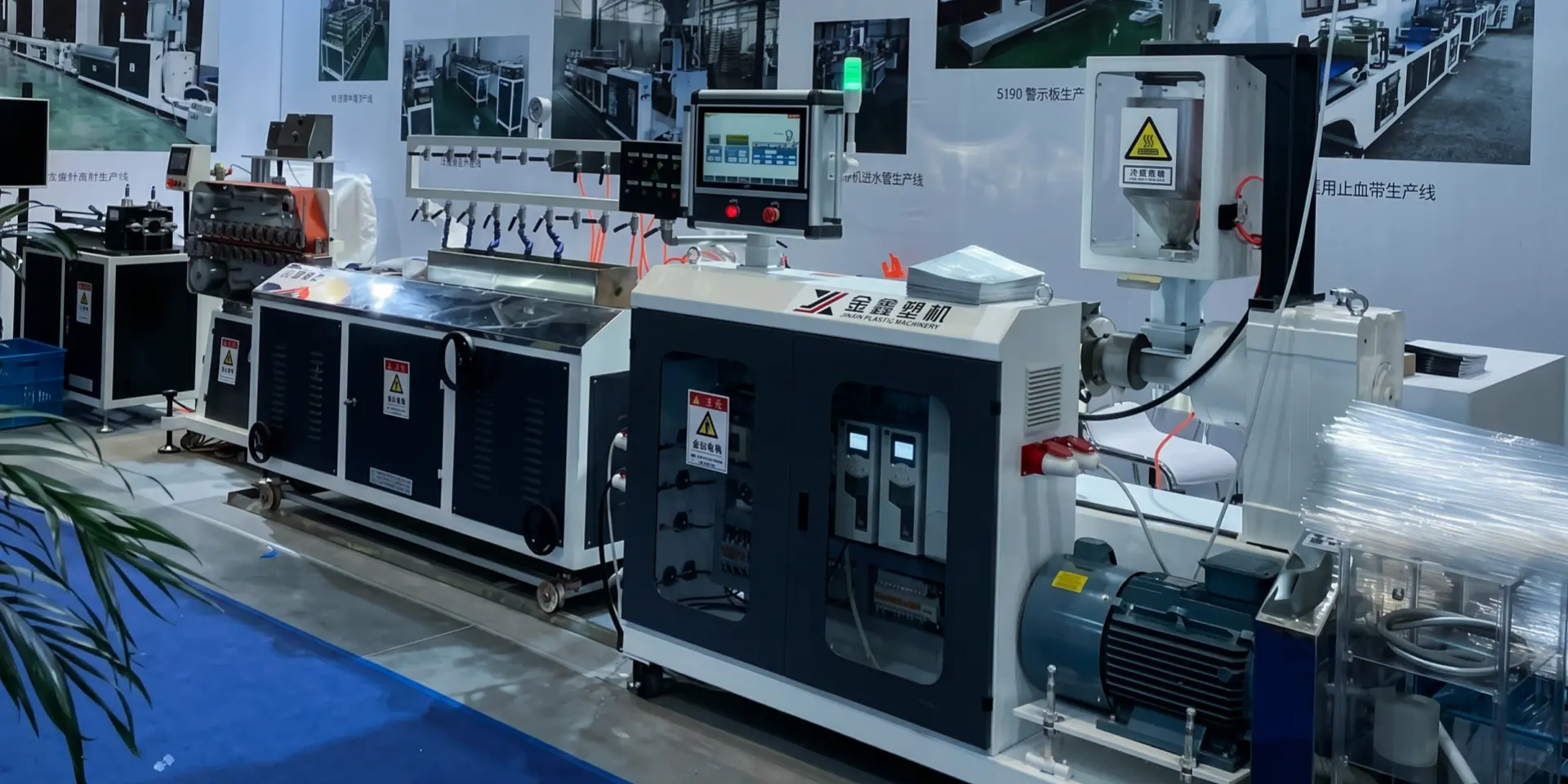
Our extrusion line work is focused on product-based configuration. Instead of treating output as a flat kg/h figure, we review the buyer’s sample, drawing, material and quality target first. Output is confirmed against the product, not guessed from the extruder model alone. Product size, material, layer or wall structure and downstream speed all affect the final configuration.
Typical Jinxin single screw extrusion line projects include:
- PPR, PE and PP pipe extrusion lines
- Dip tube extrusion lines for small precision tubes
- PVC braided hose and smooth shower hose extrusion lines
- Plastic profile extrusion lines for PP, PE, ABS, TPU and selected PVC pellet compounds
- PC and PMMA optical profile extrusion lines
- TPE tourniquet and elastic band extrusion lines
- PU and TPU tube projects where the product and material fit the line scope
Depending on the product, a configured line may use SJ55, SJ65 or another suitable single screw platform. Final selection depends on product size, material behavior, output target, cooling path and downstream handling.
For standard configured projects, lead time is commonly around 50 to 60 days after the configuration and order scope are confirmed. Special tooling, unusual materials or additional automation can change the schedule.
If your product is a continuous plastic shape and you are not sure whether extrusion fits, send a drawing, sample photo or short product description through the Contact page. Jinxin can review the process route before recommending a line configuration.
Common Mistakes When Comparing Injection Molding and Extrusion
Mistake 1: Choosing by Machine Name Instead of Product Shape
The process should follow the product. A continuous profile should not be forced into injection molding only because the part is plastic. A complex 3D housing should not be forced into extrusion only because extrusion tooling looks cheaper.
Mistake 2: Comparing Only Machine Price
Machine price is only one part of the decision. Tooling, cooling, downstream handling, process testing, scrap rate, mold modification and production stability can change the real cost.
For extrusion, the full line matters: extruder, die, cooling, haul-off, cutting or winding, controls and factory testing.
For injection molding, the mold and process validation matter: mold design, cavity balance, cooling, cycle time and shrinkage control.
Mistake 3: Assuming Extrusion Can Make Any Shape
Extrusion is flexible, but it is not magic. It is strongest when the cross-section stays consistent. If the product needs changing thickness, enclosed 3D geometry, deep ribs, undercuts or detailed molded features, injection molding may be more realistic.
Mistake 4: Assuming Injection Molding Is Always More Precise
Injection molding can be very precise for molded parts, but precision always belongs to a specific product and process. Extrusion can also hold tight dimensional requirements when the line, die, cooling and haul-off are correctly matched.
The right question is not “which process is more precise?” It is “which process can hold the required tolerance for this product at this output target?”
Summary
Injection molding vs extrusion is mainly a product-shape decision.
Choose extrusion when you need continuous products with a consistent cross-section: pipe, tube, hose, profile, strip, sheet, film or cable coating. Choose injection molding when you need individual 3D parts with complex molded geometry.
From a buyer’s perspective, the most important step is to define the product clearly before asking for equipment. A drawing, sample, material grade, output target and quality requirement will quickly show whether the project belongs to extrusion, injection molding or another process entirely.
For extrusion projects, Jinxin can help review whether a single screw extrusion line is suitable and what configuration should be checked before quotation.
Frequently Asked Questions
Q1: What is the main difference between injection molding and extrusion?
Extrusion is a continuous process used for products with a consistent cross-section, such as pipes, tubes, profiles, hose and sheet. Injection molding is a cyclic process used for separate 3D parts, such as caps, housings, containers and molded components.
Q2: Is extrusion cheaper than injection molding?
For simple continuous shapes, extrusion often has lower tooling cost because it uses a die and sizing or calibration tooling rather than a full injection mold. However, total cost depends on product geometry, material, tolerance, line configuration, tooling complexity and production volume.
Q3: Which process is faster, extrusion or injection molding?
They are fast in different ways. Extrusion runs continuously, so it can be efficient for long products and steady output. Injection molding produces separate parts in cycles, and multi-cavity molds can make many parts per cycle. The faster process depends on the product and production target.
Q4: Which process gives better quality?
Neither process is automatically better. Extrusion quality depends on stable melting, die design, cooling, haul-off and line synchronization. Injection molding quality depends on mold accuracy, filling, cooling, shrinkage control and cycle repeatability. The better process is the one that fits the product shape and quality requirement.
Q5: Can extrusion make hollow products?
Yes. Extrusion can make many hollow or tubular products, including pipes, tubes, hose and certain hollow profiles. The die, sizing method, cooling and haul-off system must be matched to the product geometry and material.
Q6: Can one extrusion line process different materials?
Sometimes, but it depends on the material family, product size, screw design, temperature range, die, cooling method and quality target. A line configured for PC and PMMA optical profiles is different from a line configured for soft TPE bands or PPR pipes. Material compatibility should be reviewed before quotation.
Q7: Should I choose a single screw or twin screw extruder for extrusion?
For many pellet-based pipe, tube, hose and profile applications, a single screw extruder is practical and economical. Twin screw extruders are usually considered when the material is powder-based, heavily filled, recycled, variable or requires stronger mixing. See Jinxin’s guide to single screw extruder vs twin screw extruder.
Q8: How long does it take to build a custom extrusion line?
For many configured Jinxin single screw extrusion line projects, lead time is commonly around 50 to 60 days after the configuration and order scope are confirmed. Special tooling, unusual materials, added automation or a larger testing scope can change the schedule.
Q9: What information should I send before requesting an extrusion line quotation?
Send a product drawing or sample photo, material grade, size range, tolerance requirement, surface requirement, output target, cutting or winding method and factory voltage. If the material is special or modified, sending a material sample for testing may help confirm the line configuration.
Q10: What extrusion problems should buyers consider before choosing a line?
Common extrusion risks include unstable output, wall thickness variation, ovality, rough surface, bubbles, black specks and poor synchronization between extruder output and haul-off speed. For troubleshooting logic, see Jinxin’s plastic extrusion troubleshooting guide.
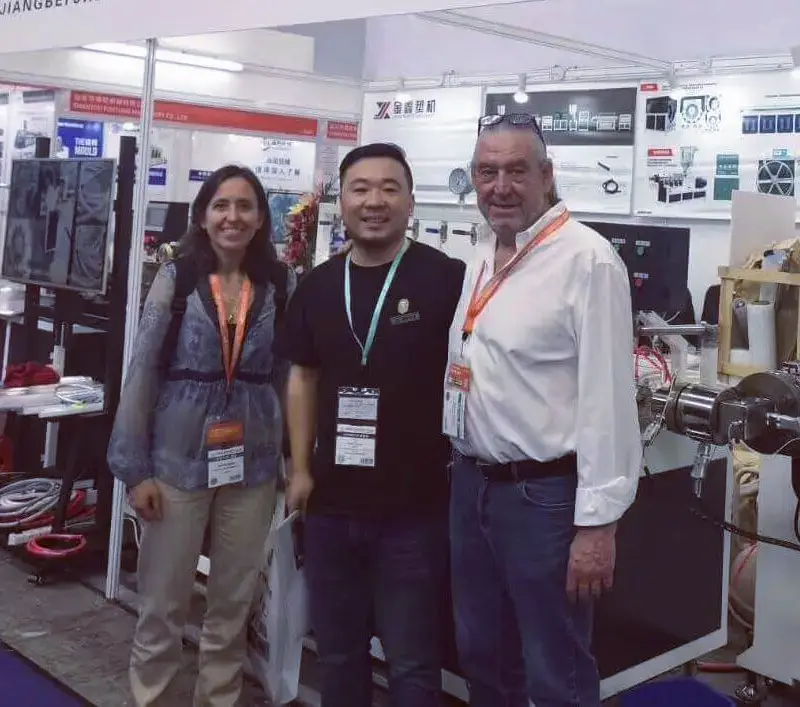
Jason Shen
Founder and Lead Engineer, Jinxin ExtruderJason Shen leads Jinxin Extruder's single screw extrusion line projects, with hands-on experience in machine configuration, tooling adjustment, factory testing and extrusion troubleshooting.
Inquiry
Email Your Line Requirements
For an accurate quotation, include your target product, material, size range, expected output, factory voltage and any product drawing or sample requirements.