
Choosing between a single screw extruder and a twin screw extruder is not a question of which machine is more advanced. It is a question of which screw system fits the material, the mixing duty and the production goal.
For stable pellet materials that are already compounded, a single screw extruder is often the better practical choice. It melts, conveys and builds pressure with lower complexity. For powders, recycled feedstock, filler-heavy recipes or processes that need stronger internal mixing, a twin screw extruder may be justified.
Quick Answer
Use a single screw extruder when the material is pelletized, consistent and already compounded, and when the line mainly needs stable melting, pressure and output.
Use a twin screw extruder when the process needs stronger mixing, powder feeding, devolatilization, additive dispersion or better tolerance for variable materials.
The common mistake is to treat twin screw as “better” and single screw as “basic.” In real extrusion lines, the better machine is the one that solves the actual processing problem without adding unnecessary cost, cleaning, wear and operator burden.
Single Screw vs Twin Screw Comparison Table
| Decision factor | Single screw extruder | Twin screw extruder |
|---|---|---|
| Best feed form | Pellets and granules | Powders, dry blends, variable feed |
| Main strength | Stable melting, conveying and pressure | Mixing, compounding and material control |
| Mixing level | Low to moderate | Moderate to high |
| Typical line | Pipe, tube, hose, profile, sheet from compounded pellets | Compounding, PVC powder, filled materials, recycling, masterbatch |
| Operation | Simpler to run and maintain | More flexible but more demanding |
| Cost logic | Lower machine and maintenance complexity | Higher cost justified by process need |
| Risk if misused | Poor mixing if recipe is too complex | Extra cost and complexity if mixing is not needed |
What a Single Screw Extruder Does Well
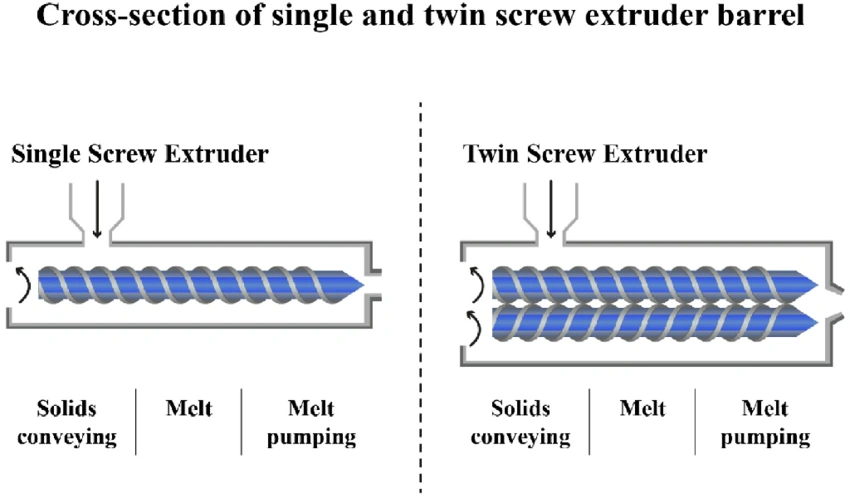
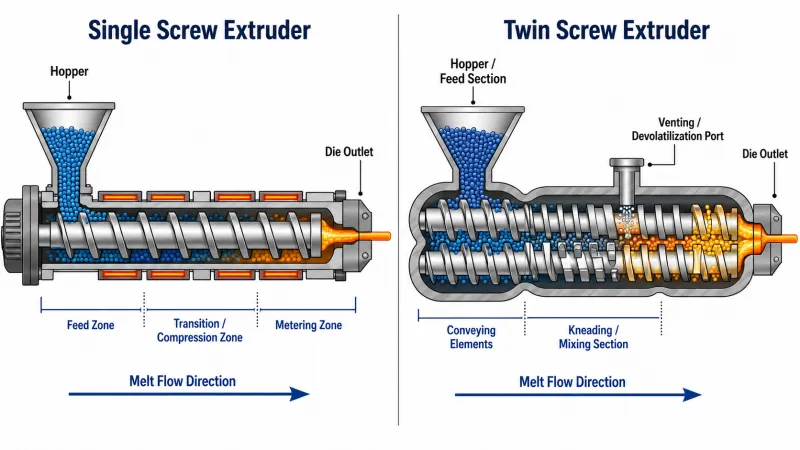
A single screw extruder uses one rotating screw inside a heated barrel. The screw conveys plastic from the hopper, melts it, compresses it and delivers a controlled melt stream to the die. In a conventional screw, the feed, transition and metering zones each support a different stage of the process.
For the basic machine layout, see Jinxin’s guide to what a plastic extruder machine is. A general polymer processing reference also describes how extrusion turns pellets or powder into a continuous melt stream before the die: Polymer extrusion.
Single screw extrusion works especially well when:
- the material is PE, PP, PC, TPE or another stable pellet material;
- the PVC is supplied as compounded pellets, not rigid dry-blend powder;
- the formulation is already mixed before extrusion;
- the product needs stable die pressure and continuous output;
- the factory values easier operation, lower maintenance and faster training.
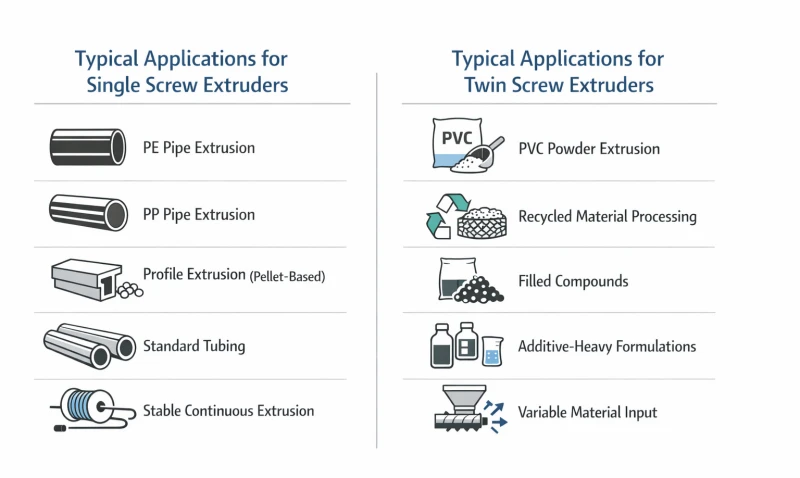
A typical application is the PPR pipe extrusion line, where pre-compounded PP-R pellets must feed the die, the calibration and the haul-off at a steady rate. For PP, PE, ABS, TPU or selected pelletized PVC profiles built to a drawing, a precision plastic profile extrusion line applies that single-screw logic with the die, sizing, cooling and haul-off matched to the product cross-section.
For many pipe, tube and profile lines, those conditions are exactly what the process needs.
What a Twin Screw Extruder Does Well
A twin screw extruder, sometimes called a double screw extruder, uses two screws inside a figure-eight barrel. Depending on the design, the screws may co-rotate or counter-rotate, intermesh or run with a different engagement pattern. The important point is not simply “two screws.” The important point is more active material control.
Twin screw systems are commonly selected when the process needs:
- stronger distributive or dispersive mixing;
- powder feeding, especially PVC dry blend;
- filler, pigment or additive incorporation;
- better handling of recycled or variable feedstock;
- venting or devolatilization;
- broader formulation flexibility.
That capability is useful, but it is not free. Twin screw machines are more complex, have more wear parts, need more process knowledge and often require more cleaning discipline.
Material Form Is Usually the First Decision
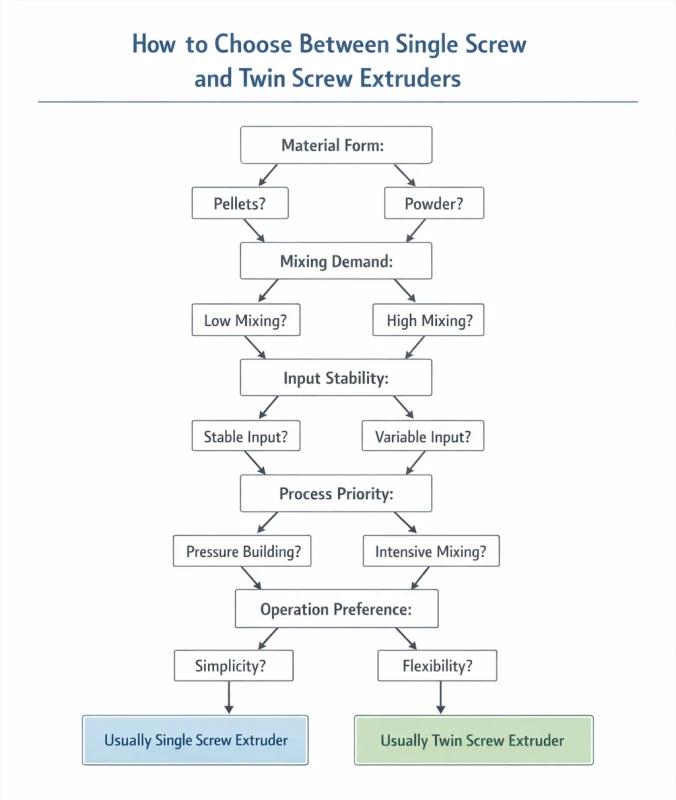
Start with the raw material. If it is a stable pellet or granule, a single screw extruder often has enough conveying and melting ability. If the material is powder, fluffy regrind, inconsistent recycled feed or a dry blend that needs intensive mixing, the decision moves toward twin screw.
This is why a PE pipe line and a PVC powder compounding line should not be evaluated with the same rule. One needs steady melt delivery to the die. The other may need controlled powder intake, plasticization and mixing before a stable melt exists.
Mixing Demand: Already Compounded or Mixed in the Extruder?
If the resin supplier or compounding stage already produced a uniform pellet, the extrusion line mainly has to remelt that material and deliver it steadily. A single screw extruder is often the efficient architecture.
If the extruder itself must combine base resin, fillers, stabilizers, pigments, modifiers or recycled material, twin screw becomes more relevant. The screws can create more mixing events and more controlled residence time.
This is also why “single screw vs twin screw” is not just an equipment question. It is a process-planning question: where will mixing happen, before the extrusion line or inside it?
Pressure, Die and Downstream Stability
In pipe, tube, hose and profile extrusion, output stability matters because the die and downstream section convert the melt into final geometry. A stable single screw extruder can be an advantage here because it builds pressure and delivers a steady melt to the forming tool.
The die and downstream equipment still decide a lot of final product quality. For a wider view of the line after the extruder, see downstream equipment in plastic extrusion and what an extrusion die does.
Twin screw extruders can also feed downstream equipment, but they are often chosen for what happens inside the barrel: mixing, compounding, powder handling or devolatilization. If the line does not need those functions, the extra complexity may not pay back.
When Single Screw Is Usually the Better Choice
Choose a single screw extruder when the process looks like this:
- stable pellets or granules;
- pre-compounded material;
- pipe, tube, hose, profile, strip or sheet production;
- priority on steady output and pressure;
- lower maintenance and easier operation are important;
- the plant does not need the extruder to do heavy compounding.
For complete pellet-based production systems, review Jinxin’s custom single screw extrusion lines for pipe, tube, hose, profile and TPE band production.
The PVC braided hose extrusion line illustrates the same choice: several extrusion and reinforcement steps must stay synchronized around a stable pellet feed.
Jinxin focuses on single screw extrusion for this reason: many customers need stable lines for pellet-based plastic products, not a universal compounding machine. The boundary matters. If your raw material is rigid PVC powder or a complex dry blend, Jinxin should tell you that a twin screw solution is normally more suitable, not force the wrong architecture. See why Jinxin focuses on single screw extrusion.
If the product shape itself is still uncertain, compare injection molding vs extrusion before choosing screw architecture.
When Twin Screw Is Justified
Twin screw is justified when the material or formulation needs what a single screw is not designed to provide:
- PVC powder or dry blend;
- high filler loading;
- color masterbatch or additive compounding;
- recycled material with changing bulk density or melt behavior;
- process steps that require intensive mixing, venting or reactive processing.
For those jobs, twin screw is not “overkill.” It is the processing tool that matches the duty. The risk is only when it is selected for a simple pellet-based line where the extra capability does not create real production value.
Cost and Operation
Do not compare only the machine price. The real cost comparison includes:
- screw and barrel wear;
- cleaning time;
- operator training;
- spare parts;
- power and maintenance;
- downtime after material changes;
- whether the plant can actually use the extra flexibility.
A single screw extruder usually has a lower operating burden. A twin screw extruder can be worth the cost when it prevents poor mixing, unstable feeding or product inconsistency. The wrong choice is the machine whose capability does not match the process.
Practical Selection Checklist
Before choosing, answer these questions:
- Is the material pellet, powder, regrind or dry blend?
- Is the formulation already compounded?
- Does the extruder need to mix additives or fillers?
- Is the product mainly pipe, tube, hose, profile, sheet or a compound?
- Is stable die pressure more important than internal mixing?
- Can the operators manage the higher complexity of twin screw?
If most answers point to stable pellets and continuous forming, single screw is usually the practical route. If most answers point to powder, mixing and formulation control, twin screw deserves serious evaluation.
Conclusion
There is no universal winner in the single screw extruder vs twin screw extruder decision. Single screw is often the better choice for stable pellet-based extrusion lines. Twin screw is better when the process needs stronger mixing, powder handling, compounding or more material-control flexibility.
The right extruder is not the more complicated one. It is the one whose screw architecture matches the material and the product.
If you are choosing equipment for a pipe, tube, hose or profile line, contact Jinxin with your material form, product size and output target. The first step is deciding whether single screw is truly the right process path.
FAQ
What is the main difference between a single screw extruder and a twin screw extruder?
A single screw extruder uses one screw and is usually better for stable pellet-based extrusion. A twin screw extruder uses two screws and is usually better for mixing-intensive, powder-based or formulation-heavy processing.
Is a twin screw extruder always better?
No. Twin screw offers more mixing and material-control capability, but it also adds cost and complexity. For many pipe, tube and profile lines using stable pellets, single screw is more suitable.
When should I choose a single screw extruder?
Choose single screw when the material is already compounded, feeds consistently and the line mainly needs stable melting, pressure and output.
When should I choose a twin screw extruder?
Choose twin screw when the material is powder, recycled, variable, highly filled or needs additive dispersion, devolatilization or compounding inside the extruder.
Which extruder is better for PVC powder?
Rigid PVC powder or dry blend usually points toward a twin screw extruder, often a conical twin screw design. Pelletized PVC compounds can often be processed by single screw depending on the formulation and product.
Which extruder is better for PE or PP pipe extrusion?
For standard PE or PP pipe extrusion from stable pellets, a single screw extruder is usually the practical choice because it provides steady melting, pressure and output with lower complexity.
What are the 4 types of extrusion?
In general polymer processing, common extrusion categories include pipe or tube extrusion, profile extrusion, sheet or film extrusion, and coating or jacketing extrusion. The single screw vs twin screw decision is separate from these product categories: it depends on the material form and mixing duty behind the product.
Jason Shen
Founder and Lead Engineer, Jinxin ExtruderJason Shen leads Jinxin Extruder's single screw extrusion line projects, with hands-on experience in machine configuration, tooling adjustment, factory testing and extrusion troubleshooting.
Inquiry
Email Your Line Requirements
For an accurate quotation, include your target product, material, size range, expected output, factory voltage and any product drawing or sample requirements.