
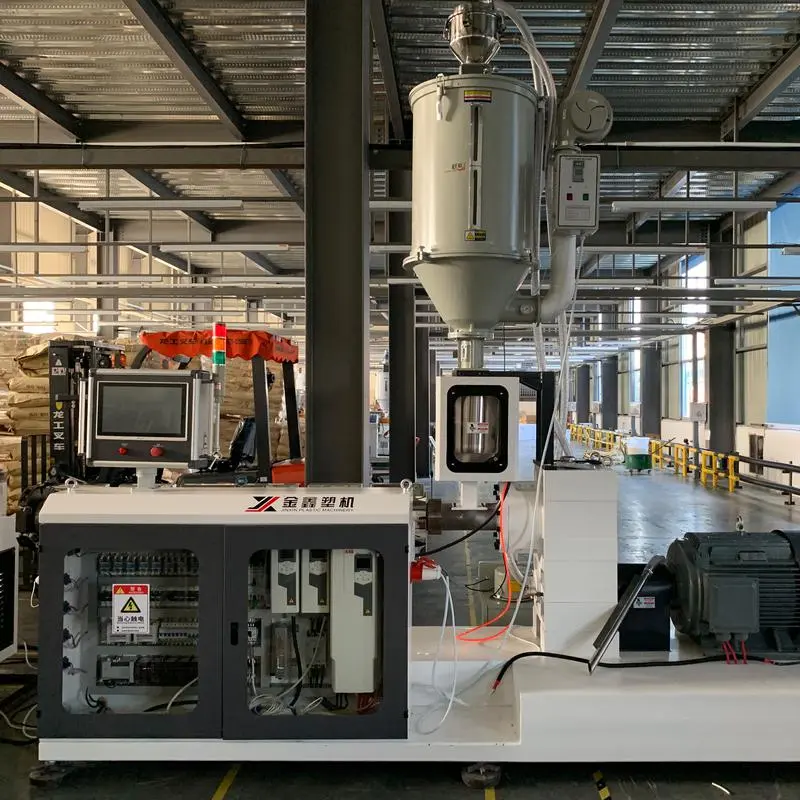
A plastic extruder machine is an industrial manufacturing device that melts, mixes and pushes plastic material through a shaped die to create continuous products such as pipes, tubing, profiles, sheets, films and wire insulation. In a typical setup, plastic pellets, granules, powder or flakes enter through a hopper, move through a heated barrel by a rotating screw, pass through a die, then cool into a stable shape.
This guide focuses on plastic extruder machines for thermoplastic processing. It does not cover food extruders, metal extrusion equipment or 3D printer extruders. Those machines share the broad idea of forcing material through an opening, but the materials, machine design and production goals are different.
If you first need the process definition before the machine details, start with the guide to what plastic extrusion is.
If you are asking “what is an extruder machine?” from a sourcing or production angle, the useful question is not only what the machine does. It is whether the machine can deliver a stable melt, steady pressure and repeatable dimensions over a real production run.
Quick Summary
Definition: a plastic extruder machine melts and pressurizes thermoplastic material, then forces the melt through a die to form a continuous shape.
Core parts: hopper, feed throat, heated barrel, rotating screw, die, cooling system, haul-off and cutting or winding equipment.
Common outputs: pipe, tube, profile, sheet, film, hose, cable coating and continuous plastic strips.
Why buyers care: the right extruder helps stabilize output, melt quality, pressure behavior and final product dimensions.
Plastic Extruder Machine Diagram
A diagram is often the fastest way to understand how a plastic extruder machine works. The machine is not just a heated tube. It is a controlled system that feeds material, melts it, builds pressure, shapes it through a die and supports cooling and pulling after the die.
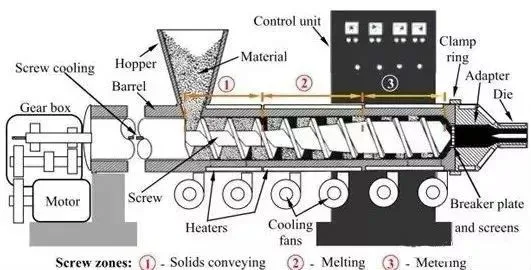
The main machine section includes four parts:
- Hopper: receives pellets, granules, powder, flakes or a prepared compound.
- Heated barrel: provides the controlled environment where material is conveyed, heated and compressed.
- Extruder screw: moves the material forward, helps melt it, mixes it and builds pressure.
- Die: gives the molten plastic its initial cross-sectional shape.
After the die, equipment such as cooling tanks, calibration tools, haul-off units, cutters and winders turns the hot extrudate into a usable product. For the full equipment layout, see the guide to plastic extrusion line categories.
How Does a Plastic Extruder Machine Work?
A plastic extruder machine works through a continuous sequence. The exact design changes by material and product, but the core working principle is usually the same.
1. Feeding through the hopper
Plastic material enters the hopper, then moves into the feed throat of the barrel. Stable feeding is important because inconsistent material flow can create output fluctuation, pressure swings and dimensional variation later in the line.
Common feed forms include:
- thermoplastic pellets or granules;
- PVC or other plastic powder;
- recycled flakes;
- filled compounds or masterbatch blends.
Material form matters. A machine that runs well on pellets may not be the right choice for powder or heavily filled compounds.
2. Melting and conveying in the heated barrel
Inside the barrel, the screw rotates and conveys material forward. External heaters raise the barrel temperature, while screw rotation creates shear and friction. Together, these forces turn solid plastic into a processable melt.
The goal is not simply to make the plastic hot. A good extruder must create a melt that is consistent enough in temperature, pressure and mixing quality to support stable production.
3. Screw zones: feed, transition and metering
Most single-screw plastic extruders are described by three functional screw zones:
- Feed zone: accepts and conveys solid material from the hopper.
- Transition or compression zone: compresses the material and completes most of the melting.
- Metering zone: evens out the melt and delivers it toward the die at a more stable rate.
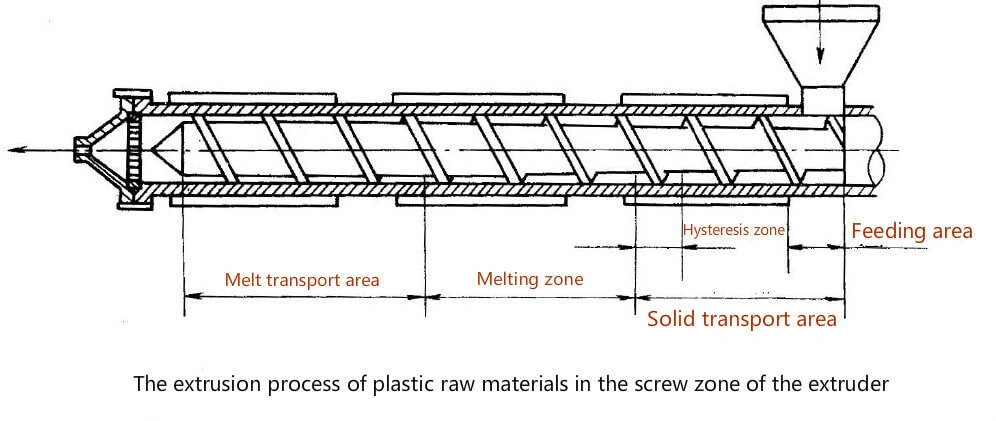
Screw design affects melt quality, output stability and the range of materials the machine can process. This is why a plastic extruder should not be selected only by motor power or barrel diameter.
4. Pressure development and die shaping
At the front of the barrel, the melt is pressurized and pushed through the die. The die is the shaped metal tool that defines the starting cross-section of the product, such as a pipe annulus, a profile opening, a sheet gap or a coating path for wire.
The die does more than form the shape. It also creates flow resistance, which affects head pressure and melt delivery. If flow is poorly balanced, the product may show uneven thickness, flow marks or unstable dimensions. For die types, flow balance, die land and their effect on quality, see our guide to the plastic extrusion die.
5. Cooling, haul-off and finishing
The hot product leaving the die is still soft. It must be cooled, supported and pulled at a controlled speed. Cooling may use water baths, air cooling, vacuum calibration, rolls or product-specific fixtures.
The haul-off or puller controls line speed. If the extruder output and haul-off speed are not synchronized, the product can become too thin, too thick, oval, warped or unstable. Cutting or winding then turns the continuous product into lengths, coils or rolls.
Main Components of a Plastic Extruder Machine
| Component | What it does | Buyer check |
|---|---|---|
| Hopper and feed throat | Introduce raw material into the barrel | Material form, bridge risk, drying or feeding needs |
| Barrel | Houses the screw and heating zones | Temperature control, wear resistance, cooling at feed throat |
| Screw | Conveys, melts, mixes and pressurizes material | L/D ratio, compression ratio, material compatibility |
| Heaters and controls | Manage thermal profile | Zone control accuracy and sensor reliability |
| Breaker plate / screen changer | Helps filter contaminants and support melt flow | Useful for recycled or contamination-sensitive material |
| Die | Shapes the melt into the starting product section | Flow balance, die material, maintenance access |
| Cooling and haul-off | Stabilize dimensions after the die | Cooling capacity, alignment, speed synchronization |
The extruder itself is only one part of the result. In production, the barrel, screw, die, cooling, haul-off and controls must work together.
Types of Plastic Extruder Machines
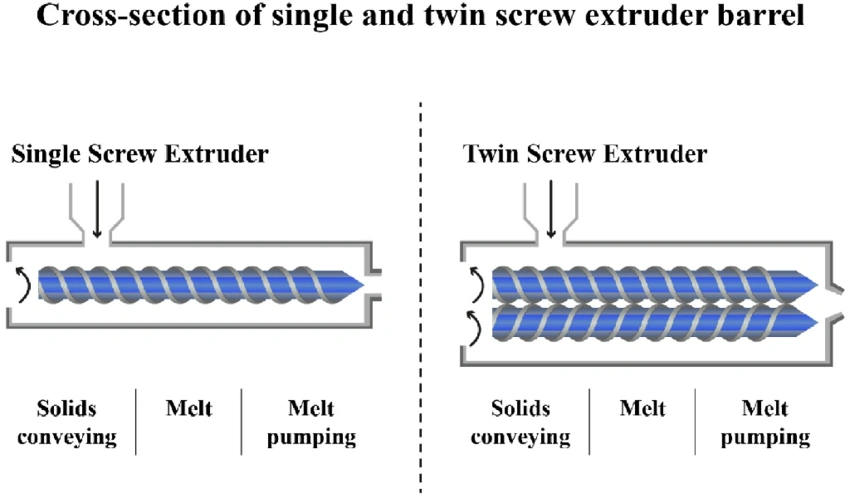
Single-screw extruder
A single-screw extruder uses one rotating screw. It is common for standard pellet-based applications such as pipe, tubing, profiles, sheet and film. For many stable thermoplastic materials, it is practical and economical.
Twin-screw extruder
A twin-screw extruder uses two screws, either co-rotating or counter-rotating depending on the design. It is often considered when stronger mixing is required, such as PVC powder, filled compounds, color and additive mixing, recycling or materials that need more controlled plastification.
For a deeper comparison, see the guide to single screw extruder vs twin screw extruder.
Ram, multi-screw and co-extrusion systems
Some specialized applications use ram extruders, multi-screw machines or multiple extruders feeding one die. These are more specific cases. For most plastic pipe, profile, hose and sheet projects, the key starting choice is usually single-screw versus twin-screw, followed by the line configuration around the product.
Granules vs Powder: Why the Feed Form Matters
One of the first questions in extruder selection is simple: are you using granules, pellets, powder, flakes or a prepared compound?
The answer changes the machine recommendation.
| Material form | Common implication |
|---|---|
| PE, PP or pre-compounded PVC pellets | Often suitable for single-screw extrusion |
| PVC dry blend or powder | Often points toward twin-screw extrusion |
| Recycled flakes | May require feeding, filtration and melt-quality checks |
| Filled or variable compounds | May require stronger mixing and careful screw selection |
This is not just a technical detail. If the raw material form is wrong for the machine, the line may struggle with unstable feeding, incomplete melting, poor mixing or inconsistent output.
What Can Plastic Extruder Machines Produce?
Plastic extruder machines are used when the product is continuous or has a constant cross-section. Common products include:
- pipes and tubing;
- hoses;
- window and industrial profiles;
- sheet and film;
- cable and wire insulation;
- sealing strips, bands and flexible profiles;
- plastic coating or continuous compound forms.
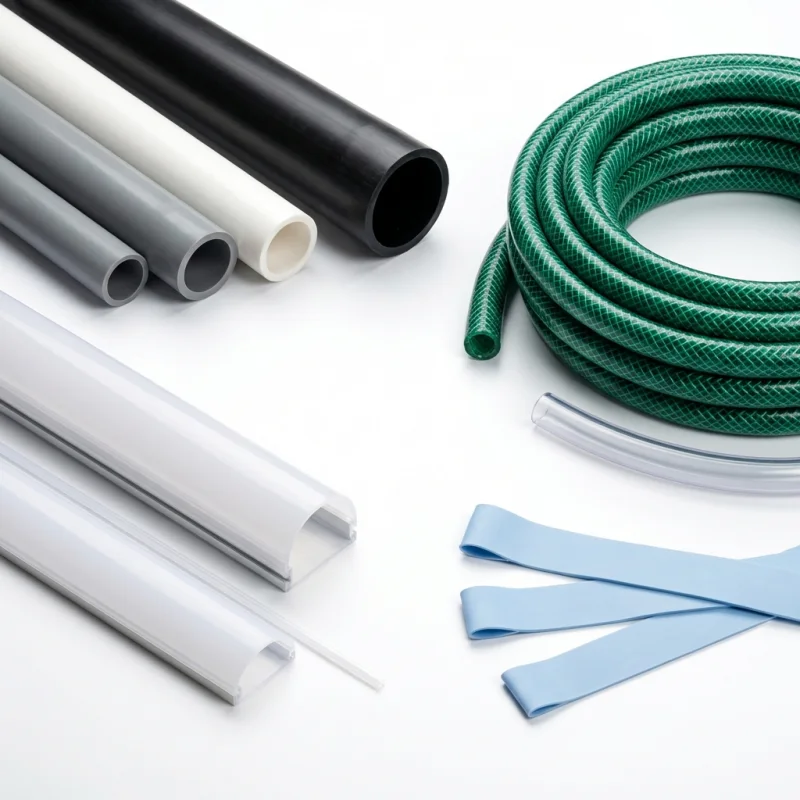
When a PP, PE, ABS or TPU profile must match a drawing, tolerance and surface requirement, the extruder alone is not enough: a precision plastic profile extrusion line combines the single screw, drawing-matched die, sizing, cooling, haul-off and cutting around that product.
If you are still comparing whether a product should be extruded or molded, see injection molding vs extrusion. In short, extrusion fits continuous shapes; injection molding fits separate 3D parts made in cycles.
What Buyers Should Prepare Before Requesting an Extruder
To evaluate a plastic extruder machine correctly, prepare the production facts first:
- product drawing or sample photo;
- material type and feed form: pellets, powder, flakes, recycled material or compound;
- target product size and tolerance;
- surface requirement: gloss, transparency, texture, scratch control;
- expected output: kg/h, m/min, rolls per day or length per shift;
- whether the project is a new line or an upgrade;
- equipment after the die: cooling, calibration, haul-off, cutting, winding or stacking;
- factory voltage, space and operating conditions.
For a machine definition page, it is better not to judge the project by a single budget number first. The correct machine depends on material, product geometry, output target and line configuration. You can send these details through the Contact page for a project review.
Maintenance and Operation
Routine maintenance helps keep output stable and reduces unplanned downtime. Important checks include:
- screw and barrel wear;
- heater bands and thermocouples;
- gearbox oil level and temperature;
- screen changer condition;
- die cleaning and assembly;
- alignment between die, cooling tank and haul-off;
- electrical cabinet and control signals.
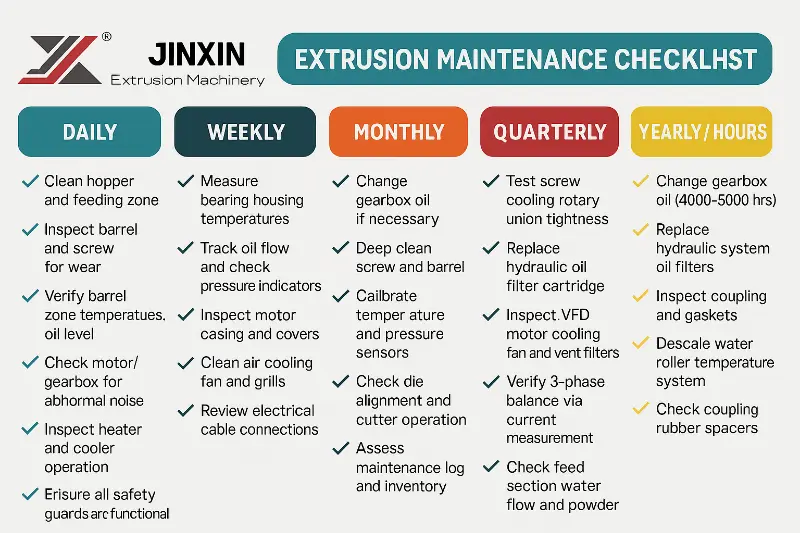
Maintenance matters because a worn screw, unstable heater, contaminated die or misaligned haul-off can make a capable machine produce poor product.
Frequently Asked Questions
What is a plastic extruder machine used for?
A plastic extruder machine is used to melt and form thermoplastic material into continuous shapes. Typical products include pipes, tubing, profiles, sheet, film, hose, cable insulation and continuous plastic strips.
What are the main parts of a plastic extruder machine?
The main parts are the hopper, feed throat, heated barrel, screw, heaters, controls, die and the equipment after the die such as cooling, haul-off, cutting or winding. The screw, barrel and die are especially important for melt quality and shape control.
What are the three zones of an extruder screw?
The three common screw zones are the feed zone, transition or compression zone and metering zone. The feed zone conveys solid material, the transition zone melts and compresses it, and the metering zone delivers a more even melt toward the die.
How does a plastic extruder machine work?
It feeds plastic material into a heated barrel, uses a rotating screw to melt, mix and pressurize the material, pushes the melt through a shaped die, then cools and pulls the continuous product before cutting or winding it.
What is the difference between a single-screw and twin-screw extruder?
A single-screw extruder uses one screw and is common for many pellet-based pipe, profile, sheet and film applications. A twin-screw extruder uses two screws and is often chosen for stronger mixing, PVC powder, filled compounds, recycling or more difficult materials.
What is the difference between extrusion and injection molding?
Extrusion produces continuous shapes with a constant cross-section. Injection molding produces separate 3D parts in cycles inside a closed mold. For a full process comparison, see injection molding vs extrusion.
How much does a plastic extruder machine cost?
The cost depends on material, screw and barrel size, single-screw or twin-screw design, output target, die, controls and the equipment required after the die. A realistic budget review usually needs a drawing or sample, material information, output target and factory conditions.
Conclusion
A plastic extruder machine is the core equipment that turns thermoplastic material into continuous products. The machine must feed material steadily, create a stable melt, build pressure, shape the melt through a die and work with cooling and haul-off equipment after the die.
For a buyer, the best question is not only “what is an extruder machine?” It is whether the machine, die and line configuration can hold the product dimensions and surface quality required for real production.
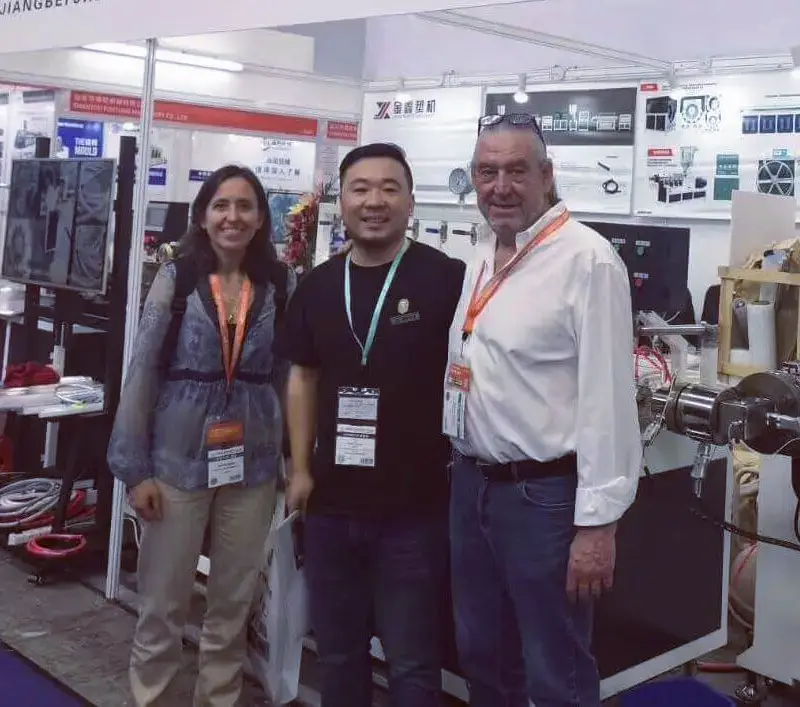
Jason Shen
Founder and Lead Engineer, Jinxin ExtruderJason Shen leads Jinxin Extruder's single screw extrusion line projects, with hands-on experience in machine configuration, tooling adjustment, factory testing and extrusion troubleshooting.
Inquiry
Email Your Line Requirements
For an accurate quotation, include your target product, material, size range, expected output, factory voltage and any product drawing or sample requirements.