
A plastic extrusion die is the forming tool installed at the end of an extruder. The screw and barrel melt the polymer and build pressure; the die turns that melt flow into the first shape of a pipe, tube, profile, sheet, coating or other continuous product.
This article is about plastic extrusion tooling, not aluminum or metal extrusion dies. That distinction matters because broad “extrusion die” searches often mix plastic processing with aluminum profile manufacturing.
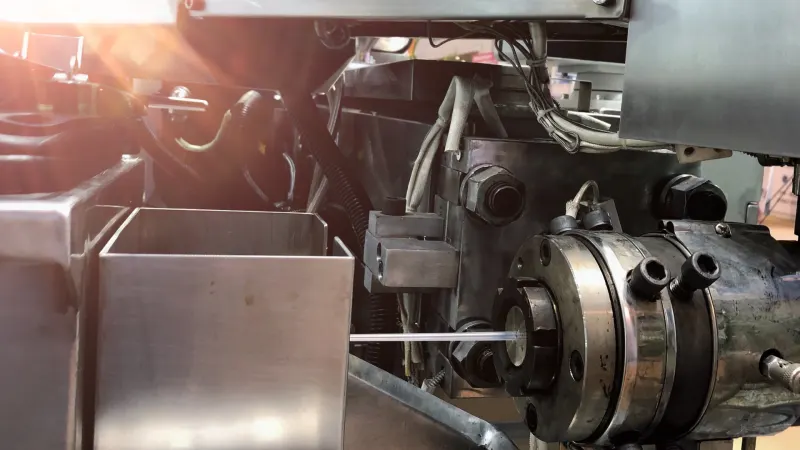
Quick Answer: What Does an Extrusion Die Do?
An extrusion die shapes molten plastic as it leaves the extruder. It controls the initial cross-section, flow distribution and surface exit of the product. It does not finish the product alone. Final dimensions also depend on die swell, draw-down, calibration, cooling, haul-off speed and line alignment.
In a complete line, the die sits between the plastic extruder machine and the downstream equipment. The extruder creates a stable melt. The die gives that melt a controlled shape. The downstream section fixes the shape while it cools.
What the Die Controls and What It Does Not Control
A die controls the melt path before the plastic exits the machine. Its internal geometry affects how evenly material reaches different parts of the opening.
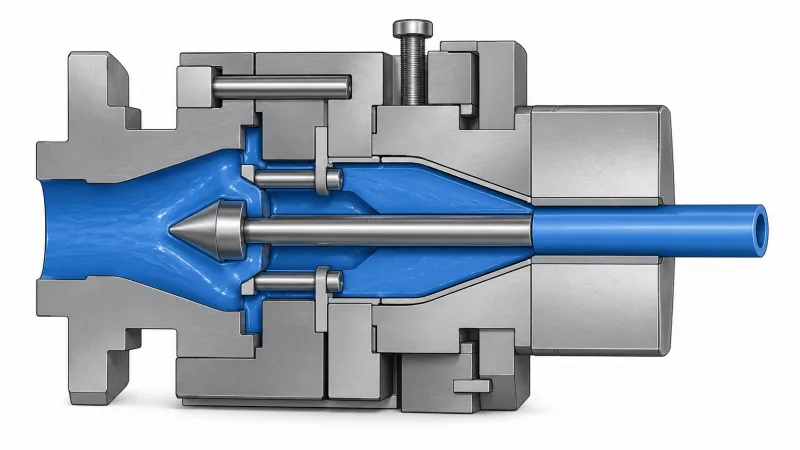
The die mainly controls:
- the first cross-section of the extrudate;
- melt distribution around the opening;
- wall thickness tendency before sizing;
- surface condition at the die lips;
- pressure drop and flow stability.
It does not fully control the finished size. Hot plastic expands after the die, then it is pulled, cooled and calibrated. A pipe die may create a round melt tube, but the final outside diameter and roundness still depend on the vacuum calibration tank, cooling length and haul-off stability.
This is why a die problem and a downstream problem can look similar. Uneven wall thickness may come from poor die balance, unstable output, a worn calibrator or a puller speed mismatch.
Flow Balance, Die Land and Die Lips
Flow balance is one of the most important die quality issues. If melt reaches one side of the die faster or under different pressure, the product can leave the die thicker on one side and thinner on the other.
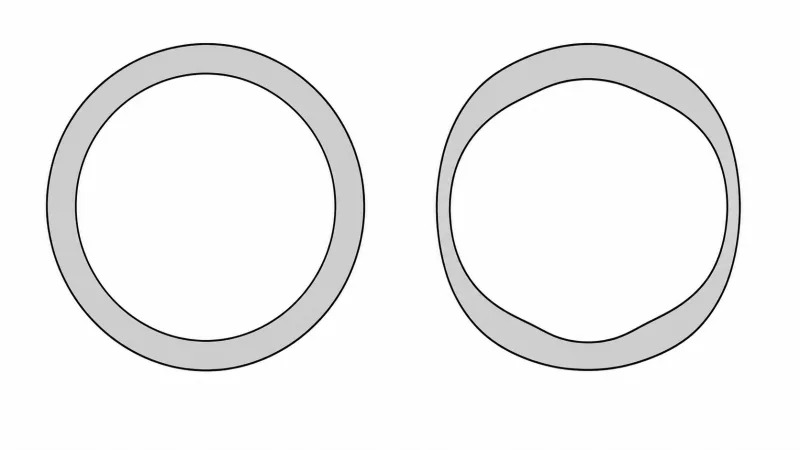
The die land is the straight section near the exit that stabilizes the shape before the melt leaves the tool. Too little land may give poor dimensional stability. Too much land can add pressure and shear heat. Die lips, especially on sheet or flat dies, affect the final gap and surface exit.
For pipes and tubes, flow balance helps reduce eccentric wall thickness and ovality. For profiles, it helps prevent one leg, rib or thin section from moving faster than the rest. For sheet, it helps control cross-direction thickness.
Common Types of Plastic Extrusion Dies
Different products need different die structures. The die has to match the polymer, product geometry, line speed and downstream configuration.
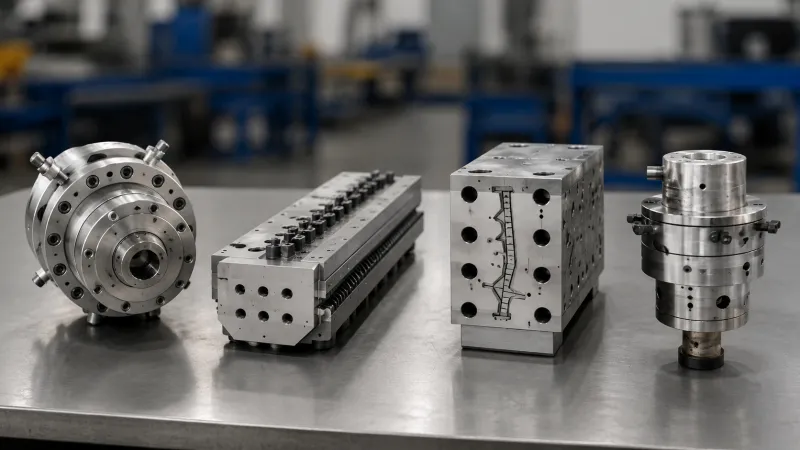
| Die type | Typical product | Key point |
|---|---|---|
| Pipe or tube die head | PVC, PE, PP-R, PC or soft tube | controls annular melt flow and wall balance |
| Profile die | window profile, strip, custom shape | balances thick and thin sections in one profile |
| Sheet or flat die | sheet, plate, film-related products | controls width direction flow and lip gap |
| Coating or cable die | wire, cable, coated tube | centers the core and distributes melt around it |
The real die photo above is a pipe or tube die head. The other images are engineering illustrations to explain die structure and quality logic across product types.
How Jinxin Matches Die Tooling by Product Type
In a real quotation, Jinxin does not select a die from a generic catalog. The die is matched to the finished product, material behavior and downstream method.
For a PPR pipe line, the die must work with vacuum calibration sleeves, spray cooling and haul-off speed so the pipe can hold OD, roundness and wall balance. For dip tubes, the tooling is smaller and the key issue is stable inner flow and clean entry into sizing and cutting. For PVC braided hose or smooth shower hose, the inner tube die and coating die must leave enough process window for yarn reinforcement, layer bonding and surface finish. For PC or PMMA profiles, the die must support stable flow, surface quality and later calibration without creating visible flow marks.
For a drawing-defined PP, PE, ABS or TPU profile, the die on a precision plastic profile extrusion line must balance thick and thin sections, then work with the selected free-sizing or vacuum-calibration route, cooling and haul-off.
For smooth, single-layer medical tubing, the die and mandrel on a soft PVC tube extrusion line are matched to OD, ID, wall thickness, compound hardness, and the selected cutting or winding format.
This is also why an extrusion project should not be judged by die price alone. When buyers compare extrusion with other production routes, the tooling scope is part of the decision. For that broader process comparison, see injection molding vs extrusion.
How Die Problems Show Up in Product Quality
Die-related problems usually appear as repeated, directional or shape-specific defects:
- one side of a pipe wall is consistently thicker;
- a tube becomes oval before calibration can correct it;
- profile corners deform or thin sections pull faster;
- surface lines appear near a damaged die lip;
- output becomes unstable after a die change;
- pressure rises because material is stuck inside the flow channel.
Before changing the die, operators should separate die causes from material, temperature, screen pack, calibration and haul-off causes. A good troubleshooting path starts with where the defect first appears: before cooling, inside calibration, after the puller or only after cutting.
Design, Cleaning and Maintenance Are Different Topics
Die design is about flow path, land length, lip gap, material choice and product geometry. Die maintenance is about cleaning, inspection, storage and reuse. They are connected, but they are not the same workflow.
For maintenance details, see extruder die maintenance. For a broader example of polymer die categories, Nordson also lists several extrusion and coextrusion die types.
If you are planning a new pipe, tube or profile extrusion line, treat the die as part of the whole system. The best die still needs the right extruder output, calibration, cooling and pulling setup. To discuss a complete plastic extrusion line, contact Jinxin.
FAQ
Is the extrusion die included in a complete extrusion line?
For a configured Jinxin extrusion line, the confirmed die or die set is part of the line scope. Extra sizes, special profiles or additional calibration tooling should be listed separately in the quotation.
Can one extrusion die make every product size?
No. A die is matched to a product shape and size range. Small adjustments are possible through calibration and process settings, but different diameters, wall structures or profile shapes normally require separate tooling.
Why does die design affect wall thickness?
The die controls how melt is distributed before the product exits the tool. If flow is unbalanced, one side can leave the die thicker or under different pressure, and downstream equipment may not fully correct it.
What is die land in extrusion?
Die land is the straight section near the die exit that helps stabilize the melt shape. Too little land can reduce dimensional stability, while too much land can raise pressure and shear heat.
Is a die problem the same as a downstream problem?
No. Die problems often start at the melt exit, while downstream problems appear during calibration, cooling, haul-off or cutting. The same finished defect may need both areas checked.
Jason Shen
Founder and Lead Engineer, Jinxin ExtruderJason Shen leads Jinxin Extruder's single screw extrusion line projects, with hands-on experience in machine configuration, tooling adjustment, factory testing and extrusion troubleshooting.
Inquiry
Email Your Line Requirements
For an accurate quotation, include your target product, material, size range, expected output, factory voltage and any product drawing or sample requirements.