
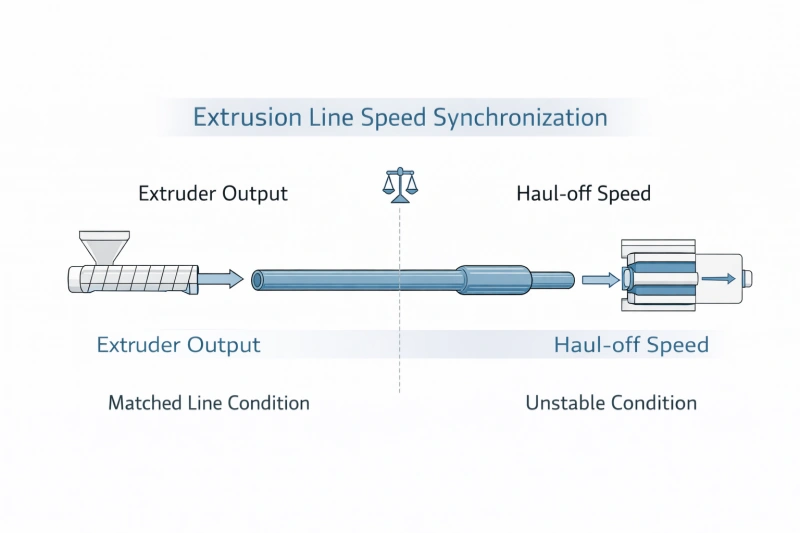
Extruder output and haul-off speed synchronization is the relationship that decides how much plastic is placed into each meter of product. The extruder delivers molten polymer through the die. The haul-off pulls the shaped product through sizing, cooling and cutting. If those two sides do not match, wall thickness, outer diameter, meter weight and product stability move immediately.
This topic is easy to underestimate because both machines may look normal on the HMI. Screw RPM may be stable. Haul-off speed may be stable. But if the amount of melt entering the line no longer matches the pulling speed, the product receives too much or too little material per meter.
That is why synchronization is not just a speed setting. It is a production condition that must be checked whenever operators change output, line speed, material, cooling or product size.
Quick Answer
Extruder output sets how much molten plastic enters the die per minute. Haul-off speed sets how fast the cooled product is pulled away. When output and haul-off speed are synchronized, each meter of pipe or profile receives a consistent amount of material.
If haul-off speed increases while output stays the same, the product is stretched. Wall thickness and meter weight fall, and OD may shrink. If output increases or haul-off speed is too slow, more material is packed into each meter. Wall thickness and meter weight rise, and the product may sag, bulge or become unstable before it is fully cooled.
On a small soft or semi-soft tube, the same mismatch can quickly shift OD, ID, wall thickness, and cut-length stability; a configured soft PVC tube extrusion line therefore matches melt output, cooling, haul-off, and cutting as one system.
For the full equipment context around this relationship, see Jinxin’s plastic extrusion line overview.
The same logic applies to multi-stage products. In PVC braided hose production, braider speed joins the same relationship: if braider rotation, melt delivery and haul-off speed drift apart, the braid pitch and wall structure move with them.
Why This Relationship Controls Dimensions
A continuous extrusion line is not a set of independent machines. It is one moving process. The screw, die, calibration system, cooling tank, haul-off and cutter all act on the same product.
The extruder side affects material flow. Screw speed, feeding stability, melt temperature, screen condition, head pressure and material viscosity all influence the actual output. The downstream side affects how fast that material is distributed along the product length. Haul-off speed, belt grip, vacuum sizing and cooling stability determine how the product is pulled and held after leaving the die.
The important practical question is simple: how much material is placed into one meter of finished product?
When that amount is stable, dimensions can be stable. When that amount changes, the line may show wall drift, diameter movement, changing meter weight, uneven sizing or scrap during startup and speed changes.
Draw-Down Ratio: Useful, But Not the Whole Page
Draw-down ratio, often shortened to DDR, helps explain the link between the die and final product. In simple terms, it compares the cross-sectional area at the die exit with the cross-sectional area of the cooled product.
DDR = die exit area / final product area
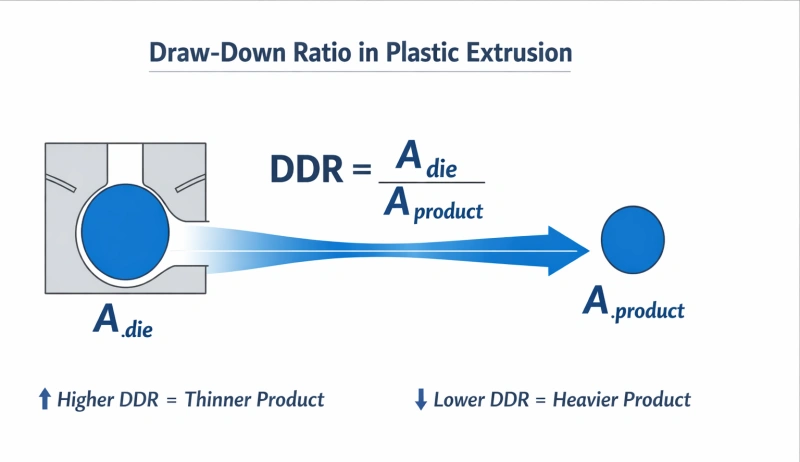
A higher DDR means the product is being drawn down more. In production, that usually means the haul-off is pulling relatively faster for the amount of material coming from the die. The product becomes thinner or lighter per meter.
A lower DDR means less draw-down. If the line receives more material than the haul-off can distribute, the product becomes thicker, heavier or less stable.
DDR is useful, but operators should not treat this article as a calculator page. In daily production, the more important point is that DDR changes whenever either side changes. Increasing screw speed changes it. Increasing haul-off speed changes it. A pressure fluctuation that changes actual output also changes it, even when the speed setpoints on the screen did not move.
What Happens When Haul-Off Runs Too Fast
If haul-off speed is too high for the actual extruder output, the product is pulled thinner. The usual signs are:
- lower meter weight;
- thinner wall thickness;
- possible OD reduction;
- higher tension before cooling is complete;
- unstable results after a speed increase.
This is common after an operator raises line speed to improve capacity. The haul-off responds immediately, but the extruder does not always deliver the matching increase at the same moment. Melt temperature, screw filling and pressure may need time to stabilize.
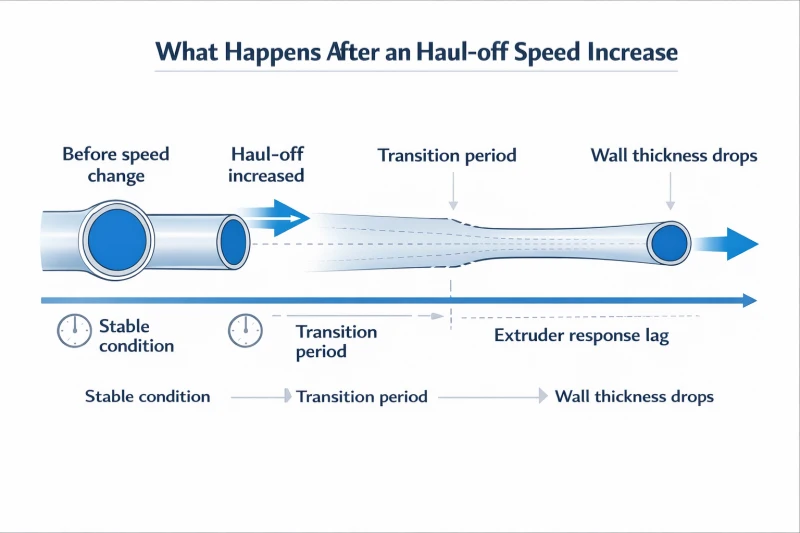
The affected product may already be several meters downstream before the operator sees the result on a wall gauge or manual measurement.
What Happens When Output Is Too High or Haul-Off Is Too Slow
The opposite mismatch is overfeeding. The extruder delivers more material than the haul-off removes at the target speed. The product receives more material per meter.
Typical signs include:
- higher meter weight;
- thicker wall;
- larger or unstable OD;
- sagging before cooling;
- product deformation near sizing or downstream equipment.
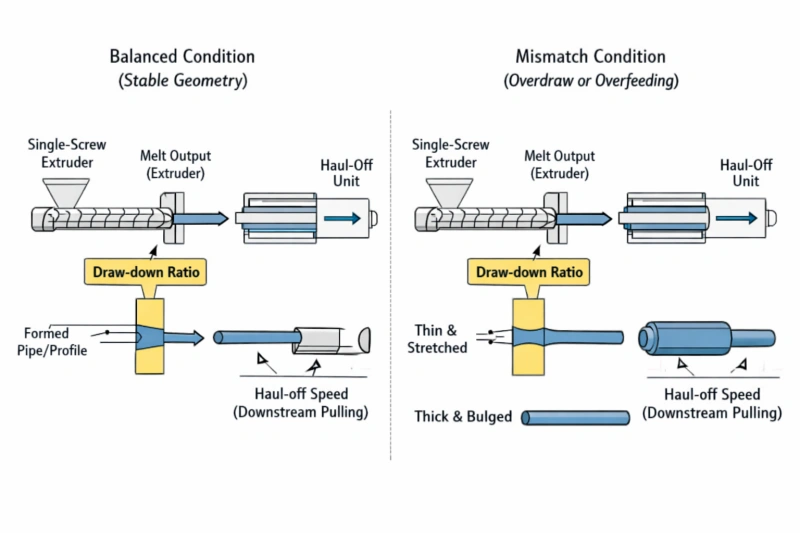
Overfeeding is not always caused by the operator slowing the haul-off. It can also happen when screw output rises because of material, temperature or pressure changes. This is why looking only at RPM is not enough. RPM is a setting. Output is what the melt actually does.
Speed Changes Need a Stabilization Period
Line speed changes are not neutral. When operators change haul-off speed, the product dimension changes first. The rest of the line then needs time to reach a new steady condition.
On a manual line, this means operators should avoid changing several parameters at once. Raise haul-off speed, wait for the product to pass through cooling and measurement, then judge the trend. If screw speed, haul-off speed and vacuum are all changed together, it becomes almost impossible to know which correction helped or hurt.
On a controlled line, the PLC/HMI can make this relationship easier to manage. Recipes can store speed ratios. Alarms can warn when pressure or motor load is abnormal. Closed-loop modules can adjust screw speed or haul-off speed based on measured output or meter weight. That is why this topic belongs inside a broader extrusion line control system discussion.
The Best First Diagnostic: Meter Weight
When wall thickness or OD moves, the first useful question is not “Which speed should I change?” It is “Is material per meter changing?”
Meter weight answers that question. If meter weight is changing, the line has an output-haul-off or upstream stability problem. If meter weight is stable while OD or wall thickness is still drifting, the cause is more likely downstream: cooling, vacuum sizing, calibration, haul-off grip or product support.
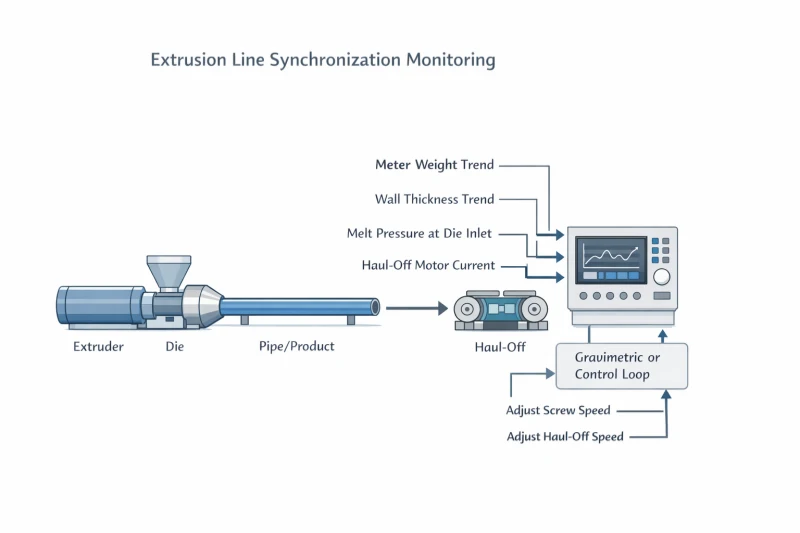
A practical checking order is:
- Meter weight trend: is material per meter stable or moving?
- Wall thickness and OD trend: is the product moving in one direction or fluctuating?
- Melt pressure: is upstream output stable, or is pressure rising and falling?
- Cooling and vacuum sizing: is the product being fixed consistently after the die?
- Haul-off grip and motor current: is the puller holding the product without slip or overload?
For higher-precision pipe or profile lines, a meter weight control system can close this loop automatically by measuring material consumption and correcting screw speed or haul-off speed.
When the Problem Is Upstream
Synchronization cannot fix unstable melt delivery. If feeding is inconsistent, the screw is worn, melt temperature is drifting, the screen pack is loading, or head pressure is fluctuating, the haul-off may be synchronized to a moving target.
In that case, check the upstream process before making repeated downstream corrections. A rising pressure trend may point to filtration or die resistance. CT-A2 explains how melt filtration and screen changers affect pressure behavior. If output fluctuation remains after feeding, melting and filtration are stable, a melt pump may be worth evaluating for precision products.
The rule is simple: do not use haul-off speed to hide an unstable output problem. It may move the dimension temporarily, but it will not remove the cause.
When the Problem Is Downstream
If meter weight is stable but dimensions still drift, the output-haul-off relationship may not be the main cause. The product may be leaving the die with the right material amount but losing shape during calibration, cooling or pulling.
Common downstream causes include unstable vacuum, worn sizing sleeves, uneven cooling, poor product support, haul-off belt slip or incorrect clamp pressure. In this case, changing screw speed or haul-off speed can create a second problem on top of the first one.
For symptom-level diagnosis, see Jinxin’s guide to wall thickness variation in plastic extrusion.
Conclusion
Extruder output and haul-off speed synchronization is not a theoretical control topic. It is one of the fastest ways to explain why wall thickness, OD and meter weight move when operators change speed or when upstream output becomes unstable.
The best diagnostic path is to check material per meter first, then pressure, wall trend, cooling and haul-off behavior. Once the cause is clear, the correction can be simple: adjust speed ratio, stabilize output, improve cooling, or add a closed-loop control module only when the product tolerance truly needs it.
If you are comparing pipe or profile line configurations, contact Jinxin with your product size, material, output target, wall tolerance and current control method. We can help you decide whether the issue is synchronization, upstream output, downstream sizing or a control-system gap.
FAQ
What is extruder output and haul-off speed synchronization?
It is the condition where the amount of melt delivered by the extruder matches the speed at which the product is pulled by the haul-off. When the relationship is stable, each meter receives a consistent amount of material.
How does haul-off speed affect wall thickness?
If haul-off speed increases while output stays the same, the product is stretched and wall thickness decreases. If haul-off speed is too slow for the output, wall thickness and meter weight increase.
What is draw-down ratio in extrusion?
Draw-down ratio compares the die exit cross-section with the final product cross-section. It helps explain how much the product is stretched between the die and the cooled final size.
Should I adjust screw speed or haul-off speed first?
First check meter weight and pressure trend. If meter weight is changing, the output-haul-off relationship or upstream process is moving. If meter weight is stable, look downstream before changing screw speed.
Can meter weight control solve synchronization problems?
It can help when the issue is material per meter variation. A gravimetric meter weight system measures consumption and can correct screw speed or haul-off speed automatically.
Is this the same as extrusion line speed control?
No. Line speed control is broader and belongs to the overall PLC/HMI control system. Output-haul-off synchronization is one specific relationship inside that system.
Further Reading
Plastics Technology — What Makes for Perfect Control in Tubing Extrusion?
Conair — Extrusion Processing: Basic Guide to Auxiliary Equipment
Jason Shen
Founder and Lead Engineer, Jinxin ExtruderJason Shen leads Jinxin Extruder's single screw extrusion line projects, with hands-on experience in machine configuration, tooling adjustment, factory testing and extrusion troubleshooting.
Inquiry
Email Your Line Requirements
For an accurate quotation, include your target product, material, size range, expected output, factory voltage and any product drawing or sample requirements.