
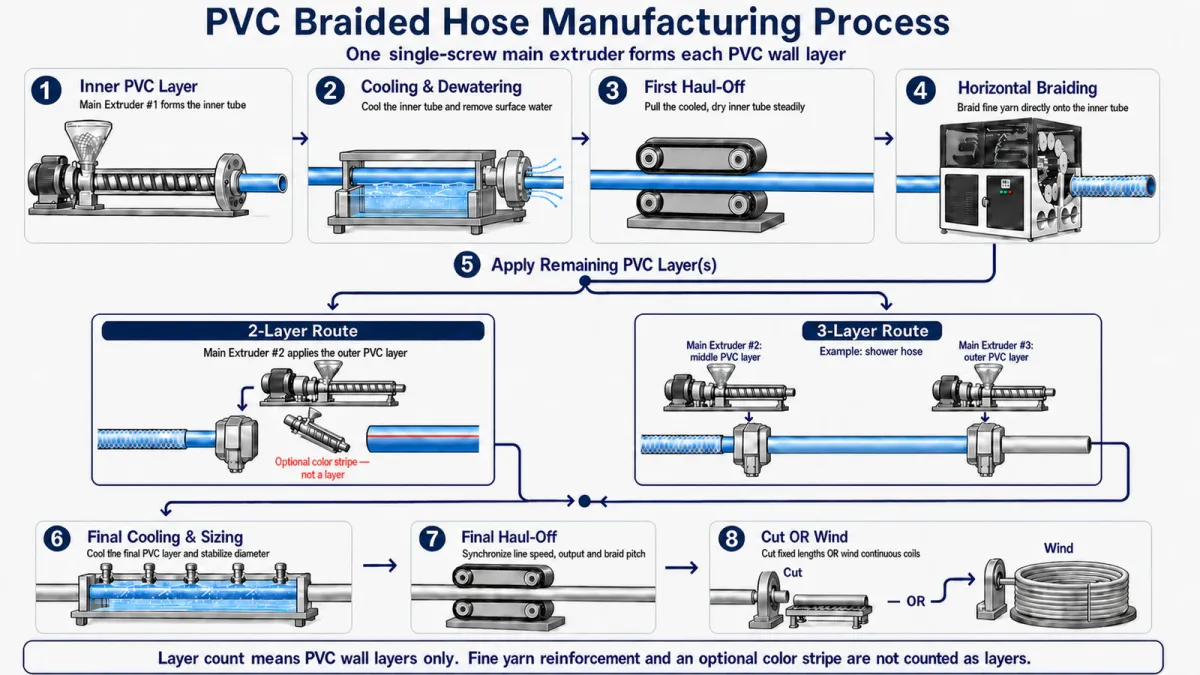
PVC braided hoses are made by extruding a flexible inner PVC tube in a single-screw extrusion stage, cooling and conditioning its surface, braiding fine polyester or nylon yarn directly onto the tube, then encapsulating that reinforcement with outer PVC supplied by another single-screw extrusion stage and a crosshead die. Final cooling, synchronized haul-off and cutting or winding complete the continuous process.
This article covers industrial yarn-reinforced flexible PVC hose, such as garden hose, washing machine inlet hose and reinforced water hose. It does not cover finished-hose sourcing, steel-wire or spiral-reinforced hose, rubber hydraulic hose, PVC layflat hose, rigid PVC pipe, silicone hose, a standalone braiding machine, or DIY hose making.
If the finished product is a smooth, single-layer, unreinforced soft PVC tube instead, it uses a different soft PVC tube extrusion line without the braiding and outer-coating stages described here.
If the finished hose, layer structure, yarn specification, pressure target and cutting or winding method are already known, review how Jinxin configures a custom PVC braided hose extrusion line around those buyer inputs.
Quick Answer
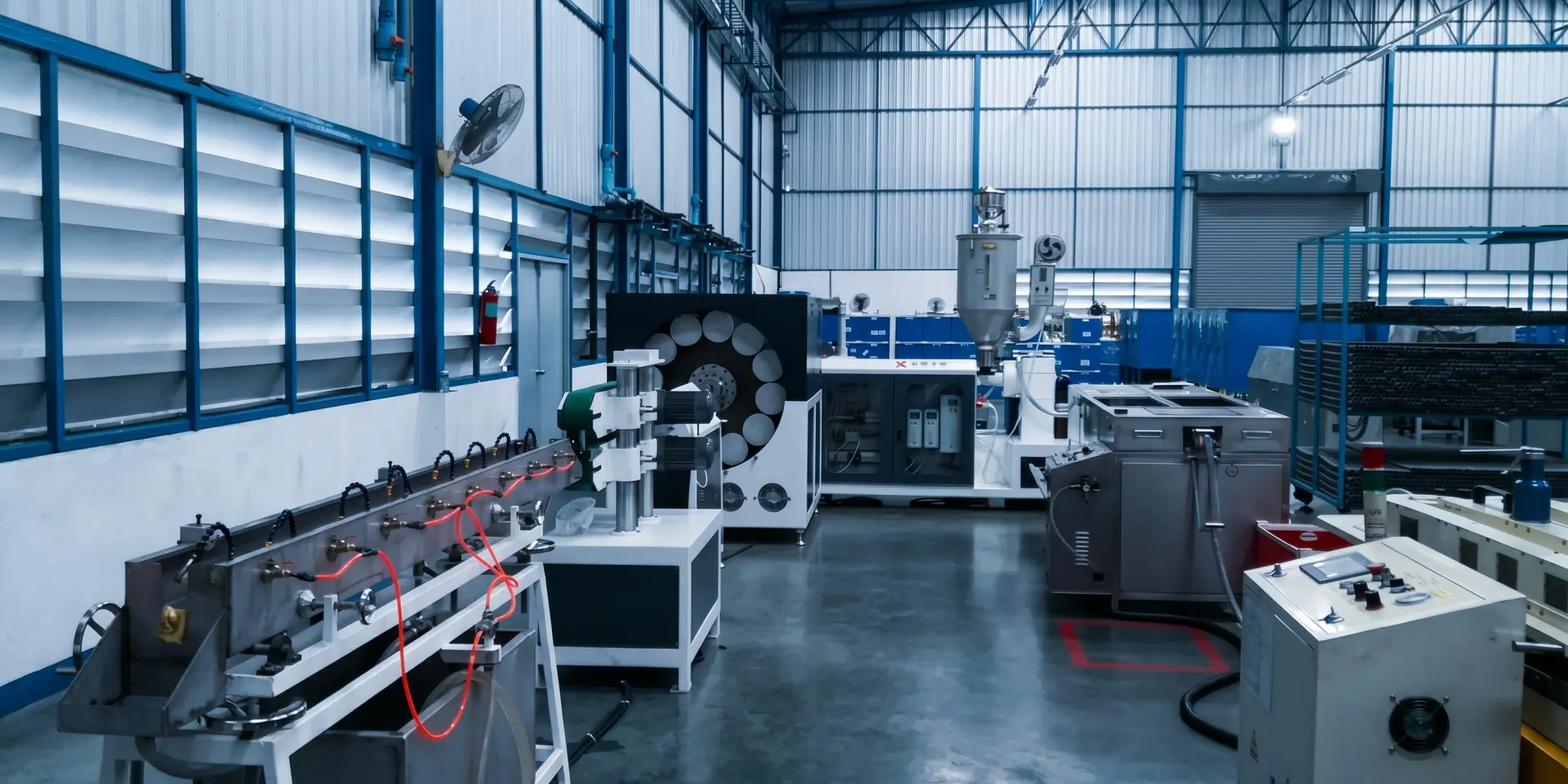
The core sequence is PVC compound feeding, inner-tube extrusion, initial cooling and surface-water removal, yarn braiding, outer crosshead coating, final cooling and sizing, synchronized pulling, then cutting or winding.
The sequence alone does not explain quality. The inner tube must be stable; yarn tension, density and pitch must stay consistent; the outer melt must encapsulate the braid without flattening it; and melt delivery, braiding and haul-off must stay synchronized. These relationships control diameter, reinforcement, surface finish and layer bonding.
1. What Type of PVC Braided Hose Is This Article About?
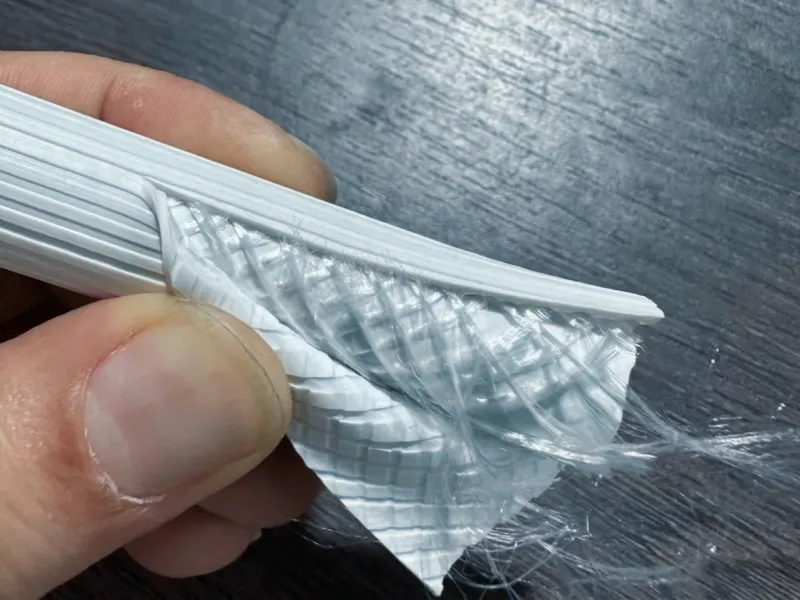
The product here is a flexible PVC hose reinforced with fine textile yarn. The yarn crosses in opposite diagonal directions and sits directly on the outside surface of the inner PVC tube. It is not a separate fabric sleeve, and there is no backing layer or air gap beneath it.
After braiding, PVC is extruded over the fine yarn, filling its open spaces and joining the structure into one hose wall. This differs from embedding steel wire, vulcanizing rubber hydraulic hose, weaving layflat hose or extruding rigid PVC pipe.
2. Two-Layer and Three-Layer Hose Structures
The layer count refers to the PVC layers; the yarn reinforcement is not counted as a PVC layer.
| Structure | Construction | Typical direction |
|---|---|---|
| 2-layer PVC braided hose | Inner PVC tube → fine yarn braided directly on the inner tube → outer PVC layer | Common garden hose, washing machine inlet hose and reinforced water hose |
| 3-layer PVC braided hose | Inner PVC tube → yarn braid → middle PVC layer → additional colored outer coating | Special high-strength or colored-coating projects |
In both structures, the braid contacts the inner tube; a completed 2-layer hose does not stop with exposed yarn. The 3-layer structure adds another coating outside the PVC that covers the braid.
Polyester and nylon are common reinforcement directions. Yarn material, twist, density, tension and braid pitch must match the hose diameter, flexibility and pressure target. Some reinforced projects may be tested against a breaking-force target up to 120 kgf, but that is project-specific—not a universal pressure rating.
3. Flexible PVC Compound and the Processing Window
The inner and outer layers use flexible PVC compound. A formulation can include PVC resin, plasticizer, stabilizer and filler where the application requires it. The correct balance affects flexibility, clarity, surface feel, extrusion stability and bonding between PVC layers.
Shore hardness must match the product. A compound that is too hard or too soft for the design can make sizing unstable, reduce flexibility or weaken pressure performance. Inner and outer compounds also need compatible bonding behavior.
A broad barrel-temperature starting reference for PVC braided hose extrusion is often around 155-195°C. It is not a fixed recipe. Compound formulation, stabilizer system, screw geometry, hose structure and output all change the usable window. Calcium-zinc-stabilized soft PVC can have a narrower processing window than some organotin-stabilized compounds, so another factory’s zone settings should not be copied blindly.
Food-contact or drinking-water suitability depends on the PVC compound and additives meeting the relevant standard. The production line alone cannot make a non-compliant formulation food-safe.
4. Process Overview: One Production Flow, Multiple Speed Relationships
The manufacturing route combines multiple single-screw extrusion stages with textile reinforcement. The first extrusion forms a stable inner tube. Braiding then adds the load-carrying yarn pattern. A later single-screw extrusion stage supplies the PVC melt that covers the yarn and creates the finished outside surface.
For the general principle of melting and continuous forming, see what plastic extrusion is. In braided-hose production, that continuous melt flow must also coordinate with the rotational motion of the braider and the linear motion of the haul-off.
5. Step-by-Step PVC Braided Hose Manufacturing
Step 1: Feed and Plasticize the PVC Compound
PVC compound for each active plastic layer enters its corresponding single-screw extrusion stage, where the rotating screw conveys, heats and plasticizes it into a stable melt. The inner-tube stream starts the product; the later coating stream is prepared for the crosshead die. The objective is uniform melt delivery, not simply a high barrel temperature.
Step 2: Extrude the Inner PVC Tube
The melt passes through tube tooling to form the continuous inner layer. Wall distribution and melt stability matter because this tube becomes the base for every downstream stage. If its diameter or wall moves, the braid and outer coating inherit that movement.
Step 3: Cool and Condition the Inner-Tube Surface
Initial cooling stabilizes the tube so braiding tension does not collapse or stretch it. Surface water must also be removed before coating. Some lines use dedicated drying or conditioning equipment, but the universal requirement is a stable, dry interface—not one mandatory dryer design.
Step 4: Braid Fine Yarn Directly on the Inner Tube
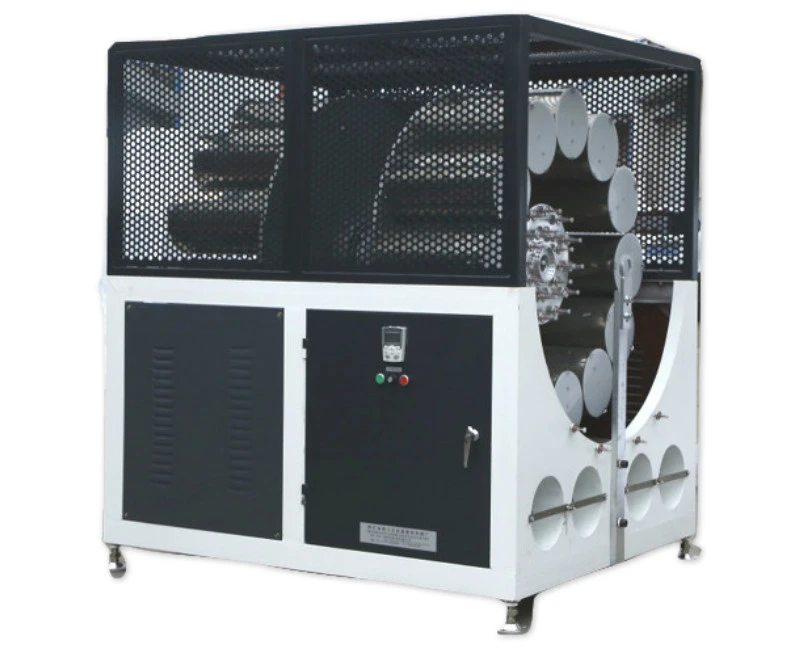
The braiding unit lays many fine polyester or nylon yarn paths across the tube in opposite directions. The yarn should form a dense, regular diamond pattern while remaining in direct contact with the inner PVC surface.
Tension that is too low can produce loose or shifting reinforcement. Excessive tension can deform the soft tube or flatten low-twist yarn. Braid density and pitch also change when line speed and braider speed lose their intended relationship.
Step 5: Encapsulate the Braid Through a Crosshead Die
The braided tube passes through crosshead tooling, where outer PVC from its single-screw extrusion stage flows around the moving tube and covers the yarn. The melt must reach and seal the spaces around the braid while keeping the wall distribution even.
Coating pressure has a working window. Too little pressure leaves poor encapsulation or separation points. Too much pressure can flatten or distort the yarn twist and reduce reinforcement efficiency. For the broader role of flow distribution and die geometry, see what an extrusion die does.
A special 3-layer hose adds another extrusion or coating stage for the colored outer layer after the PVC layer that covers the braid.
Step 6: Final Cooling, Sizing and Collection
Cooling fixes the bonded wall, diameter and roundness. Sizing or vacuum assistance can be applied where the compound, wall or product requires it. The haul-off then pulls the hose at a controlled speed before fixed-length cutting or winding.
6. Why Synchronization Decides Braid Pitch and Wall Stability
Three rates interact: inner and outer melt delivery, braider rotation, and linear haul-off speed. If haul-off speed increases while braider speed stays unchanged, the braid pitch opens. If the braider speeds up relative to line travel, the pattern becomes denser.
The outer layer has a similar balance. More melt per meter makes it heavier; faster pulling with unchanged output makes it thinner. When these speed chains drift independently, the result can be changing diameter, uneven coverage, distorted diamonds or unstable layer thickness.
The control logic is explained more broadly in extruder output and haul-off speed synchronization.
7. What Causes Layer Bonding Failure and Delamination?
Delamination means the outer PVC separates from the reinforcement zone or inner structure. Common process causes include:
- too much external lubricant in the inner-tube compound, which weakens surface adhesion;
- outer tooling that is too large for the structure, so the melt does not press and seal around the braid;
- an outer melt temperature that is too low for effective fusion;
- trapped air at the coating interface, which may require vacuum evacuation at the tooling;
- residual cooling water carried into the braid and coating interface;
- incompatible hardness or formulation between the PVC layers.
Raising coating pressure alone is not a complete solution. The process needs enough pressure and heat for encapsulation, while preserving the yarn geometry that provides reinforcement.
8. Braid Coverage, Yarn Show-Through and Surface Feel
A normal reinforcement pattern uses many narrow yarn bundles, not a few thick cords. The bundles sit close to the inner tube and form small, regular diamond openings. The outer PVC should cover this network evenly.
If the outer layer is too thin or wall distribution is uneven, the yarn pattern can remain visible or easy to feel. Correcting the surface therefore involves tooling, layer distribution, braid density and stable pulling—not simply adding random material.
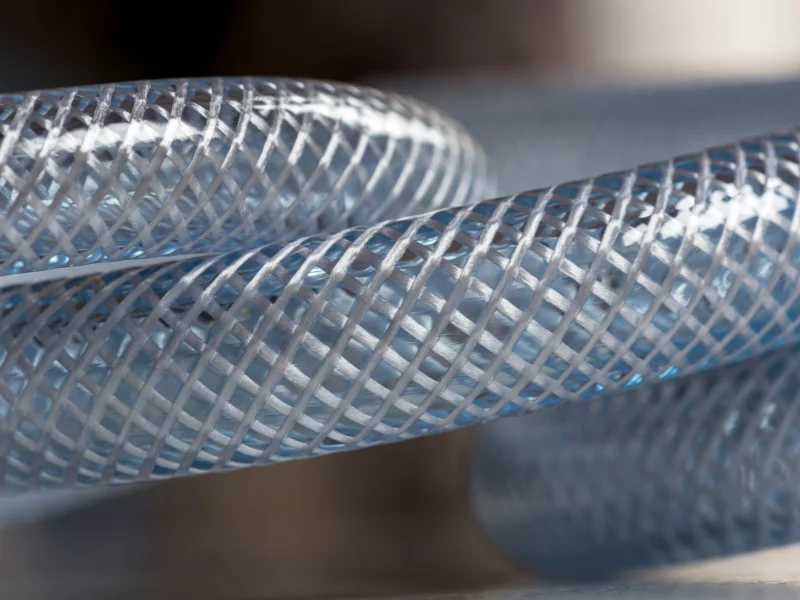
Pressure performance is also a system result. Yarn type, twist, braid density, tension, pitch, hose diameter, wall structure and layer bonding all contribute. The line itself does not assign one pressure rating to every hose it can produce.
9. Common PVC Braided Hose Defects and Causes
| Defect | Process areas to inspect |
|---|---|
| Delamination | Compound compatibility, lubricant level, residual water, trapped air, outer melt temperature, tooling and coating pressure |
| Yarn show-through or rough feel | Outer-layer thickness, wall distribution, braid density and die centering |
| Bubbles | Moisture at the interface, trapped air, compound condition and melt stability |
| Diameter drift | Inner and outer output, cooling, sizing and haul-off speed |
| Irregular braid pattern | Yarn tension, braider speed, haul-off speed and unstable inner-tube diameter |
| Distorted or flattened yarn | Excessive braiding tension or excessive outer-coating pressure |
For a wider symptom-first diagnostic method, see common extrusion problems and how to trace them.
10. Yarn-Braided PVC Hose vs Other Hose Types
| Product type | Reinforcement and manufacturing route | This article’s scope? |
|---|---|---|
| Yarn-braided flexible PVC hose | Inner PVC extrusion, fine textile braiding, outer PVC coating | Yes |
| Steel-wire or spiral-reinforced PVC hose | Metal wire or spiral reinforcement with different tooling and line requirements | No |
| Rubber hydraulic braided hose | Rubber processing, textile or wire reinforcement and vulcanization | No |
| PVC layflat hose | Collapsible flat-hose construction and a different forming route | No |
| Rigid PVC pipe | Rigid compound, pipe tooling and rigid-pipe sizing; not flexible braided hose | No |
Silicone hose, standalone braiding-machine output and DIY hose assembly are also outside this process. The distinction matters because the word “braided” alone does not identify the material, reinforcement or production route.
Conclusion
PVC braided hoses are made by combining stable inner-tube extrusion, fine-yarn braiding, controlled outer coating, final cooling and synchronized pulling. Finished quality depends on how those stages interact: the inner tube supports the braid, the braid carries reinforcement loads, and the outer PVC must encapsulate the yarn without damaging it.
If you are evaluating a yarn-reinforced PVC hose project, contact Jinxin with the sample or drawing, compound, layer structure, yarn, dimensions and collection method. Jinxin can review the complete route without treating the extruder or braider as the whole process.
FAQ
Are PVC braided hoses made by extrusion alone?
No. Extrusion forms the inner PVC tube and the PVC layer or layers that cover the reinforcement, but a braiding stage places polyester or nylon yarn directly around the stabilized inner tube. Cooling, synchronized haul-off and cutting or winding are also part of the continuous process.
What materials go into a PVC braided hose?
The plastic layers use flexible PVC compound selected for the required hardness, flexibility, color, transparency and application. The reinforcement is normally polyester or nylon yarn. Compound additives and compliance requirements depend on the intended use.
What is the difference between a 2-layer and a 3-layer braided hose structure?
The count refers only to PVC layers; the yarn is not counted. A common 2-layer hose has an inner PVC tube, yarn braided directly on that tube and an outer PVC layer. A special 3-layer structure adds a further colored outer coating outside the PVC layer that already covers the braid.
Why is the inner tube surface conditioned before braiding?
The inner tube must be cool and stable enough to resist braiding tension. Residual surface water also needs to be removed so it is not trapped at the later coating interface, where it can weaken bonding or contribute to bubbles and delamination.
What causes delamination in PVC braided hose production?
Possible causes include excessive external lubricant in the inner compound, incompatible PVC layers, residual water, trapped air, an outer melt that is too cold, unsuitable outer tooling or insufficient coating pressure. The pattern should be traced before one setting is changed.
Why can you feel the yarn pattern on some braided hoses?
The outer PVC may be too thin or unevenly distributed, or the braid may not have the intended density and geometry. Tooling, wall distribution, braid setup and pulling stability should be reviewed together.
Which production factors decide the pressure rating of a braided hose?
Pressure performance depends on hose diameter and wall structure, yarn material and twist, braid density, tension and pitch, PVC compound, layer bonding and the relevant product test. It cannot be assigned from the extrusion-line model alone.
Can one line produce both garden hose and washing machine inlet hose?
It can when both products fall within the configured size, compound, layer, tooling, braiding and collection range. Changeover may require different dies, yarn setup, speed relationships or cutting and winding arrangements, so the answer depends on the actual product specifications.
Jason Shen
Founder and Lead Engineer, Jinxin ExtruderJason Shen leads Jinxin Extruder's single screw extrusion line projects, with hands-on experience in machine configuration, tooling adjustment, factory testing and extrusion troubleshooting.
Inquiry
Email Your Line Requirements
For an accurate quotation, include your target product, material, size range, expected output, factory voltage and any product drawing or sample requirements.