
An extrusion line maintenance checklist is useful only when it covers the full production line, not just the screw and barrel. A plastic extrusion line can lose output because of feed-throat overheating, die-lip buildup, blocked cooling filters, worn haul-off belts, cutter timing drift, cabinet overheating or seasonal humidity. Those failures appear in different places, but they all have the same pattern: a small inspection item was missed long before the line stopped.
This guide gives production teams a practical extruder maintenance checklist inside a whole-line maintenance system. It separates daily checks, weekly stop-time inspections, monthly trend measurements and seasonal preventive adjustments. The goal is simple: reduce extrusion downtime by finding drift early, while the correction is still planned maintenance instead of emergency troubleshooting.
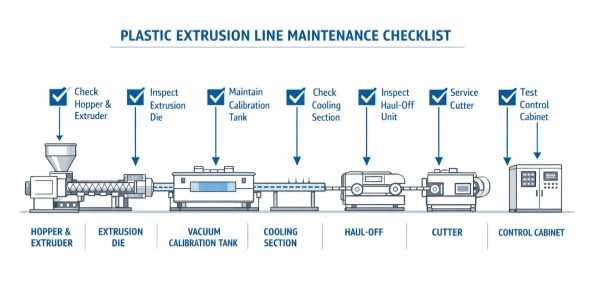
Quick Answer
Use a daily, weekly and monthly maintenance rhythm:
| Frequency | Main purpose | Typical checks |
|---|---|---|
| Daily | Confirm the line is safe and stable before defects appear | Feed throat cooling, zone temperature, melt pressure trend, die lip, cooling water, haul-off grip, cutter timing, cabinet ventilation and alarms. |
| Weekly | Inspect wear points during a planned stop | Gearbox oil, heater terminals, die bolts, water filters, vacuum seals, belts, blades, VFD heat sinks and terminal blocks. |
| Monthly | Record trend data for planned replacement | Screw/barrel clearance, gearbox temperature, motor insulation, vacuum pump performance, water quality, drive response, cut-length variation and parameter backups. |
A checklist should not replace troubleshooting. It should reduce the number of problems that need troubleshooting. If a defect is already visible, use the plastic extrusion troubleshooting guide to locate the cause by symptom and station.
What the Checklist Covers
This maintenance hub covers six areas of a single-screw extrusion line:
- Extruder: motor, gearbox, screw/barrel condition, heaters, feed throat cooling and melt pressure.
- Die and adapter: temperature uniformity, bolt torque, leakage, die-lip buildup and cleaning discipline.
- Cooling and calibration: vacuum level, water temperature, water filters, spray coverage, calibration sleeves and seals.
- Haul-off: belt condition, clamping force, speed feedback and encoder accuracy.
- Cutter: blade condition, clamp alignment, cut timing and length consistency.
- Electrical and controls: cabinet cooling, VFD heat sinks, terminals, grounding, alarm history and parameter backups.
This is why the primary target is extrusion line maintenance checklist. The extruder is critical, but maintenance failures often happen downstream or in utilities. A page that only says “inspect the extruder” misses the causes that stop real production lines.
Daily Checks Before or During Each Shift
Daily checks should take 10-15 minutes. They are not deep repair work; they are a structured walk-through to confirm the line is still inside its normal operating window.
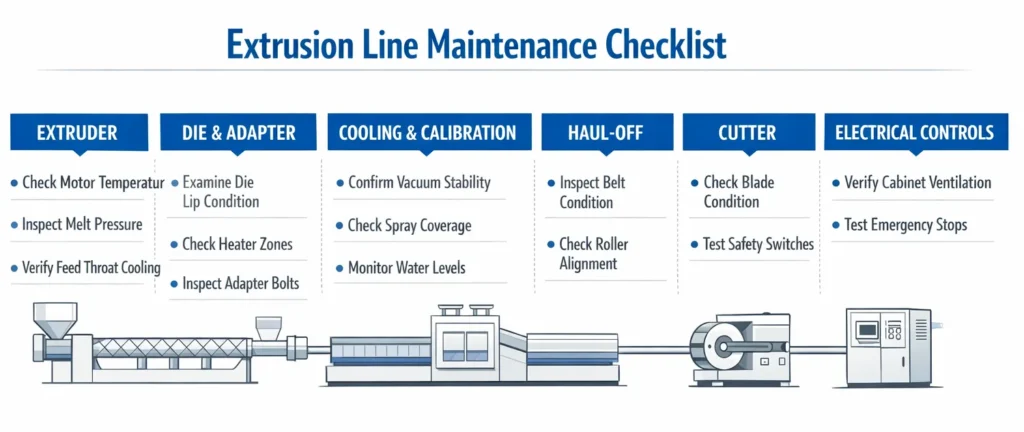
| Station | Daily check | What goes wrong if skipped |
|---|---|---|
| Extruder | Listen for motor or gearbox noise; check actual zone temperatures against setpoints. | Bearing wear, loose coupling or heater failure turns into unstable melt and unplanned stop. |
| Feed section | Confirm feed-throat cooling flow and warm return water. | Pellets soften too early, bridge in the feed zone and cause output fluctuation or no feeding. |
| Melt path | Record melt pressure at a fixed screw speed. | Rising pressure may hide screen loading or die buildup; sudden drops may indicate feeding loss. |
| Die | Inspect die lip and adapter joint for buildup or leakage. | Streaks, black specks, wall variation and safety risk from resin leakage. |
| Cooling | Check water level, water temperature, spray coverage, vacuum gauge and seal leakage. | Warping, ovality, dimension drift and misdiagnosed process defects. |
| Haul-off | Confirm belt contact, clamping force and displayed speed. | Slip, product marks, crushed profile or unstable dimension. |
| Cutter | Check blade condition, clamp hold and cut timing. | Burrs, angled cuts and inconsistent length. |
| Controls | Review alarms, cabinet fans and emergency stop function. | Repeated warnings become VFD trips, control faults or unsafe operation. |
A daily checklist is strongest when operators record only abnormal items. Keep the form short enough that it is actually used every shift.
Weekly Checks During Planned Downtime
Weekly checks need the line stopped or slowed safely. Use die changes, material changes or planned production gaps. The goal is to catch wear before it becomes a defect.
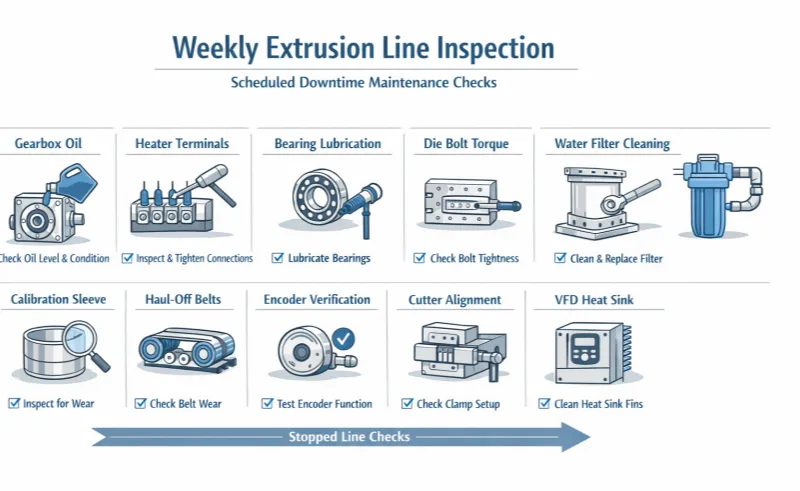
| Area | Weekly task | Maintenance reason |
|---|---|---|
| Gearbox and drive | Check oil level, oil color, belt tension or coupling condition. | Foaming, dark oil or vibration points to wear that will become heat and output loss. |
| Barrel heaters | Inspect heater-band terminals and wiring discoloration. | Loose or corroded terminals create resistance, current draw and heater failure. |
| Screw/barrel cleanliness | Review purge history and material-change residue. | Residual polymer degrades and contaminates the next run; deep cleaning belongs in screw and barrel cleaning. |
| Die and adapter | Spot-check bolt torque and seal surfaces. | Thermal cycling loosens bolts and causes leaks or flow imbalance. |
| Water circuit | Clean strainers, filters and spray nozzles. | Restricted flow reduces cooling capacity and creates defects that look like die or material problems. |
| Vacuum tank | Inspect seals and calibration surfaces. | Operators often compensate for leaking seals by increasing pump load until the process becomes unstable. |
| Haul-off | Measure belt wear and verify encoder feedback. | Small speed errors directly affect dimensions and cut length. |
| Cutter | Sharpen or replace blades and check clamp alignment. | Dull blades increase force and stress the cutter mechanism. |
| Electrical cabinet | Clean VFD heat sinks, tighten sample terminals and check grounding. | Dust and vibration cause intermittent faults that are hard to diagnose during production. |
Monthly Checks and Trend Records
Monthly maintenance is about data. One reading tells you the current state; repeated readings show the direction of wear.
| Monthly record | How to use it |
|---|---|
| Screw and barrel clearance | Track wear at feed, transition and metering sections. Plan replacement before output and melt quality collapse. |
| Gearbox oil temperature under stable load | Rising temperature at the same load suggests lubrication degradation or internal wear. |
| Motor insulation resistance | Detect moisture ingress or insulation breakdown before a motor burn-out. |
| Vacuum pump performance | Compare ultimate vacuum with the baseline; loss of capacity points to oil, vane or seal issues. |
| Cooling system delta-T and water quality | Fouling, hardness and conductivity trends explain gradual cooling loss. |
| Cut-length variation over 10+ samples | Increasing deviation points to encoder, trigger sensor or servo drift. |
| PLC/HMI/VFD parameter backup | A current backup prevents days of reprogramming after controller replacement. |
Trend data is the difference between plastic extrusion maintenance and emergency repair. If melt pressure, gearbox temperature, cooling delta-T or screw clearance moves in the wrong direction for two or three readings, schedule the repair before the line forces the schedule for you.
Seasonal Preventive Maintenance for Extrusion Lines
The standard checklist assumes stable workshop conditions. Real factories are not stable. Heat, humidity, dust and temperature swings change which parts of the line are under stress.
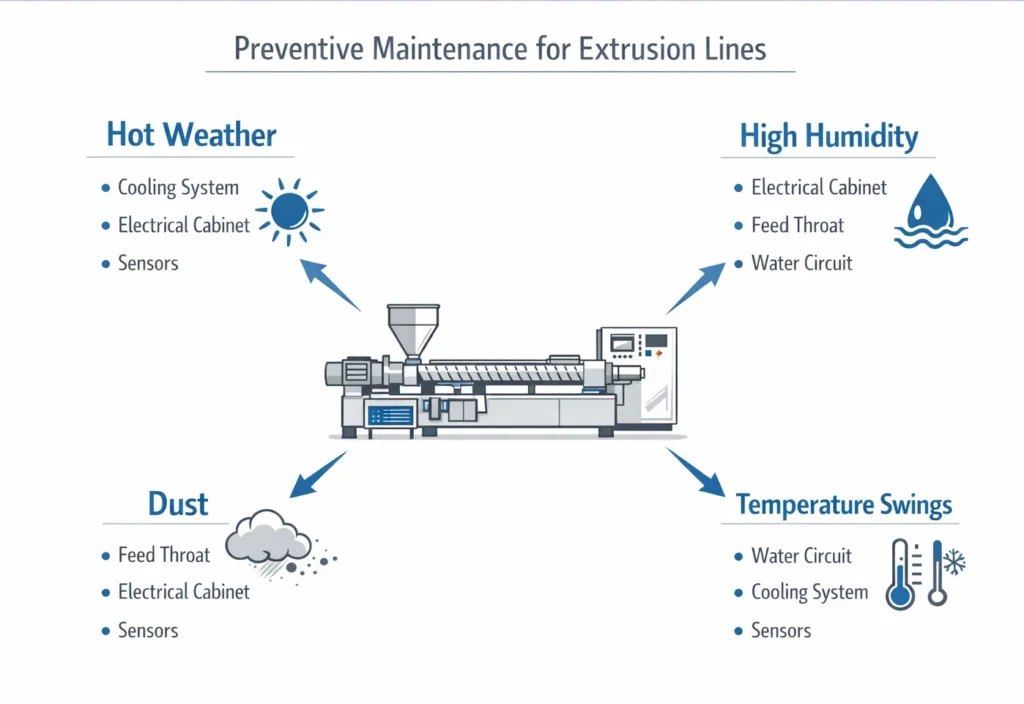
Hot weather
When ambient temperature rises, cooling towers reject less heat, chillers work harder and electrical cabinets retain more heat. Confirm the actual water temperature reaching the process, not just the controller setpoint. Check feed-throat cooling more often because warmer inlet water reduces the safety margin against pellet softening. Clean cabinet filters and verify that VFD and PLC temperatures stay inside their rated range.
High humidity
Humidity creates condensation inside cabinets, rust on dies and tooling, moisture pickup in hygroscopic resins and biological growth in water systems. Keep anti-condensation heaters active during shutdown, protect polished die surfaces after cleaning, monitor dryer dew point and shorten water-filter inspection intervals. If wet-season defects appear, check resin and water handling before changing barrel temperatures.
Dust-heavy environments
Dust blocks cabinet filters, coats heat sinks, contaminates grease and weakens sensor signals. In dusty workshops, weekly filter cleaning may need to become twice weekly. Keep hoppers and feed points covered, clean optical sensors and encoders before accuracy drifts, and inspect bearings or guide rails for gritty lubricant.
Large temperature swings
During transition seasons, allow more preheat time for the barrel, adapter and die. Check for condensation before morning startup. Recheck die bolts, hose clamps and fittings affected by thermal cycling. Cooling-water setpoints may also need seasonal adjustment because water that is correct in summer may overcool the product in cooler months.
Commonly Overlooked Items That Cause Downtime
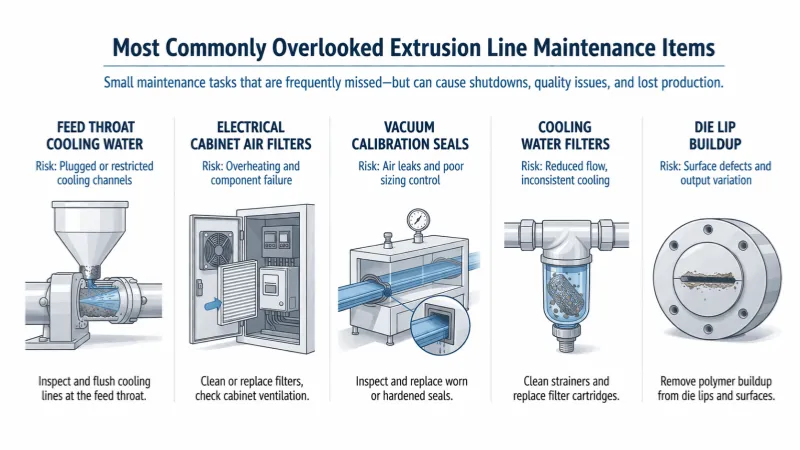
| Overlooked item | Why it matters |
|---|---|
| Feed throat cooling | A small blocked circuit can stop feeding and make operators chase the wrong cause. |
| Cabinet air filters | Clogged filters cause VFD overtemperature alarms and sudden line stops. |
| Vacuum calibration seals | Worn seals reduce vacuum stability and create dimensional drift. |
| Water filters and strainers | Partial blockage reduces cooling flow long before the pump fails. |
| Die lip buildup | A thin layer of degraded resin creates streaks, black specks and surface marks. |
| Parameter backups | A failed controller without a current backup turns a hardware replacement into a long outage. |
These items are simple, which is why they are often ignored. They are also common sources of downtime because they affect feeding, cooling, control stability and product quality at the same time.
Maintenance vs Troubleshooting
Maintenance and troubleshooting should not compete for the same job.
Use this checklist when the line is still running and you want to prevent drift. Use the troubleshooting hub when a defect is already visible and the team needs to identify the first likely station. A good maintenance system sends fewer problems into troubleshooting, but it does not replace diagnosis.
| Situation | Use |
|---|---|
| No defect yet, but readings are drifting | This maintenance checklist. |
| Material changes leave contamination risk | Clean extruder screw and barrel. |
| Die is removed for cleaning, storage or inspection | Extruder die maintenance. |
| Bubbles, black specks, wall variation, output loss or poor cuts are already visible | Plastic extrusion troubleshooting. |
| You need site-specific maintenance intervals after commissioning | Commissioning and start-up support. |
When maintenance records keep pointing back to the same station, the question can shift from upkeep to configuration: Jinxin’s custom plastic extrusion lines show how each line is specified around the product, so recurring drift can be checked against the actual equipment scope.
FAQ
Is this an extrusion line maintenance checklist or an extruder maintenance checklist?
It is a whole-line checklist. The extruder is included, but the page also covers die, cooling, haul-off, cutter and controls because many production stops begin outside the screw and barrel.
Which daily check matters most?
Feed throat cooling and melt pressure trend are two of the highest-value checks. They take little time and reveal feeding loss, screen loading or die restriction before the line stops.
How does this checklist reduce extrusion downtime?
It converts hidden drift into planned work. When operators record pressure, cooling, speed and wear trends, maintenance can be scheduled before failures interrupt production.
Can preventive maintenance replace troubleshooting?
No. Preventive maintenance reduces the number of defects. Troubleshooting is still needed when a visible defect already exists and the team must find the first cause.
Jason Shen
Founder and Lead Engineer, Jinxin ExtruderJason Shen leads Jinxin Extruder's single screw extrusion line projects, with hands-on experience in machine configuration, tooling adjustment, factory testing and extrusion troubleshooting.
Inquiry
Email Your Line Requirements
For an accurate quotation, include your target product, material, size range, expected output, factory voltage and any product drawing or sample requirements.