
The common plastics used in extrusion are mainly thermoplastics such as PVC, PE, PP, ABS, PC, PMMA, TPU, TPE and PA. They are chosen according to the product shape, required rigidity or flexibility, transparency, wear resistance, drying sensitivity and the way the material behaves after it leaves the die.
This page is not a material datasheet. It is a practical map for connecting plastic extrusion materials with real products: pipe, profile, tube, film, sheet, cable coating, seal, diffuser and engineering strip.
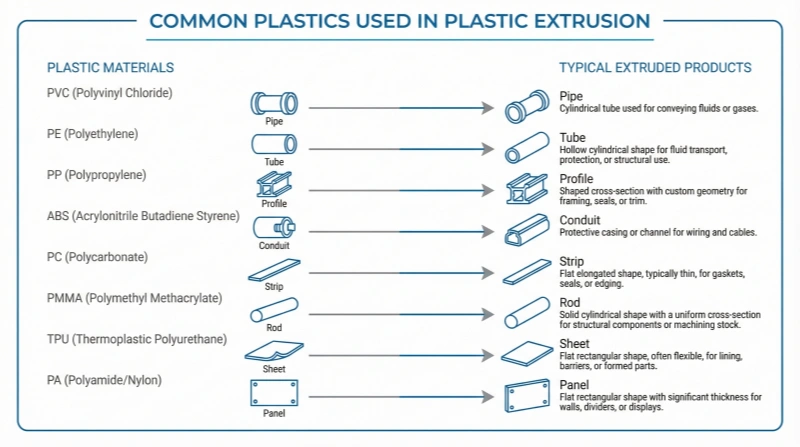
If you need the basic process first, start with what plastic extrusion is. This article focuses on material choice after you already know that extrusion melts plastic and shapes it continuously through a die.
If you are still deciding whether a part should be extruded or molded instead, use injection molding vs extrusion as the process-selection guide before choosing the material route.
Quick Comparison of Plastic Extrusion Materials
| Material | Typical extrusion products | Why it is chosen | Watch-outs |
|---|---|---|---|
| PVC | Rigid pipe, window profile, conduit, flexible hose, cable coating | Wide application range; can be rigid or flexible | Rigid PVC and flexible PVC behave like different product routes |
| PE | HDPE pipe, LDPE/LLDPE tubing, film, cable coating | Chemical resistance, toughness and flexible grades | HDPE and LDPE should not be treated as one material |
| PP | PPR pipe, sheet, profile, packaging and industrial parts | Lightweight, chemical resistance and higher heat tolerance than PE | More sensitive to process stability than many people expect |
| ABS | Decorative profile, trim, edge banding, appliance and automotive parts | Rigid feel with good surface appearance | Not the cheapest route for basic pipe or tubing |
| PC | Transparent cover, protective profile, lighting cover | Impact resistance and clear appearance | Moisture and surface defects are easy to see |
| PMMA | Light diffuser, display cover, clear decorative profile | Optical clarity and polished appearance | More brittle than PC |
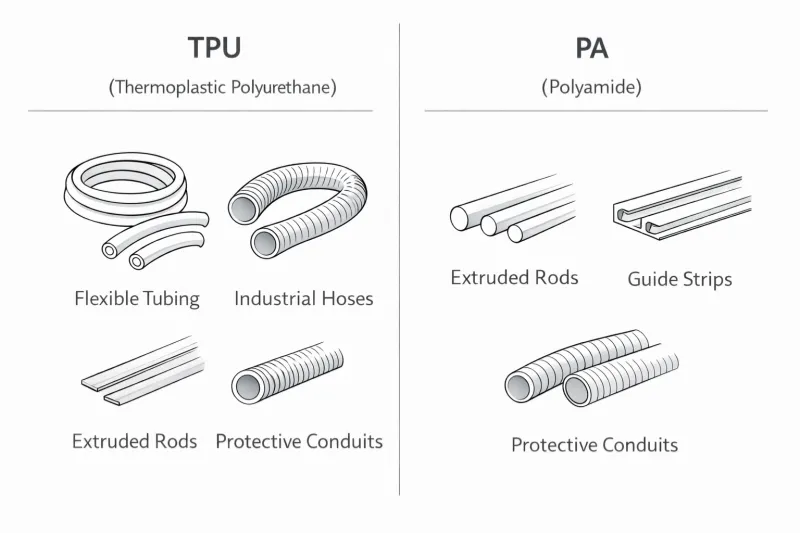
| TPU / TPE | Flexible tube, seal, soft profile, co-extruded soft edge | Elasticity and soft-touch performance | Compound family and hardness matter |
| PA | Wear strip, industrial tube, guide, engineering profile | Strength and wear resistance | Moisture-sensitive; drying matters |
Start With Product Feel
The fastest way to understand plastic extrusion materials is to look at the product you want to make.
- Rigid structural products usually point toward PVC, HDPE, PP or ABS.
- Flexible tubing and seals often point toward flexible PVC, LDPE, TPU or TPE.
- Transparent products usually need PC or PMMA.
- Wear-resistant engineering parts often point toward PA.
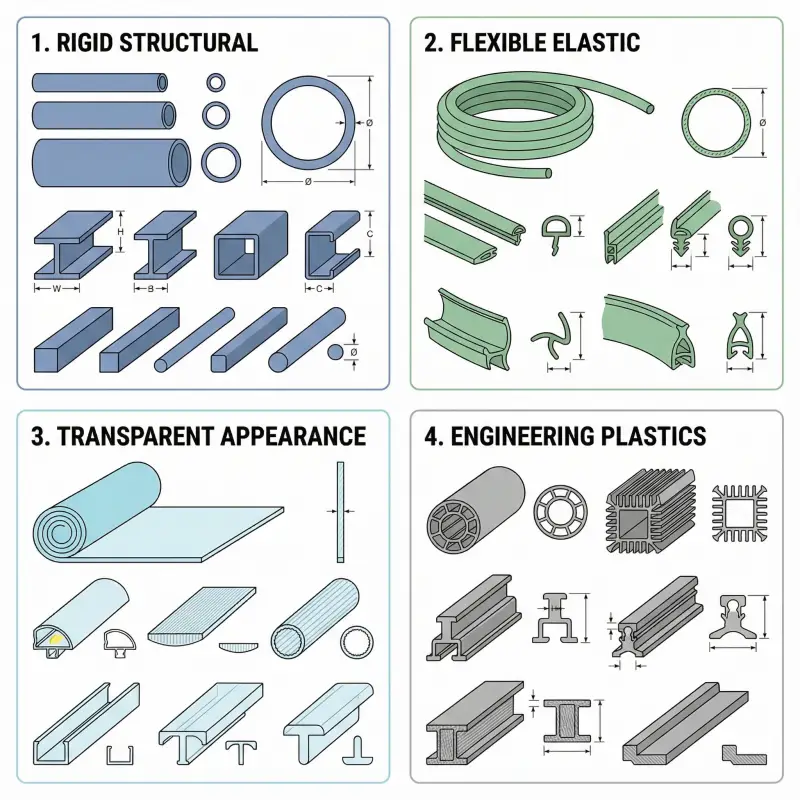
This approach is more useful than memorizing generic polymer properties. A pipe, a diffuser and a soft tube may all come from extrusion, but they do not ask the material to do the same job.
PVC: One Name, Two Product Routes
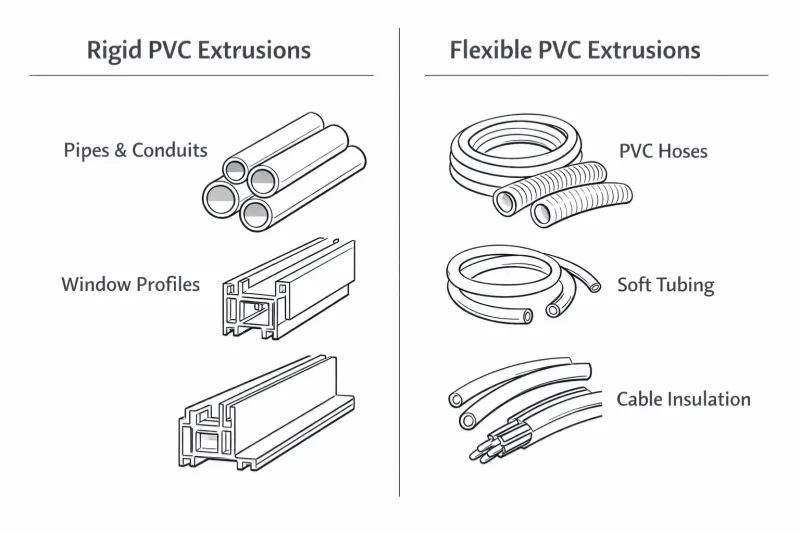
PVC is one of the most common plastics in extrusion because it covers both rigid and flexible product families.
Rigid PVC is used for pipe, window profile, conduit, wall panel and other construction-related products. It is selected when the product needs dimensional stability, a firm feel and a cost-effective route for long continuous shapes.
Flexible PVC is a different product logic. With plasticizers, PVC can be used for hose, soft tubing, cable insulation, protective strip and flexible covering. It is still PVC, but the line configuration and downstream handling may be very different from rigid profile extrusion.
For smooth, single-layer, unreinforced tubing, the soft PVC tube extrusion line connects this material choice to tube tooling, cooling, synchronized haul-off, and cutting or winding.
For structural profiles, PVC and PC answer different needs. PVC is usually selected for cost-effective rigid construction profiles, while PC is selected when transparency and impact resistance matter. That is why a question such as “polycarbonate extrusion or PVC extrusion for structural profiles” cannot be answered by material name alone; it depends on whether the product needs visibility, toughness, weathering, cost control or profile stiffness.
PE: HDPE, LDPE and LLDPE Are Not Interchangeable
PE is a material family. In extrusion, the difference between HDPE and LDPE/LLDPE is often more important than the name polyethylene itself.
HDPE is more rigid and is widely used for water pipe, gas pipe, drainage pipe and other products that need toughness and chemical resistance. It holds shape better and is commonly associated with pipe extrusion.
LDPE and LLDPE are softer and more flexible. They are more common in film, flexible tubing, soft covering and products where pliability matters.
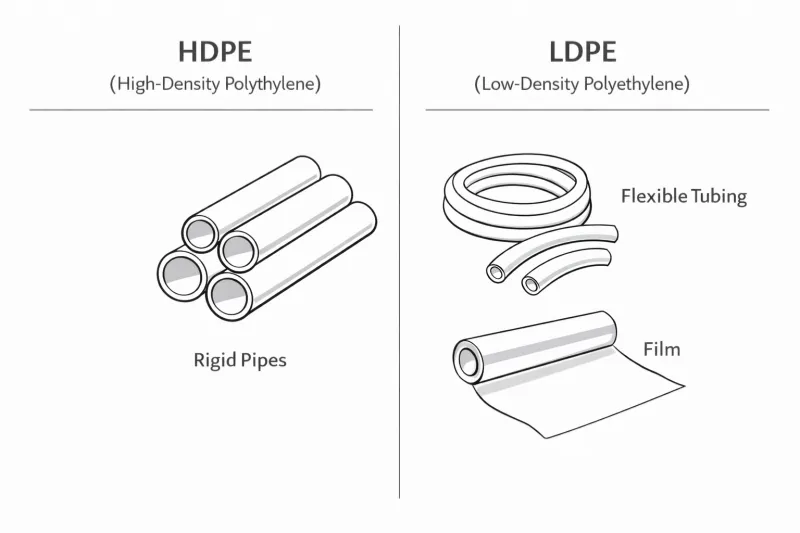
When someone says “PE extrusion”, the next question should be: rigid pipe, flexible tube, film, coating or another product form?
PP: Lightweight and Functional
PP is chosen when the product needs a light material, chemical resistance and better heat tolerance than PE in many everyday applications. In extrusion, PP appears in PPR pipe, sheet, profile, packaging parts and functional industrial products.
PP is not usually selected for optical beauty. It is a function-oriented material. PPR pipe is one familiar example: the choice is driven by hot-water use, product stability and a suitable material route, not by appearance.
When PP, PE, ABS or TPU must become a continuous profile built to a drawing, a precision plastic profile extrusion line matches the material grade with profile tooling, free or vacuum sizing, cooling, haul-off and cutting.
ABS: Rigid Parts With a Finished Look
ABS is used when a profile or part needs both structure and a good surface. It is common in decorative profiles, appliance trims, automotive trim, furniture edging and other products where the extrusion should look like a finished component.
ABS does not replace PVC or PE for every basic extrusion job. Its value is the combination of rigidity, toughness and surface appearance.
PC and PMMA: Both Transparent, Different Priorities
PC and PMMA are both used for transparent extrusion products, but they are not the same choice.
PC is used when the product must be transparent and impact resistant. It is common in protective covers, lighting covers, safety-related profiles and clear parts that may face stress.
PMMA is used when optical clarity and surface appearance are the priority. It is common in light diffusers, display covers, signage and decorative clear profiles.
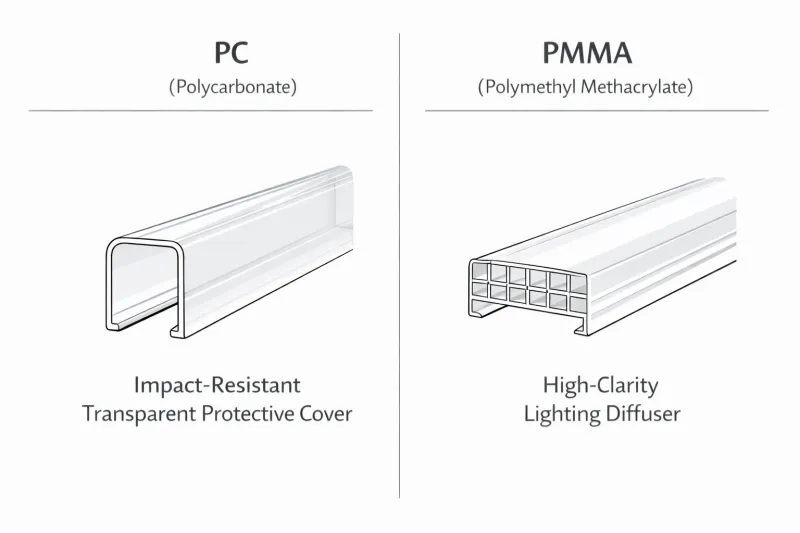
Transparent extrusion has less room to hide defects. Moisture marks, bubbles, flow lines and contamination are more visible than they would be in opaque products. For PC, PMMA, TPU and PA, drying and material handling are especially important. See why resin drying matters in plastic extrusion for the moisture side of the problem.
TPU, TPE and PA: Flexible and Engineering Materials
TPU and TPE belong to the flexible-material side of extrusion, but they should not be treated as simple “soft plastic” replacements.
TPU is used for flexible tubing, protective covering, elastic bands, cable jackets and products where softness must also carry wear resistance or durability.
For pneumatic air tubing, the PU / TPU tube extrusion line connects material preparation, diameter control and cutting or winding in one configured production line.
TPE is a broad family of thermoplastic elastomer compounds. It can be used for soft-touch profiles, seals, flexible strips and co-extruded soft edges. TPE should be evaluated by compound type, hardness and end-use requirement; it should not be selected from the name alone.
PA is an engineering material used for industrial tubing, wear strips, guides and profiles that need strength and abrasion resistance. It is less general-purpose than PVC or PE, but it is common in applications where wear and mechanical load matter.
Additives and Compounds Also Shape the Choice
Plastic extrusion materials are rarely just a base resin name. Plasticizers, stabilizers, fillers, flame retardants, color masterbatch and other additives can change flexibility, weather resistance, cost, surface finish and processing behavior.
That is why two PVC profiles or two TPE profiles may behave very differently. In real projects, material selection should consider both the polymer family and the compound design.
How Jinxin Looks at Material Choice
As an extrusion line manufacturer, Jinxin treats material choice as part of line configuration. PVC pipe, PE pipe, TPU tubing, PMMA diffuser and PA wear strip do not ask for the same screw design, cooling method, haul-off control or downstream layout.
For a broad equipment view, see the plastic extrusion line categories. If you already know the target product and material family, Jinxin can help evaluate the line configuration around that product route.
Conclusion
The most useful way to understand plastic extrusion materials is to connect each plastic with what it does:
- PVC for rigid and flexible high-volume routes;
- PE for pipe, film, tubing and chemical-resistant products;
- PP for lightweight and functional products;
- ABS for rigid parts with a finished look;
- PC and PMMA for transparent products with different priorities;
- TPU and TPE for flexible and elastic products;
- PA for strength and wear resistance.
If you are choosing a material for a new extrusion product, send the product shape, expected rigidity or flexibility, transparency requirement and working environment through the contact page. The material name is only the start; the line has to fit the product behind it.
Jason Shen
Founder and Lead Engineer, Jinxin ExtruderJason Shen leads Jinxin Extruder's single screw extrusion line projects, with hands-on experience in machine configuration, tooling adjustment, factory testing and extrusion troubleshooting.
Inquiry
Email Your Line Requirements
For an accurate quotation, include your target product, material, size range, expected output, factory voltage and any product drawing or sample requirements.