
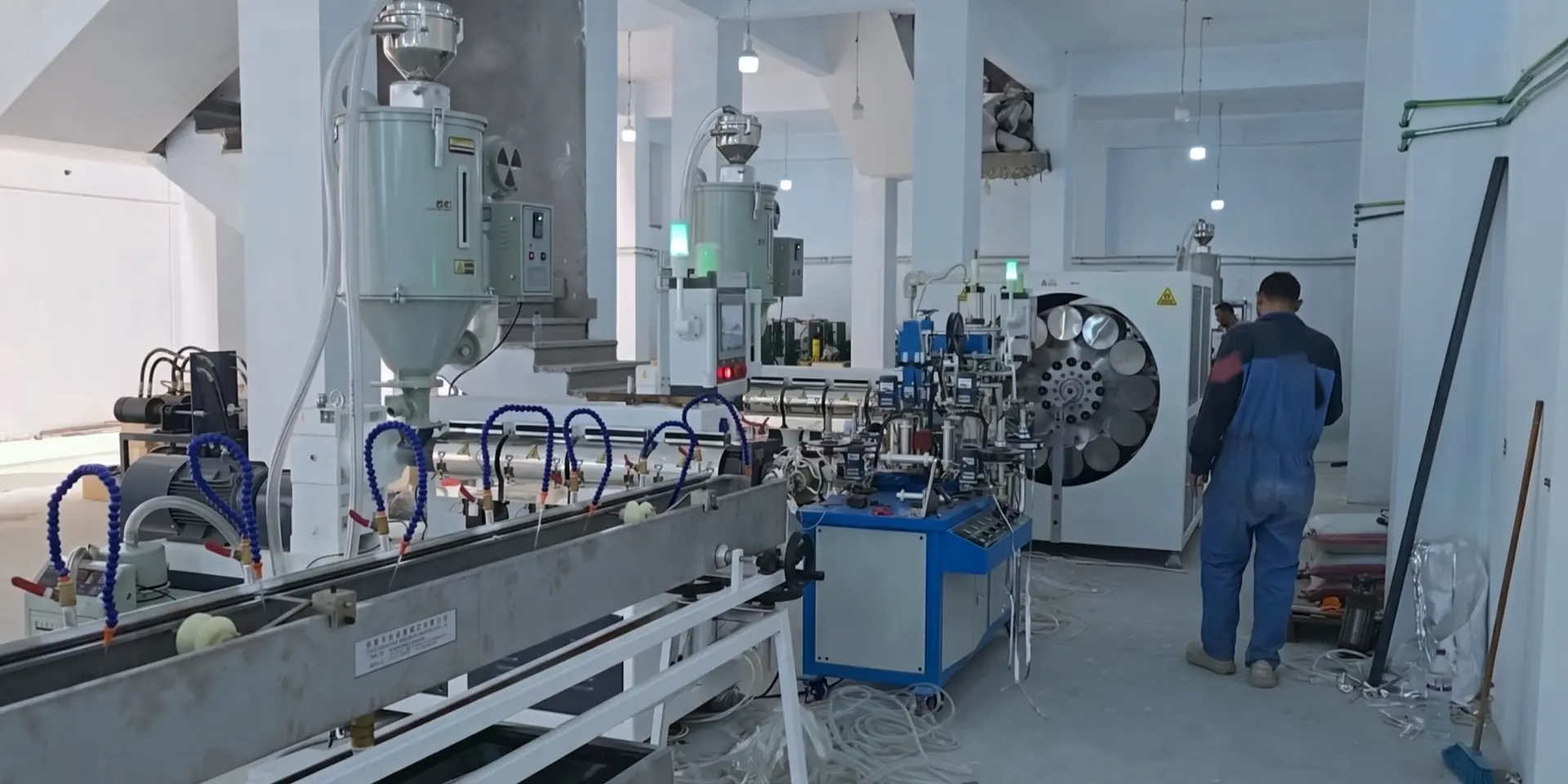
Smooth PVC shower hoses are made in several synchronized stages. A single-screw extrusion stage forms the inner PVC tube, fine reinforcement yarn is braided directly onto the cooled tube, and separate extrusion stages cover the braid with intermediate and final outer PVC layers. Depending on the required surface, a coating-related treatment, thermal-transfer film or PVC color formulation is integrated before the final layer and cooling.
The subject here is a flexible bathroom shower hose with textile reinforcement hidden inside a smooth wall. It is not a finished hose assembly, metal or stainless shower hose, rubber- or EPDM-core hose, silicone hose, steel-wire or spiral-reinforced hose, visible braided garden hose, layflat hose, rigid PVC pipe, or DIY project.
A smooth shower hose is therefore not the same as a smooth, single-layer medical tube. The latter belongs on a soft PVC tube extrusion line without hidden textile reinforcement or the outer-covering stages.
For the equipment route used to build this structure, see Jinxin’s smooth shower hose extrusion line.
Quick Answer
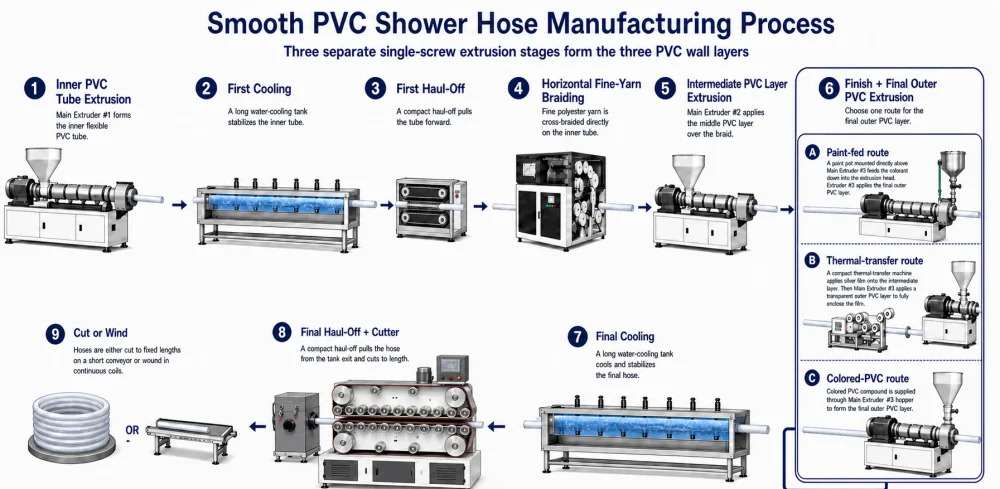
The continuous route is compound feeding, inner-tube extrusion, first cooling and conditioning, horizontal fine-yarn braiding, intermediate-layer extrusion, the selected finish operation, final outer-layer extrusion, final cooling, haul-off, and cutting or winding.
The yarn does not form another plastic layer. It lies directly on the inner tube and is encapsulated inside the PVC wall. Quality depends on stable output from each extrusion stage, controlled yarn tension and coverage, correct finish placement, even encapsulation, and one synchronized speed chain from the first tube to collection.
1. What Is Inside a Smooth PVC Shower Hose?
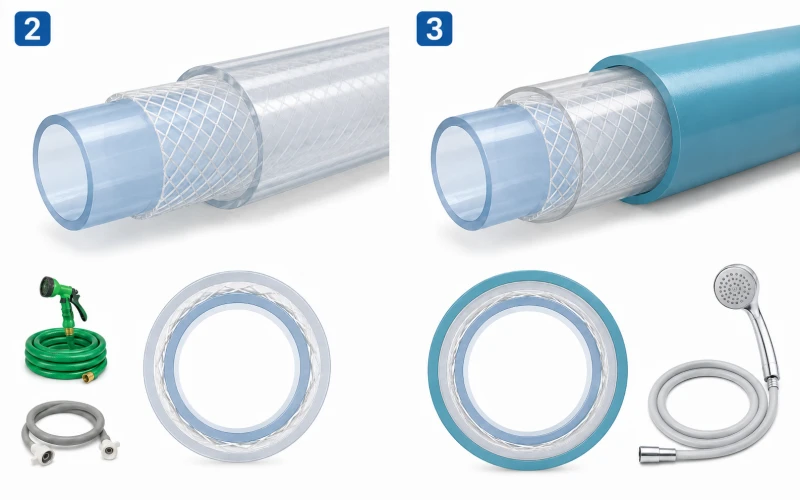
In the structure covered here, “three layers” means three PVC layers:
- an inner PVC tube that carries the flow and supports downstream processing;
- an intermediate PVC layer that encapsulates the yarn and creates a controlled base for finishing;
- a final outer PVC layer that establishes the smooth exterior and protects the finish-bearing zone.
Between the first and second PVC layers, many fine yarn paths cross in opposite diagonal directions. The braid sits against the inner tube without a backing sleeve or air gap. It is reinforcement, not a fourth PVC layer.
This construction differs from a common two-layer yarn-reinforced hose, where an inner PVC tube is braided and then covered by one outer PVC layer. That route is explained with the PVC braided hose extrusion line. A smooth shower hose adds the intermediate-to-final-layer sequence needed for its concealed reinforcement and selected surface treatment.
2. Why Does the Line Use Separate Extrusion Stages?
Each PVC layer is formed at a different point in the process and has a different job. The inner tube must be stable enough to accept braiding. The intermediate layer must flow around and encapsulate the yarn. The final layer must cover the finish-bearing zone evenly and produce the required smooth exterior. One extrusion stage cannot create all three layers at those separate physical positions.
The stages are therefore connected into one continuous line, but melt delivery is controlled separately. Layer thickness and compound selection follow the approved sample, dimensions and surface target.
Separate stages also make synchronization more important. Inner-tube variation changes the base presented to the braider, while unstable intermediate output changes yarn coverage and the surface presented to the finish unit.
3. Process Map: What Changes at Each Stage?
The process is not just “extrude, braid and cover.” Each stage fixes a different part of the structure:
| Stage | What it establishes |
|---|---|
| Inner-tube extrusion | Base diameter, first PVC wall and a stable carrier for the yarn |
| First cooling and conditioning | Shape resistance, surface condition and water removal before braiding |
| Horizontal braiding | Yarn angle, pitch, coverage and reinforcement continuity |
| Intermediate-layer extrusion | Yarn encapsulation and a uniform base for the selected finish |
| Finish route | Matte, gloss, multicolor, metallic-look or formulated-color direction |
| Final outer-layer extrusion | Smooth protective exterior and final wall distribution |
| Final cooling and haul-off | Diameter stability, roundness, surface preservation and line-speed control |
| Cutting or winding | Fixed lengths or continuous coils, according to the downstream plan |
Sizing assistance can be used where the compound and product require it, but one universal vacuum arrangement should not be assumed for every hose.
4. Step-by-Step Smooth PVC Shower Hose Manufacturing
Step 1: Plasticize the Compound for the Inner Tube
Flexible PVC compound enters the first single-screw extrusion stage. The screw conveys and plasticizes the material into a stable melt. Consistent feeding and melt delivery matter because the inner tube becomes the dimensional reference for everything that follows.
The processing window depends on the formulation, stabilizer system, screw geometry, layer assignment and output; settings from an unrelated compound should not be copied.
Step 2: Extrude the Inner PVC Tube
The melt passes through tube tooling to form a continuous inner wall. Die centering and flow distribution control wall balance. If one side is heavier, the tube can cool unevenly and present an eccentric surface to the braid.
Tooling must distribute the melt around the annular flow path while accounting for drawdown, pressure and compound behavior. The general function is covered in what an extrusion die does.
Step 3: Cool and Condition the Tube
Initial cooling gives the tube enough stability to resist braid tension. Surface water must not be carried into the reinforcement and trapped under later PVC; the requirement is a stable, suitably dry interface, not one universal dryer design.
Step 4: Apply Fine Yarn on a Horizontal Braider
The tube travels horizontally through the braiding unit while multiple fine yarn carriers lay paths in opposite diagonal directions. The resulting pattern should be dense and regular, with small diamond openings and direct contact between yarn and inner PVC.
Yarn size, tension, carrier speed and line travel determine coverage and pitch. Loose yarn can shift; excessive tension can deform the tube. A few oversized cords cannot reproduce a dense fine-yarn network.
Step 5: Extrude the Intermediate PVC Layer
The braided tube enters the next die, supplied by its own single-screw extrusion stage. PVC flows around the moving structure and fills the open spaces in the braid. The goal is full encapsulation without flattening the reinforcement or trapping water and air.
This layer hides the yarn, bonds the wall and creates the base for finishing. Insufficient flow, unsuitable tooling or poor centering can leave thin areas where the pattern later prints through.
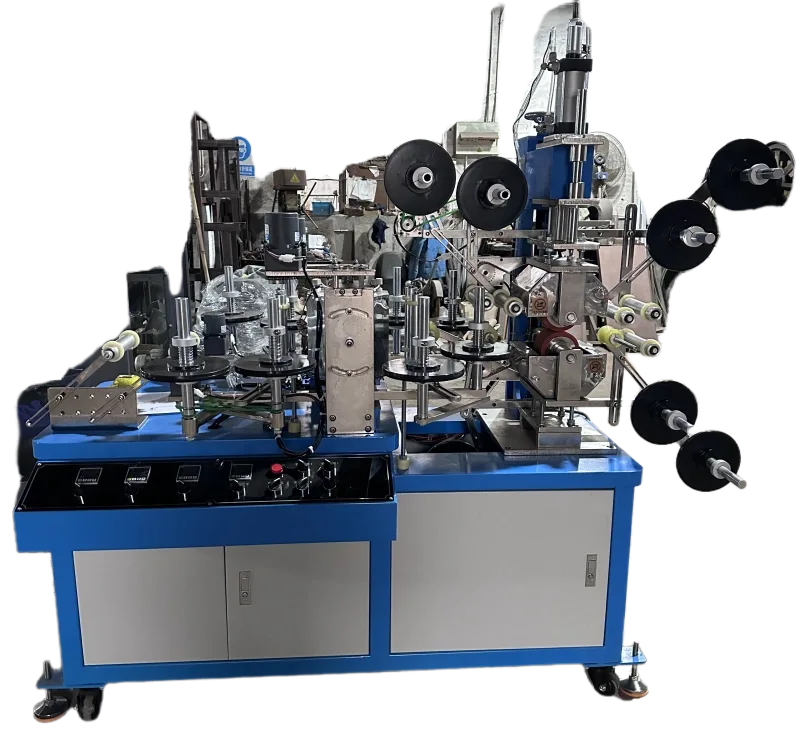
Step 6: Apply the Selected Finish Route
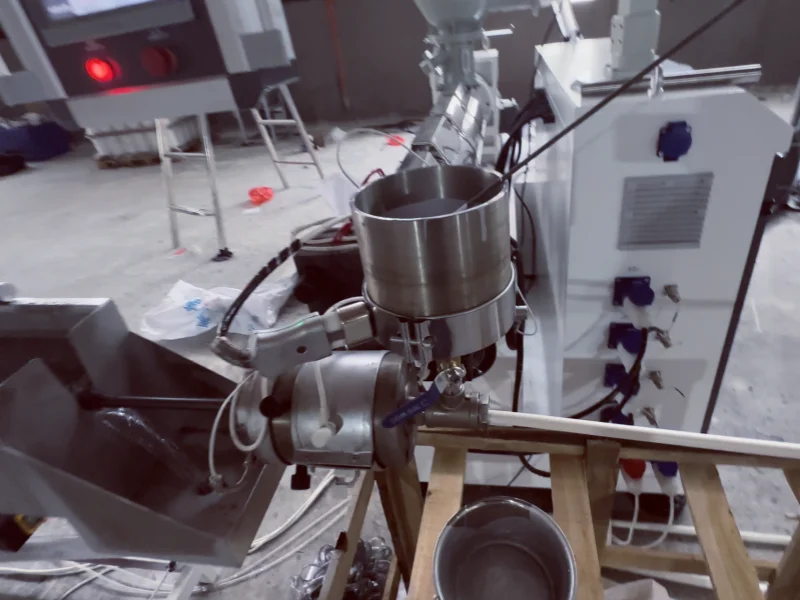
The approved sample determines the finish. A coating-related treatment may create selected matte, gloss or multicolor effects. Thermal transfer places decorative film on the intermediate surface for a silver or chrome-look direction. Alternatively, color can come from the PVC formulation when material conditions support it.
The finish stage belongs before final outer-layer encapsulation. It should not be drawn as an unrelated machine after collection, and a transfer film should not remain exposed as the finished wear surface.
Step 7: Extrude the Final Outer PVC Layer
The final single-screw extrusion stage supplies PVC to the last die. This layer covers the finish-bearing zone, establishes the smooth exterior and protects the underlying effect. Thin or off-center areas can reveal the braid or intermediate texture, so distribution follows the sample and dimensional target rather than a universal layer ratio.
Step 8: Cool, Pull and Collect the Hose
Final cooling stabilizes diameter, roundness, wall distribution and surface appearance. The haul-off mounted on the cooling tank pulls the hose without marking or flattening it. The product is then cut to the required production length or wound into continuous coils.
This article stops at hose extrusion and collection. Connector hardware and finished assembly are separate downstream operations, not steps in forming the smooth multi-layer wall.
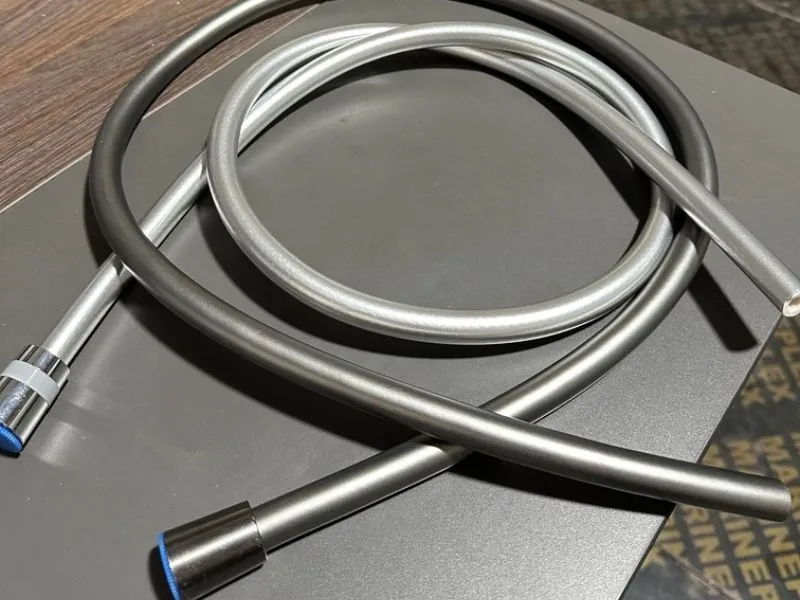
5. Three Finish Routes and Their Layer Positions
| Finish direction | Where the effect is created | Main process concern |
|---|---|---|
| Coating-related matte, gloss or multicolor finish | On the prepared intermediate surface before final coverage | Uniform application, drying or conditioning as required, and compatibility with the covering layer |
| Thermal-transfer silver or chrome-look finish | Film is transferred onto the intermediate layer, then covered by final outer PVC | Registration, overlap, adhesion and complete protection beneath the final layer |
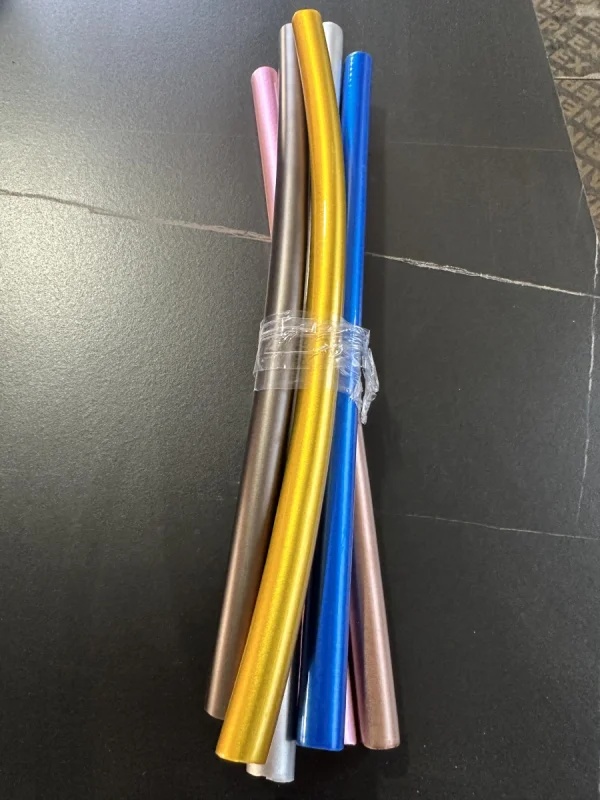
| PVC color formulation | Color is carried by the selected PVC compound | Dispersion, material compatibility, color stability and agreement with the approved sample |
These routes are not one generic “printing” step. Their equipment and interface controls differ, so the final structure and sample decide the route.
6. How Does the Reinforcement Stay Strong but Invisible?
Fine yarn creates many load paths around the tube. Opposing diagonal paths form regular diamonds, while controlled pitch and tension keep coverage stable. Direct contact with the inner tube prevents the braid from behaving like a loose sleeve.
Intermediate melt must penetrate the openings and surround the yarn. Complete encapsulation locks the geometry in place; even intermediate and final wall distribution hides the pattern; controlled cooling preserves the surface. Coarse yarn, irregular openings or eccentric covering layers can make the pattern visible or tactile. Extra outer material alone cannot correct an unstable braid.
7. Why Synchronization Controls Surface Quality
The linked rates are output from three extrusion stages, braider rotation, travel through cooling, finish-unit motion and haul-off speed. Each changes the material, yarn or decoration applied per meter.
Faster travel with unchanged braider speed opens the braid pitch. Unchanged intermediate output with faster haul-off makes that layer thinner. A transfer unit out of step can create overlap or registration changes, while final-output drift changes surface thickness and gloss. The control objective is a stable ratio between stages, refined against the sample and wall measurements. The melt-per-length relationship is explained in output and haul-off speed synchronization.
8. Common Defects and Process Causes
| Defect | Process areas to inspect |
|---|---|
| Yarn pattern shows through | Yarn size and coverage, braid tension, intermediate encapsulation, layer thickness and die centering |
| Delamination or poor encapsulation | Surface water, trapped air, compound compatibility, interface condition, melt stability and tooling |
| Bubbles or voids | Moisture, trapped air, contaminated interfaces and unstable plasticization |
| Uneven gloss or color | Coating uniformity, formulation dispersion, layer distribution, cooling and surface contact |
| Film overlap, gaps or weak lock-in | Transfer registration, line-speed stability, intermediate surface condition and final encapsulation |
| Scratches or haul-off marks | Cooling level, guide alignment, contact surfaces and pulling pressure |
| Diameter drift or flattening | Output-to-haul-off ratio, cooling, sizing where used, and excessive downstream tension |
| Distorted braid | Unstable inner tube, uneven yarn tension, braider-to-line speed mismatch and handling before encapsulation |
Trace defects from the first stage that can create them: a final surface mark may originate in inner-tube eccentricity or braid instability, not only in the last die. See plastic extrusion troubleshooting for a symptom-led method.
9. Smooth PVC Shower Hose vs Other Hose Types
| Product type | Structure and production route | This article’s scope? |
|---|---|---|
| Smooth textile-reinforced PVC shower hose | Three PVC layers with fine cross-braided yarn hidden inside and a selected finish route | Yes |
| Visible yarn-braided PVC hose | Inner PVC, visible textile braid pattern and outer PVC; commonly a two-layer plastic structure | No |
| Metal or stainless shower hose | Interlocked or formed metal exterior and a different assembly route | No |
| Rubber or EPDM-core shower hose | Elastomer tube and cover construction with different material processing | No |
| Silicone hose | Silicone material system and curing route | No |
| Steel-wire, spiral or layflat hose | Different reinforcement geometry, tooling and end use | No |
| Rigid PVC pipe | Rigid compound, rigid-pipe sizing and no flexible shower-hose braid | No |
The words “shower hose” describe an application, not one universal material or manufacturing method. Confirming the wall structure prevents metal, rubber, silicone or spiral-hose processes from being mixed into this PVC route.
Conclusion
Smooth PVC shower hoses are made by building the wall in sequence: inner-tube extrusion, fine-yarn braiding, intermediate encapsulation, the selected finish route, final outer-layer extrusion, cooling and controlled collection. The yarn remains directly on the inner tube and hidden inside three PVC layers; each plastic layer is formed by its own single-screw extrusion stage.
The inner tube supports the braid, the intermediate layer locks it in, the finish sits at the correct interface, and the final layer and cooling preserve the smooth surface.
If you are evaluating a smooth PVC shower hose project, contact Jinxin with the target sample, layer structure, dimensions, compound direction, yarn, surface effect and collection method. Jinxin can review the continuous route without treating one machine as the whole process.
FAQ
How many PVC layers are used in a smooth shower hose?
The structure covered here uses three PVC layers: an inner tube, an intermediate layer that encapsulates the yarn, and a final outer layer that creates and protects the smooth exterior. The exact thickness and compound assignment follow the approved product sample.
Is the reinforcement yarn counted as a plastic layer?
No. The yarn is a textile reinforcement positioned between the inner and intermediate PVC layers. It is not PVC and is not counted when the hose is described as having three plastic layers.
Why is the yarn braided directly onto the inner PVC tube?
Direct contact keeps the braid from behaving like a loose sleeve and gives it a stable base while the intermediate PVC is applied. Controlled tension, pitch and coverage create a continuous reinforcement network around the tube.
Why does each PVC layer need a separate extrusion stage?
The three layers are formed at different locations and perform different jobs. The first stage makes the tube, the second encapsulates the braid, and the third covers the finish-bearing zone and forms the smooth exterior. Each stage therefore needs independently controlled melt delivery.
What is the difference between coating and thermal transfer finishing?
A coating-related route applies a surface treatment for selected matte, gloss or multicolor effects. Thermal transfer places a decorative film on the intermediate PVC surface. The two routes use different equipment and interface controls and should not be treated as the same generic step.
Why is metallic-look film covered by a final outer PVC layer?
The film carries the decorative effect but is not intended to remain as an exposed structural surface in this process. Final outer PVC encapsulates and protects it while establishing the hose’s smooth exterior.
What causes the yarn pattern to show through a smooth shower hose?
Possible causes include coarse yarn, changing tension or pitch, incomplete encapsulation, thin or uneven covering layers, and die misalignment. Check the braid and both covering stages together.
Why must extrusion, braiding, cooling and haul-off speeds be synchronized?
Their ratios determine material per meter, braid pitch, finish registration, wall thickness and diameter. If one rate changes independently, the hose can develop open braid patterns, thin layers, surface variation, diameter drift or flattening.
Jason Shen
Founder and Lead Engineer, Jinxin ExtruderJason Shen leads Jinxin Extruder's single screw extrusion line projects, with hands-on experience in machine configuration, tooling adjustment, factory testing and extrusion troubleshooting.
Inquiry
Email Your Line Requirements
For an accurate quotation, include your target product, material, size range, expected output, factory voltage and any product drawing or sample requirements.